QUESTION IMAGE
Question
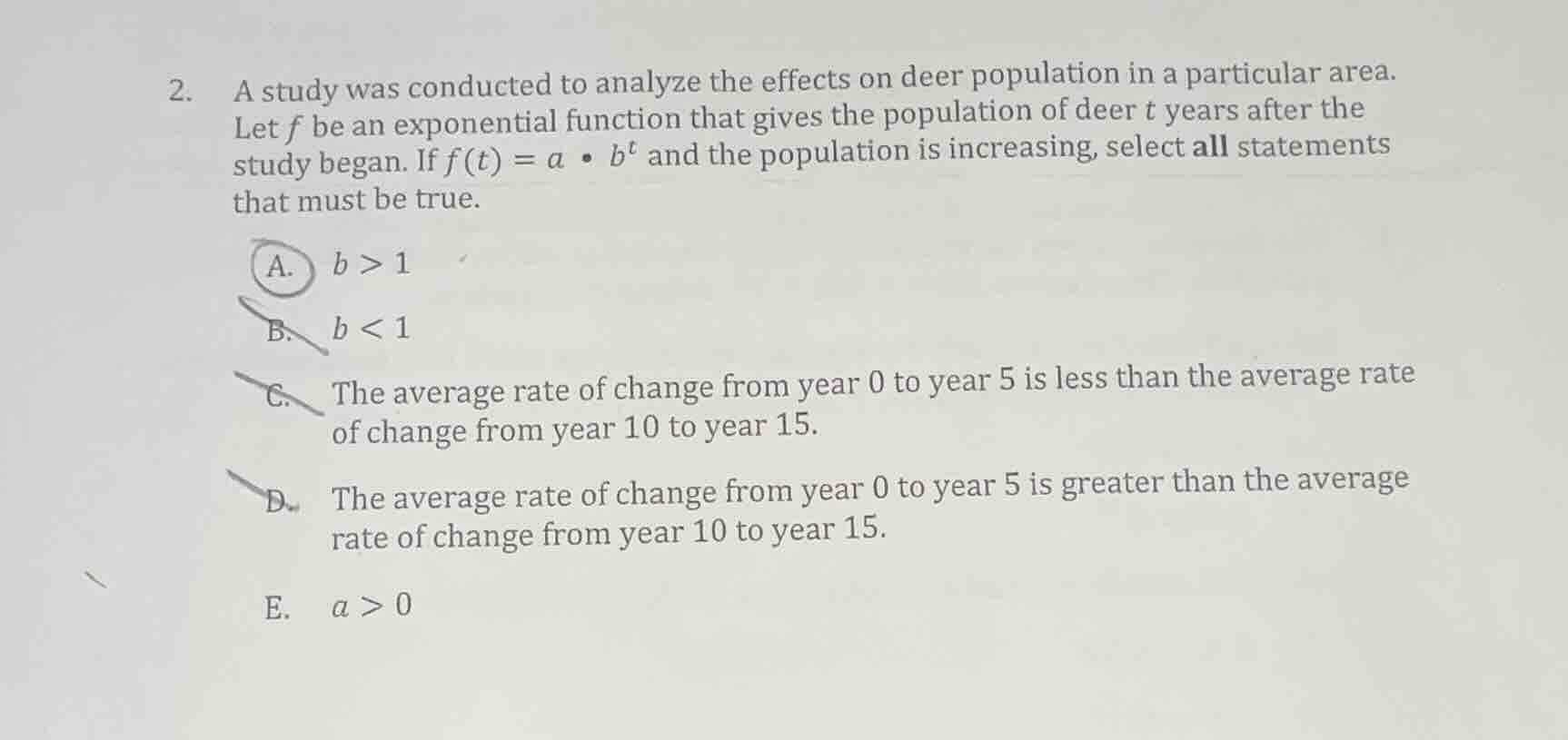
- a study was conducted to analyze the effects on deer population in a particular area. let f be an exponential function that gives the population of deer t years after the study began. if $f(t) = a \bullet b^t$ and the population is increasing, select all statements that must be true. a. $b > 1$ b. $b < 1$ c. the average rate of change from year 0 to year 5 is less than the average rate of change from year 10 to year 15. d. the average rate of change from year 0 to year 5 is greater than the average rate of change from year 10 to year 15. e. $a > 0$
Step1: Analyze exponential growth condition
For $f(t)=a \cdot b^t$ to be increasing (population growth), $b>1$ (since $b$ is the growth factor; values $0
Step2: Compare average rates of change
Average rate of change from $t_1$ to $t_2$ is $\frac{f(t_2)-f(t_1)}{t_2-t_1}$.
- 0 to 5: $\frac{a \cdot b^5 - a \cdot b^0}{5-0} = \frac{a(b^5 - 1)}{5}$
- 10 to 15: $\frac{a \cdot b^{15} - a \cdot b^{10}}{15-10} = \frac{a b^{10}(b^5 - 1)}{5}$
Since $b>1$, $b^{10}>1$, so $\frac{a b^{10}(b^5 - 1)}{5} > \frac{a(b^5 - 1)}{5}$. Thus the average rate from 10-15 is greater than 0-5.

Snap & solve any problem in the app
Get step-by-step solutions on Sovi AI
Photo-based solutions with guided steps
Explore more problems and detailed explanations
A. $b > 1$
C. The average rate of change from year 0 to year 5 is less than the average rate of change from year 10 to year 15.
E. $a > 0$