QUESTION IMAGE
Question
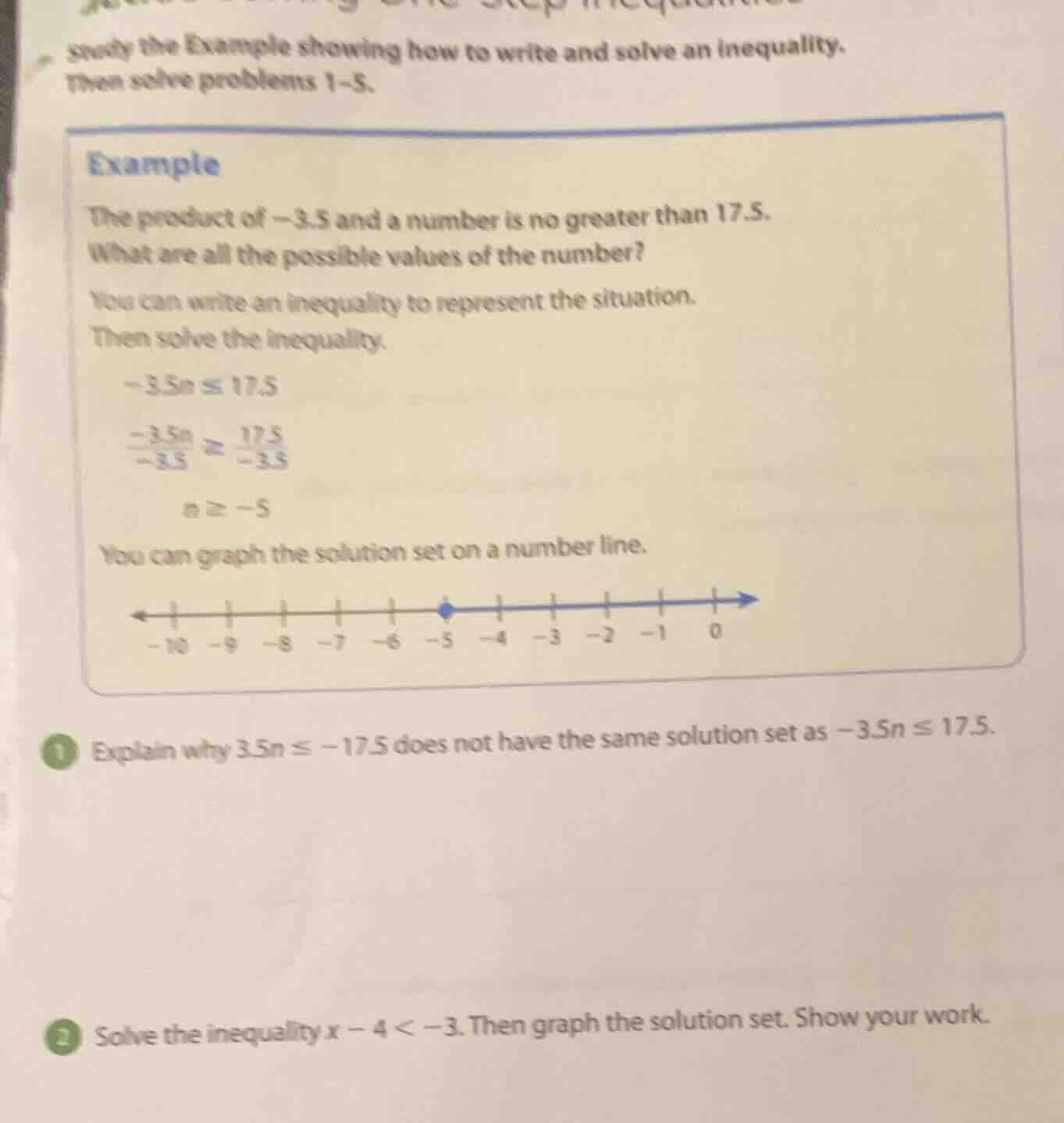
study the example showing how to write and solve an inequality. then solve problems 1–5. example the product of -3.5 and a number is no greater than 17.5. what are all the possible values of the number? you can write an inequality to represent the situation. then solve the inequality. -3.5n ≤ 17.5 \\(\frac{-3.5n}{-3.5} \geq \frac{17.5}{-3.5}\\) n ≥ -5 you can graph the solution set on a number line. (number line with -10 to 0, dot at -5 and line to right) 1 explain why 3.5n ≤ -17.5 does not have the same solution set as -3.5n ≤ 17.5. 2 solve the inequality x - 4 < -3. then graph the solution set. show your work.
Problem 1
To determine why \(3.5n \leq - 17.5\) and \(-3.5n \leq 17.5\) have different solution sets, we solve each inequality:
- For \(3.5n\leq - 17.5\):
Divide both sides by \(3.5\) (a positive number, so the inequality sign remains the same).
\(\frac{3.5n}{3.5}\leq\frac{-17.5}{3.5}\)
\(n\leq - 5\)
- For \(-3.5n\leq17.5\):
Divide both sides by \(- 3.5\) (a negative number, so the inequality sign flips).
\(\frac{-3.5n}{-3.5}\geq\frac{17.5}{-3.5}\)
\(n\geq - 5\)
The solution set of \(3.5n\leq - 17.5\) is \(n\leq - 5\) and the solution set of \(-3.5n\leq17.5\) is \(n\geq - 5\). These are different because when dividing by a negative number in an inequality, the direction of the inequality sign changes, and the constants on the right - hand side are different in sign and magnitude, leading to different solution sets.
Step 1: Solve the inequality \(x - 4<-3\)
To isolate \(x\), we add \(4\) to both sides of the inequality.
\(x-4 + 4<-3 + 4\)
Step 2: Simplify both sides
Simplifying the left - hand side gives \(x\), and simplifying the right - hand side gives \(1\). So we have \(x < 1\).
To graph the solution set:
- Draw a number line.
- Place an open circle at \(x = 1\) (since \(x\) is less than \(1\), not less than or equal to \(1\)).
- Shade the region to the left of \(1\) on the number line.

Snap & solve any problem in the app
Get step-by-step solutions on Sovi AI
Photo-based solutions with guided steps
Explore more problems and detailed explanations
The solution set of \(3.5n\leq - 17.5\) is \(n\leq - 5\) and the solution set of \(-3.5n\leq17.5\) is \(n\geq - 5\). The difference comes from the sign of the coefficient of \(n\) (which causes a sign flip in one case but not the other when dividing to solve) and the different constant terms, resulting in different solution sets.