QUESTION IMAGE
Question
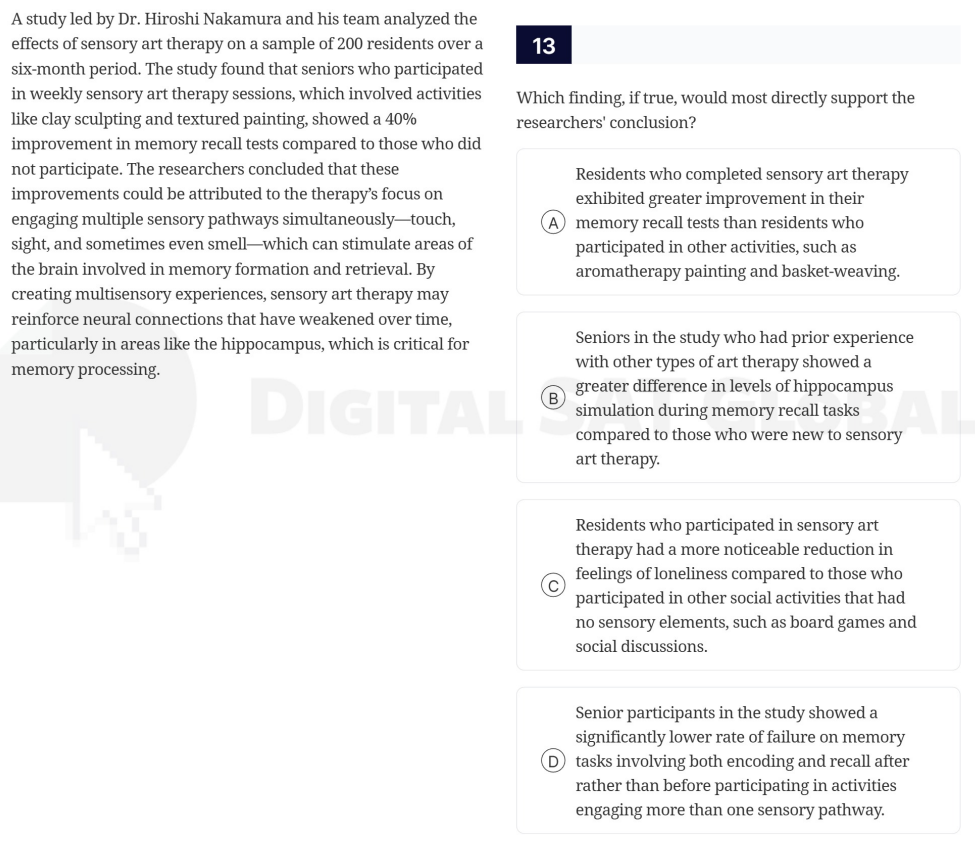
a study led by dr. hiroshi nakamura and his team analyzed the effects of sensory art therapy on a sample of 200 residents over a six - month period. the study found that seniors who participated in weekly sensory art therapy sessions, which involved activities like clay sculpting and textured painting, showed a 40% improvement in memory recall tests compared to those who did not participate. the researchers concluded that these improvements could be attributed to the therapy’s focus on engaging multiple sensory pathways simultaneously—touch, sight, and sometimes even smell—which can stimulate areas of the brain involved in memory formation and retrieval. by creating multisensory experiences, sensory art therapy may reinforce neural connections that have weakened over time, particularly in areas like the hippocampus, which is critical for memory processing.
13
which finding, if true, would most directly support the researchers conclusion?
a residents who completed sensory art therapy exhibited greater improvement in their memory recall tests than residents who participated in other activities, such as aromatherapy painting and basket - weaving.
b seniors in the study who had prior experience with other types of art therapy showed a greater difference in levels of hippocampus simulation during memory recall tasks compared to those who were new to sensory art therapy.
c residents who participated in sensory art therapy had a more noticeable reduction in feelings of loneliness compared to those who participated in other social activities that had no sensory elements, such as board games and social discussions.
d senior participants in the study showed a significantly lower rate of failure on memory tasks involving both encoding and recall after rather than before participating in activities engaging more than one sensory pathway.
The researchers' conclusion is that sensory art therapy (using multiple simultaneous senses) improves memory by stimulating brain areas for memory and reinforcing neural connections. Option D directly links participation in multi-sensory activities to improved performance on memory encoding/recall tasks, which directly supports the causal claim that the therapy's multi-sensory focus drives memory improvement.
Option A compares to other activities but does not tie the improvement to the multi-sensory mechanism. Option B focuses on prior therapy experience, not the effect of the multi-sensory therapy itself. Option C addresses loneliness, which is unrelated to the memory-focused conclusion.

Snap & solve any problem in the app
Get step-by-step solutions on Sovi AI
Photo-based solutions with guided steps
Explore more problems and detailed explanations
D. Senior participants in the study showed a significantly lower rate of failure on memory tasks involving both encoding and recall after rather than before participating in activities engaging more than one sensory pathway.