QUESTION IMAGE
Question
4.4.1 study: transformation of parent functions
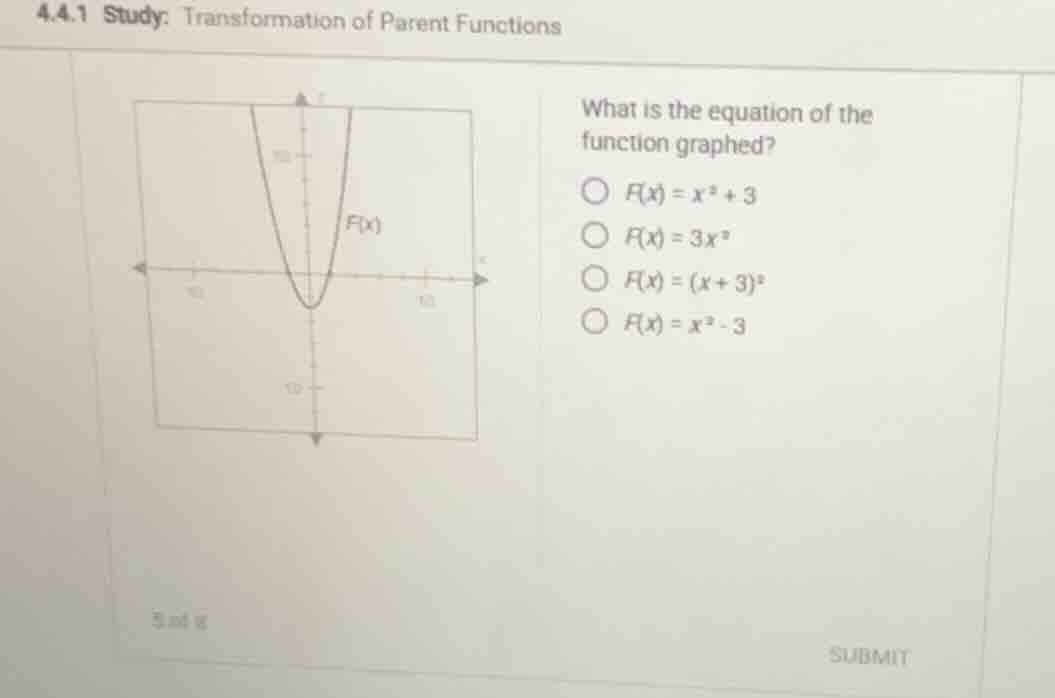
what is the equation of the
function graphed?
\\( f(x) = x^2 + 3 \\)
\\( f(x) = 3x^2 \\)
\\( f(x) = (x + 3)^2 \\)
\\( f(x) = x^2 - 3 \\)
5 of 9
submit
Step1: Recall Parent Function Transformations
The parent function for a parabola is \( y = x^2 \), which has its vertex at \( (0,0) \). We analyze each option based on transformations:
- Vertical shift: \( y = x^2 + k \) shifts up \( k \) units if \( k>0 \), down if \( k<0 \).
- Vertical stretch/compression: \( y = ax^2 \), \( |a|>1 \) stretches, \( 0<|a|<1 \) compresses.
- Horizontal shift: \( y = (x - h)^2 \) shifts right \( h \) units, left if \( h<0 \).
Step2: Analyze Each Option
- Option 1: \( F(x)=x^2 + 3 \) shifts \( y = x^2 \) up 3 units. Vertex at \( (0,3) \).
- Option 2: \( F(x)=3x^2 \) vertically stretches \( y = x^2 \) by factor 3. Vertex at \( (0,0) \), but narrower.
- Option 3: \( F(x)=(x + 3)^2 \) shifts \( y = x^2 \) left 3 units. Vertex at \( (-3,0) \).
- Option 4: \( F(x)=x^2 - 3 \) shifts \( y = x^2 \) down 3 units. Vertex at \( (0,-3) \).
From the graph, the vertex is at \( (0,0) \) (wait, no, the graph shows vertex on y-axis, maybe I misread. Wait, the options: let's re-express. Wait, the graph's vertex: looking at the options, if the graph is a parabola opening up, vertex at (0,0) but narrower? Wait no, the first option: \( x^2 + 3 \) has vertex (0,3). Wait maybe the graph's vertex is at (0,0)? No, the options: let's check the transformations again.
Wait, the parent function is \( y = x^2 \), vertex at (0,0).
- \( F(x)=x^2 + 3 \): vertex (0,3) (shift up 3)
- \( F(x)=3x^2 \): vertex (0,0), vertical stretch (narrower)
- \( F(x)=(x + 3)^2 \): vertex (-3,0) (shift left 3)
- \( F(x)=x^2 - 3 \): vertex (0,-3) (shift down 3)
Looking at the graph, the vertex is on the y-axis (x=0), so horizontal shift is 0 (so eliminate option 3). Now, check vertical position: if the vertex is at (0,0)? No, the options: wait maybe the graph is narrower? Wait, the second option is \( 3x^2 \), which is a vertical stretch. Wait, maybe I made a mistake. Wait, the original graph: the parabola is narrower than \( y = x^2 \), so vertical stretch. So \( F(x)=3x^2 \) would make it narrower. Wait, but let's check the options again.
Wait, the first option: \( x^2 + 3 \) moves up, third moves left, fourth moves down. The second is stretch. So if the graph is narrower (steeper), then \( 3x^2 \) is correct. Wait, but maybe the graph's vertex is at (0,0), and it's narrower. So the correct answer is \( F(x)=3x^2 \)? Wait no, maybe I misread the graph. Wait, the problem's graph: the parabola is opening up, vertex at (0,0), and it's narrower than \( y = x^2 \), so the coefficient is greater than 1, so \( 3x^2 \) is correct. Wait, but let's check the options again.
Wait, the options:
- \( F(x)=x^2 + 3 \): vertex (0,3)
- \( F(x)=3x^2 \): vertex (0,0), stretch
- \( F(x)=(x + 3)^2 \): vertex (-3,0)
- \( F(x)=x^2 - 3 \): vertex (0,-3)
So if the vertex is at (0,0) and the parabola is narrower, then \( 3x^2 \) is correct. So the answer is \( F(x)=3x^2 \).

Snap & solve any problem in the app
Get step-by-step solutions on Sovi AI
Photo-based solutions with guided steps
Explore more problems and detailed explanations
B. \( F(x) = 3x^2 \)