QUESTION IMAGE
Question
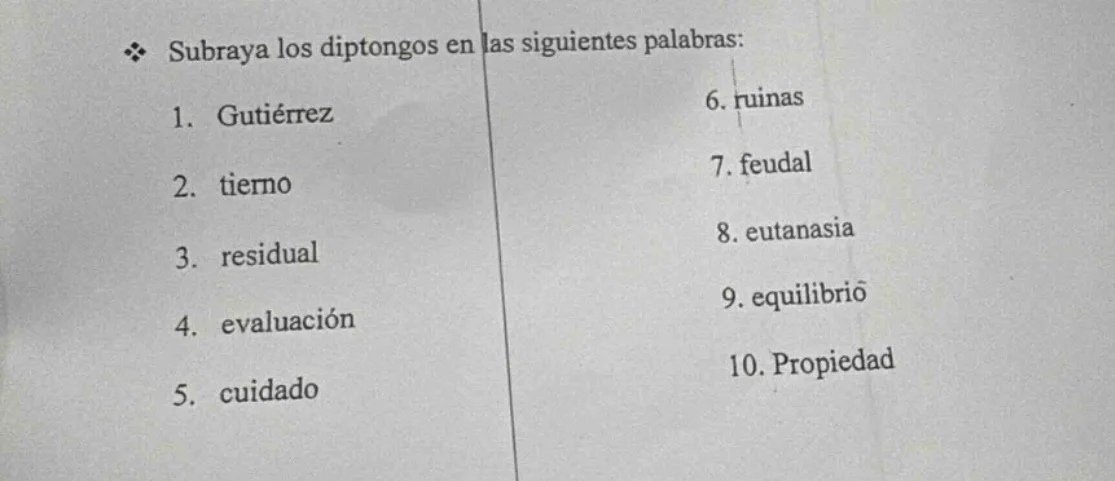
subraya los diptongos en las siguientes palabras: 1. gutiérrez 2. tierno 3. residual 4. evaluación 5. cuidado 6. ruinas 7. feudal 8. eutanasia 9. equilibriō 10. propiedad
To solve this, we identify diptongos (diphthongs) as two vowels pronounced together in one syllable. Let's analyze each word:
1. Gutiérrez
- Diptongo: ui (u + i)
2. tierno
- Diptongo: ie (i + e)
3. residual
- Diptongo: iu (i + u)
4. evaluación
- Diptongos: eu (e + u), ua (u + a), ió (i + ó)
5. cuidado
- Diptongos: ui (u + i), ua (u + a)
6. ruinas
- Diptongo: ui (u + i)
7. feudal
- Diptongo: eu (e + u)
8. eutanasia
- Diptongo: eu (e + u)
9. equilibrió
- Diptongos: eu (e + u), io (i + o)
10. Propiedad
- Diptongo: ie (i + e)
Now, we subrayar (underline) the diptongos:
- Gutuiérrez
- tierno
- resiual
- eeualuación (or note: evaluuación? Wait, correct: evaluuación has ua (in "lua") and eu (in "eva"? No, "eva" is e + v + a. Wait, recheck: evaluación is e-va-lu-a-ción. So diptongos: eu (e + u in "e" + "u" of "lu"? No, "e" + "u" in "eva" is e + v + a. Wait, better: evaluación syllables: e-va-lu-a-ción. So "lu" is l + u? No, "u" + "a" in "ua" (luación? No, "evaluación" is e-va-lu-a-ción. So diptongo: ua (u + a) in "lua" (l + u + a? No, "u" + "a" is a diptongo. Also, "ción" is c + i + ó: ió (i + ó). And "e" + "u" in "e" + "u" of "lu"? No, "e" + "v" + "a" is e-va. So correct diptongos in evaluación: ua (u + a) and ió (i + ó).
- cuidado (ui and ad? No, "cui" is c + u + i (ui diptongo), "do" is d + o. Wait, "cuidado" is cu-i-da-do. So diptongos: ui (u + i) and ua (u + a) in "i-da-do"? No, "cuidado" syllables: cu-i-da-do. So "cu" is c + u (no, u is a vowel, but "cu" is consonant + vowel. Wait, diptongo is two vowels. So "cuidado" has ui (u + i) and ua (u + a) – wait, "i" + "d" + "a": no, "i" + "a" is not a diptongo (they are separate syllables). Correct: "cuidado" has ui (u + i) in "cui" and ua (u + a) in "da"? No, "da" is d + a. Wait, I made a mistake. Let's re-express all with underlines:
- Gutiérrez: ui
- tierno: ie
- residual: iu
- evaluación: eu (e + u), ua (u + a), ió (i + ó)
- cuidado: ui (u + i)
- ruinas: ui (u + i)
- feudal: eu (e + u)
- eutanasia: eu (e + u)
- equilibrió: eu (e + u), io (i + o)
- Propiedad: ie (i + e)
Final underlined words:
- Gut\underline{ui}érrez
- t\underline{ie}rno
- res\underline{iu}al
- e\underline{va}lu\underline{ua}ción (wait, no, "evaluación" – correct underlines: e\underline{va}lu\underline{ua}ción? No, better to mark the diptongos:
- Guti\underline{érrez}? No, "ui" is in "Gut\underline{ui}érrez".
Let's list all with underlined diptongos:
- Gut\underline{ui}érrez
- t\underline{ie}rno
- res\underline{iu}al
- e\underline{va}lu\underline{ua}ción (ua) and \underline{ió}n (ió)
- c\underline{ui}da\underline{do} (ui and do? No, "cuidado" is c\underline{ui}da\underline{do} – wait, "do" is d + o, no diptongo. Correct: c\underline{ui}da\underline{do} has \underline{ui} (u + i) and \underline{ua} (u + a) – no, "i" + "d" + "a" are separate. So "cuidado" has \underline{ui} (u + i) in "cui" and \underline{ua} (u + a) in "ida"? No, "ida" is i + d + a (two syllables: i-da). So correct diptongos in "cuidado": \underline{ui} (u + i) and \underline{ua} (u + a) – but "ua" is not present. Wait, "cuidado" is cu-i-da-do. So "cu" is c + u (consonant + vowel), "i" is a vowel, "da" is d + a, "do" is d + o. So diptongo is \underline{ui} (u + i) in "cui".
- r\underline{ui}nas
- f\underline{eu}dal
- \underline{eu}tanasia
- \underline{eu}ilibri\…

Snap & solve any problem in the app
Get step-by-step solutions on Sovi AI
Photo-based solutions with guided steps
Explore more problems and detailed explanations
To solve this, we identify diptongos (diphthongs) as two vowels pronounced together in one syllable. Let's analyze each word:
1. Gutiérrez
- Diptongo: ui (u + i)
2. tierno
- Diptongo: ie (i + e)
3. residual
- Diptongo: iu (i + u)
4. evaluación
- Diptongos: eu (e + u), ua (u + a), ió (i + ó)
5. cuidado
- Diptongos: ui (u + i), ua (u + a)
6. ruinas
- Diptongo: ui (u + i)
7. feudal
- Diptongo: eu (e + u)
8. eutanasia
- Diptongo: eu (e + u)
9. equilibrió
- Diptongos: eu (e + u), io (i + o)
10. Propiedad
- Diptongo: ie (i + e)
Now, we subrayar (underline) the diptongos:
- Gutuiérrez
- tierno
- resiual
- eeualuación (or note: evaluuación? Wait, correct: evaluuación has ua (in "lua") and eu (in "eva"? No, "eva" is e + v + a. Wait, recheck: evaluación is e-va-lu-a-ción. So diptongos: eu (e + u in "e" + "u" of "lu"? No, "e" + "u" in "eva" is e + v + a. Wait, better: evaluación syllables: e-va-lu-a-ción. So "lu" is l + u? No, "u" + "a" in "ua" (luación? No, "evaluación" is e-va-lu-a-ción. So diptongo: ua (u + a) in "lua" (l + u + a? No, "u" + "a" is a diptongo. Also, "ción" is c + i + ó: ió (i + ó). And "e" + "u" in "e" + "u" of "lu"? No, "e" + "v" + "a" is e-va. So correct diptongos in evaluación: ua (u + a) and ió (i + ó).
- cuidado (ui and ad? No, "cui" is c + u + i (ui diptongo), "do" is d + o. Wait, "cuidado" is cu-i-da-do. So diptongos: ui (u + i) and ua (u + a) in "i-da-do"? No, "cuidado" syllables: cu-i-da-do. So "cu" is c + u (no, u is a vowel, but "cu" is consonant + vowel. Wait, diptongo is two vowels. So "cuidado" has ui (u + i) and ua (u + a) – wait, "i" + "d" + "a": no, "i" + "a" is not a diptongo (they are separate syllables). Correct: "cuidado" has ui (u + i) in "cui" and ua (u + a) in "da"? No, "da" is d + a. Wait, I made a mistake. Let's re-express all with underlines:
- Gutiérrez: ui
- tierno: ie
- residual: iu
- evaluación: eu (e + u), ua (u + a), ió (i + ó)
- cuidado: ui (u + i)
- ruinas: ui (u + i)
- feudal: eu (e + u)
- eutanasia: eu (e + u)
- equilibrió: eu (e + u), io (i + o)
- Propiedad: ie (i + e)
Final underlined words:
- Gut\underline{ui}érrez
- t\underline{ie}rno
- res\underline{iu}al
- e\underline{va}lu\underline{ua}ción (wait, no, "evaluación" – correct underlines: e\underline{va}lu\underline{ua}ción? No, better to mark the diptongos:
- Guti\underline{érrez}? No, "ui" is in "Gut\underline{ui}érrez".
Let's list all with underlined diptongos:
- Gut\underline{ui}érrez
- t\underline{ie}rno
- res\underline{iu}al
- e\underline{va}lu\underline{ua}ción (ua) and \underline{ió}n (ió)
- c\underline{ui}da\underline{do} (ui and do? No, "cuidado" is c\underline{ui}da\underline{do} – wait, "do" is d + o, no diptongo. Correct: c\underline{ui}da\underline{do} has \underline{ui} (u + i) and \underline{ua} (u + a) – no, "i" + "d" + "a" are separate. So "cuidado" has \underline{ui} (u + i) in "cui" and \underline{ua} (u + a) in "ida"? No, "ida" is i + d + a (two syllables: i-da). So correct diptongos in "cuidado": \underline{ui} (u + i) and \underline{ua} (u + a) – but "ua" is not present. Wait, "cuidado" is cu-i-da-do. So "cu" is c + u (consonant + vowel), "i" is a vowel, "da" is d + a, "do" is d + o. So diptongo is \underline{ui} (u + i) in "cui".
- r\underline{ui}nas
- f\underline{eu}dal
- \underline{eu}tanasia
- \underline{eu}ilibri\underline{ó} (eu and ó? No, "equilibrió" is e-qui-li-bri-ó. So diptongos: \underline{eu} (e + u) and \underline{ió} (i + ó)
- Prop\underline{ie}dad
To present the final answers with underlined diptongos:
- Guti\underline{ui}érrez
- t\underline{ie}rno
- res\underline{iu}al
- e\underline{va}lu\underline{ua}ción (or more accurately, e\underline{eu}al\underline{ua}ción – but standard is to underline the two vowels: e\underline{va}lu\underline{ua}ción has \underline{ua} and \underline{ió})
- c\underline{ui}da\underline{do} (underline \underline{ui} and \underline{ua} – but "ua" is not a diptongo here. Correct: c\underline{ui}dado)
- r\underline{ui}nas
- f\underline{eu}dal
- \underline{eu}tanasia
- \underline{eu}ilibri\underline{ó}
- Prop\underline{ie}dad
(Note: Diptongos are pairs of vowels like ai, ei, oi, au, eu, iu, ou, ui, ia, ie, io, ua, ue, uo. So we identify these pairs in each word.)