QUESTION IMAGE
Question
such as paper, canvas, wood panel, etc.
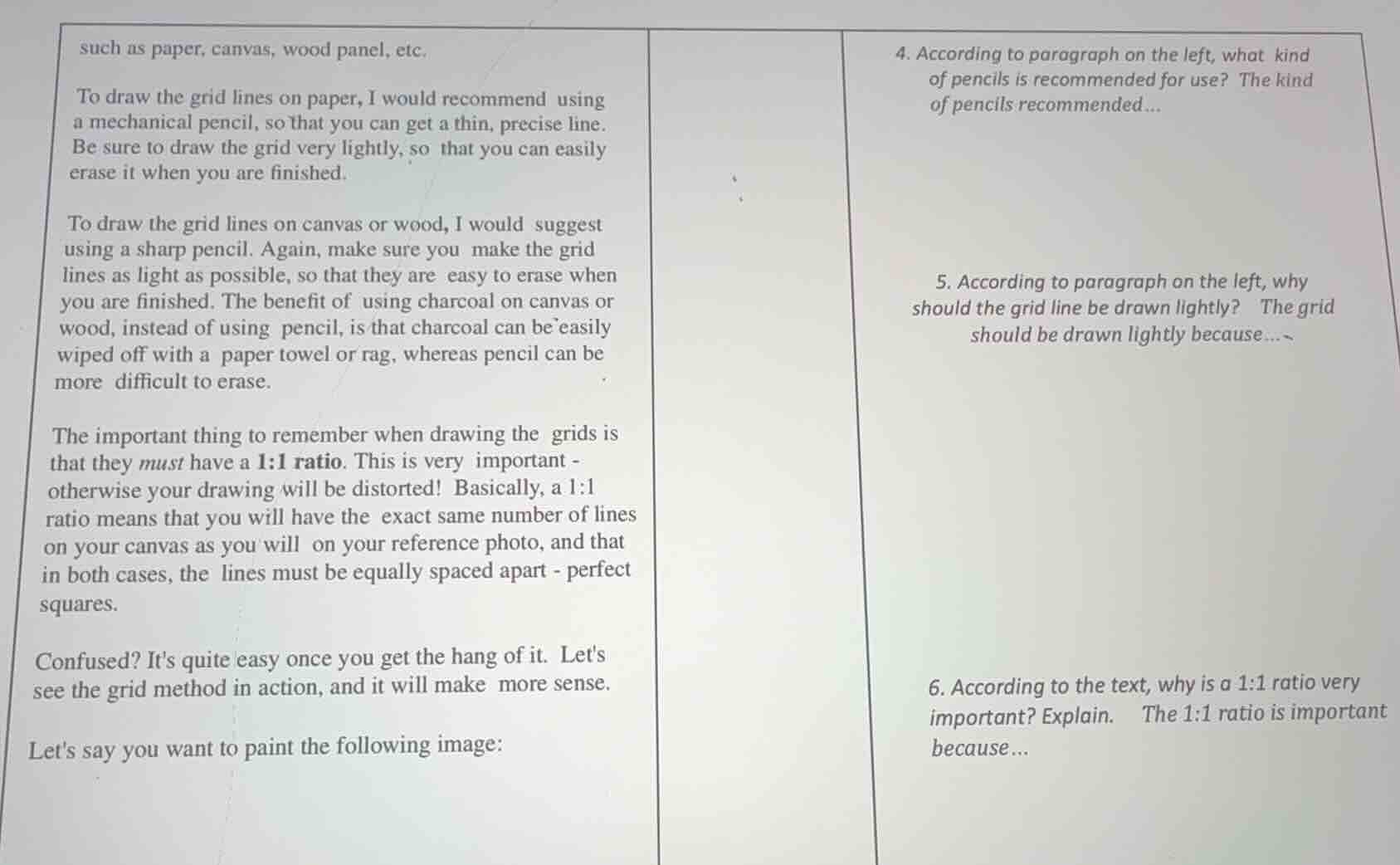
to draw the grid lines on paper, i would recommend using a mechanical pencil, so that you can get a thin, precise line. be sure to draw the grid very lightly, so that you can easily erase it when you are finished.
to draw the grid lines on canvas or wood, i would suggest using a sharp pencil. again, make sure you make the grid lines as light as possible, so that they are easy to erase when you are finished. the benefit of using charcoal on canvas or wood, instead of using pencil, is that charcoal can be easily wiped off with a paper towel or rag, whereas pencil can be more difficult to erase.
the important thing to remember when drawing the grids is that they must have a 1:1 ratio. this is very important - otherwise your drawing will be distorted! basically, a 1:1 ratio means that you will have the exact same number of lines on your canvas as you will on your reference photo, and that in both cases, the lines must be equally spaced apart - perfect squares.
confused? its quite easy once you get the hang of it. lets see the grid method in action, and it will make more sense.
lets say you want to paint the following image:
- according to paragraph on the left, what kind of pencils is recommended for use? the kind of pencils recommended...
- according to paragraph on the left, why should the grid line be drawn lightly? the grid should be drawn lightly because...
- according to the text, why is a 1:1 ratio very important? explain. the 1:1 ratio is important because...
- For question 4, the text specifies different pencil types for different surfaces: mechanical for paper, sharp for canvas/wood.
- For question 5, the text directly states the reason for light grid lines is easy erasure after finishing.
- For question 6, the text clarifies that a 1:1 ratio prevents drawing distortion by matching reference and canvas grids.

Snap & solve any problem in the app
Get step-by-step solutions on Sovi AI
Photo-based solutions with guided steps
Explore more problems and detailed explanations
- For paper: a mechanical pencil; for canvas or wood: a sharp pencil
- it can be easily erased when you are finished
- without it, your drawing will be distorted. A 1:1 ratio ensures the exact same number of equally spaced lines on both the canvas and reference photo, creating perfect squares to keep the drawing accurate