QUESTION IMAGE
Question
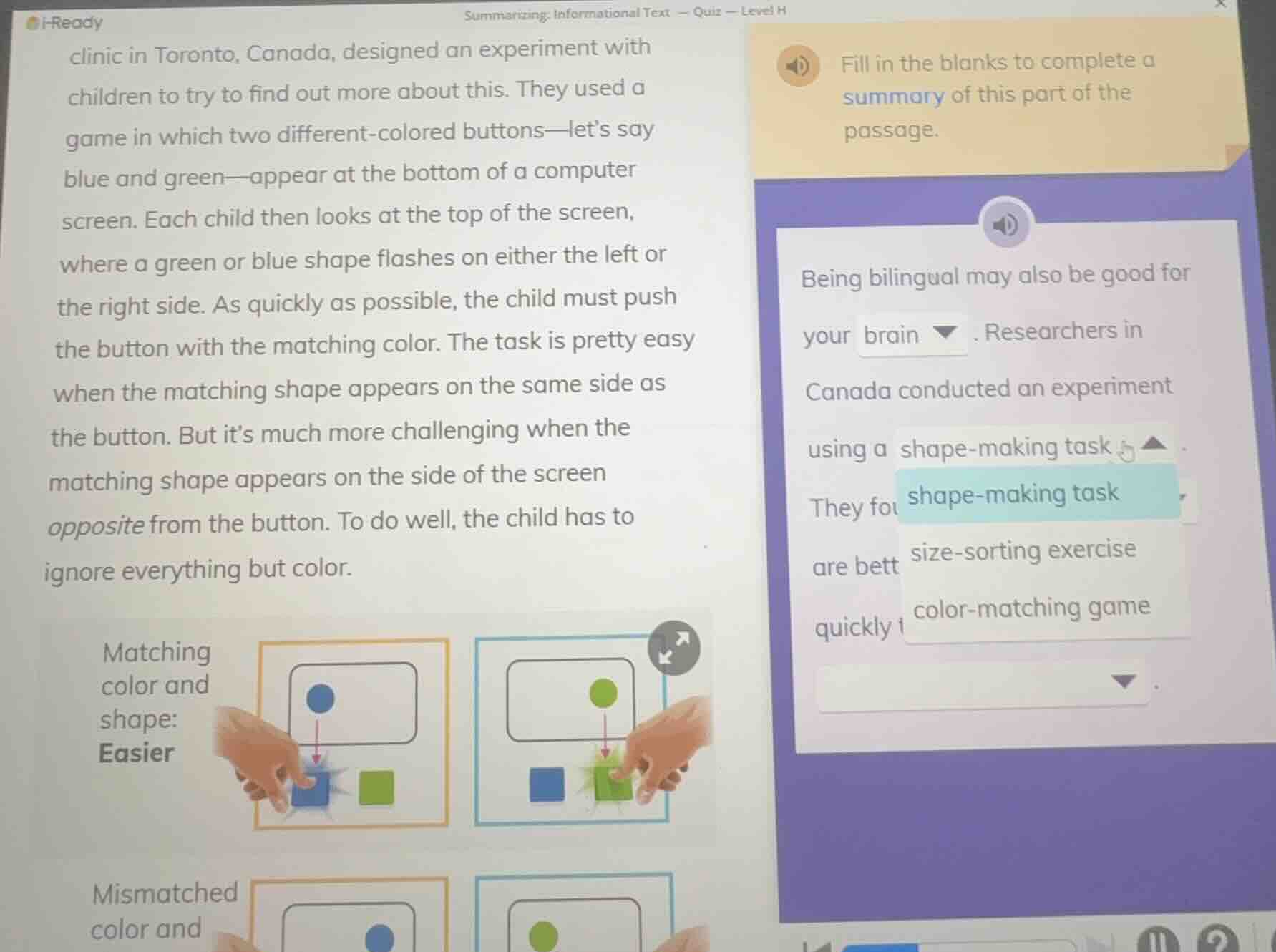
summarizing: informational text — quiz — level hclinic in toronto, canada, designed an experiment with children to try to find out more about this. they used a game in which two different-colored buttons—lets say blue and green—appear at the bottom of a computer screen. each child then looks at the top of the screen, where a green or blue shape flashes on either the left or the right side. as quickly as possible, the child must push the button with the matching color. the task is pretty easy when the matching shape appears on the same side as the button. but its much more challenging when the matching shape appears on the side of the screen opposite from the button. to do well, the child has to ignore everything but color.matching color and shape:easiermismatched color andfill in the blanks to complete a summary of this part of the passage.being bilingual may also be good for your brain . researchers in canada conducted an experiment using a shape-making tasksize-sorting exercisecolor-matching game. they fouare bettquickly
- The first blank is filled based on the passage's focus on how bilingualism impacts mental function, and the context of a brain experiment.
- The second blank is filled by identifying the exact activity described: children match the color of a flashed shape to a button, which is a color-matching game.
- The final implied blank (from the partial text "They fou[nd]... are bett[er] quickly [responding]") would conclude that bilingual children are better at quickly ignoring distractions to complete the color-matching task, but the only selectable blank here is the second one.

Snap & solve any problem in the app
Get step-by-step solutions on Sovi AI
Photo-based solutions with guided steps
Explore more problems and detailed explanations
Being bilingual may also be good for your brain. Researchers in Canada conducted an experiment using a color-matching game.