QUESTION IMAGE
Question
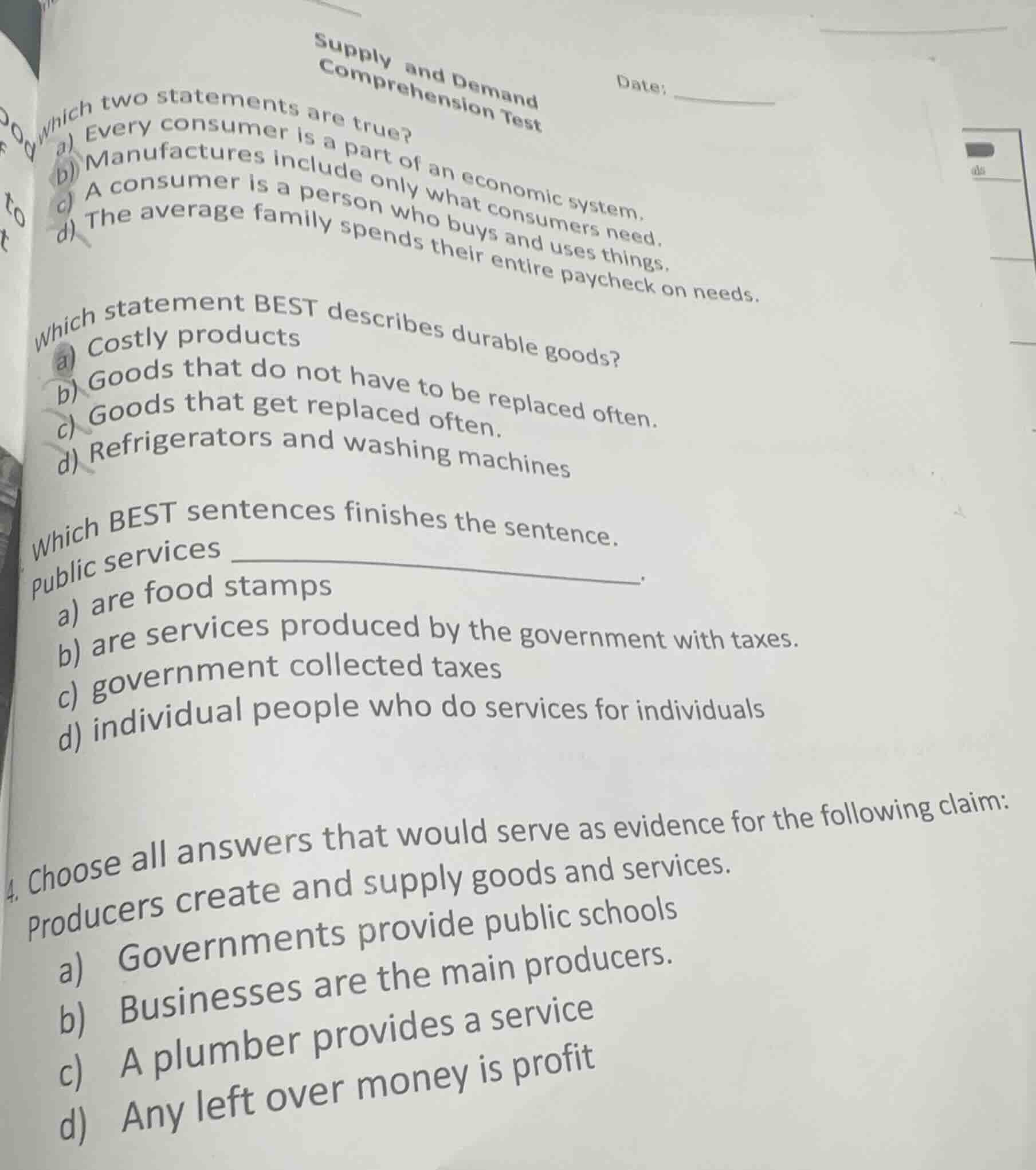
supply and demand comprehension test date: which two statements are true? a) every consumer is a part of an economic system. b) manufactures include only what consumers need. c) a consumer is a person who buys and uses things. d) the average family spends their entire paycheck on needs. which statement best describes durable goods? a) costly products b) goods that do not have to be replaced often. c) goods that get replaced often. d) refrigerators and washing machines which best sentences finishes the sentence. public services _______________. a) are food stamps b) are services produced by the government with taxes. c) government collected taxes d) individual people who do services for individuals 4. choose all answers that would serve as evidence for the following claim: producers create and supply goods and services. a) governments provide public schools b) businesses are the main producers. c) a plumber provides a service d) any left over money is profit
Question 1: Which two statements are true?
- Option a: Consumers are part of the economic system (they buy goods/services), so this is true.
- Option b: Manufacturers produce goods for both consumers and other businesses (e.g., raw materials for other production), so "only what consumers need" is false.
- Option c: A consumer is defined as someone who buys and uses goods/services, so this is true.
- Option d: Families typically spend on needs and wants, not the entire paycheck on needs, so this is false.
So the true statements are a and c.
- Option a: Costly products aren't the definition of durable goods (some cheap items can be durable, some costly non - durable).
- Option b: Durable goods (e.g., cars, appliances) have a long lifespan and don't need frequent replacement, which matches the definition.
- Option c: Durable goods don't get replaced often, so this is the opposite.
- Option d: Refrigerators and washing machines are examples, but the question asks for a description, not examples.
- Option a: Food stamps are a form of public assistance, not the definition of public services.
- Option b: Public services (like police, schools) are provided by the government using tax revenue, which is correct.
- Option c: The structure is wrong, and it's about tax collection, not public services.
- Option d: Public services are provided by the government (or public entities), not individual people for individuals.

Snap & solve any problem in the app
Get step-by-step solutions on Sovi AI
Photo-based solutions with guided steps
Explore more problems and detailed explanations
a) Every consumer is a part of an economic system, c) A consumer is a person who buys and uses things