QUESTION IMAGE
Question
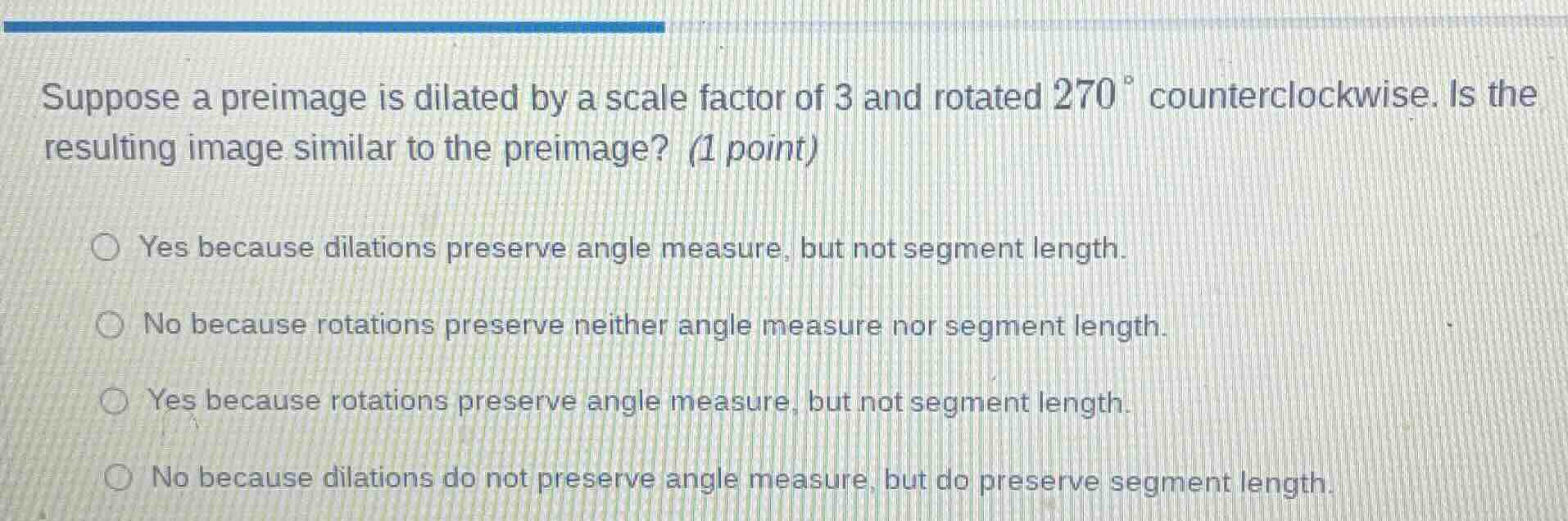
suppose a preimage is dilated by a scale factor of 3 and rotated (270^circ) counterclockwise. is the resulting image similar to the preimage? (1 point)
(\bigcirc) yes because dilations preserve angle measure, but not segment length.
(\bigcirc) no because rotations preserve neither angle measure nor segment length.
(\bigcirc) yes because rotations preserve angle measure, but not segment length.
(\bigcirc) no because dilations do not preserve angle measure, but do preserve segment length.
To determine if the image is similar to the preimage, we analyze the transformations: dilation (scale factor 3) and rotation (270° counterclockwise).
- Dilation: This transformation scales the figure (changes segment lengths) but preserves angle measures.
- Rotation: This is a rigid transformation, so it preserves both angle measures and segment lengths.
Similarity requires that corresponding angles are equal (preserved by both dilation and rotation) and corresponding sides are proportional (dilation makes sides proportional, rotation preserves side lengths which are then scaled proportionally by dilation). The first option correctly states that dilations preserve angle measure (and rotation also preserves angles) and that dilation changes segment lengths (making them proportional, which is acceptable for similarity). The other options have errors: rotations do preserve angle and segment length (so B is wrong), C ignores dilation’s role, and D misstates dilation’s properties (dilations preserve angles, not segment lengths).

Snap & solve any problem in the app
Get step-by-step solutions on Sovi AI
Photo-based solutions with guided steps
Explore more problems and detailed explanations
A. Yes because dilations preserve angle measure, but not segment length.