QUESTION IMAGE
Question
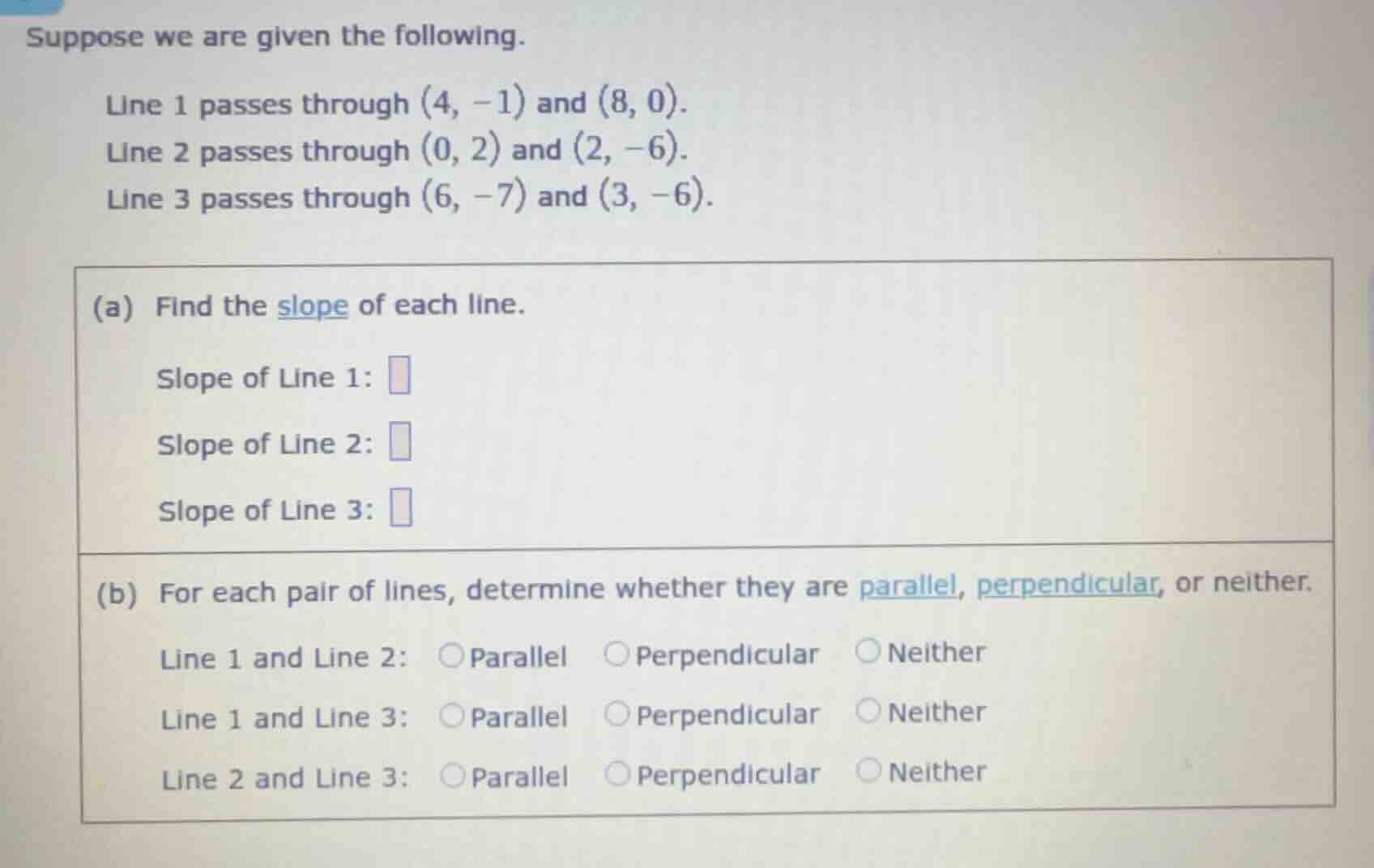
suppose we are given the following.
line 1 passes through (4, -1) and (8, 0).
line 2 passes through (0, 2) and (2, -6).
line 3 passes through (6, -7) and (3, -6).
(a) find the slope of each line.
slope of line 1:
slope of line 2:
slope of line 3:
(b) for each pair of lines, determine whether they are parallel, perpendicular, or neither.
line 1 and line 2: ∘parallel ∘perpendicular ∘neither
line 1 and line 3: ∘parallel ∘perpendicular ∘neither
line 2 and line 3: ∘parallel ∘perpendicular ∘neither
Part (a)
To find the slope of a line passing through two points \((x_1, y_1)\) and \((x_2, y_2)\), we use the slope formula \(m = \frac{y_2 - y_1}{x_2 - x_1}\).
Slope of Line 1:
Line 1 passes through \((4, -1)\) and \((8, 0)\).
Let \((x_1, y_1) = (4, -1)\) and \((x_2, y_2) = (8, 0)\).
Using the slope formula:
\[
m_1 = \frac{0 - (-1)}{8 - 4} = \frac{0 + 1}{4} = \frac{1}{4}
\]
Slope of Line 2:
Line 2 passes through \((0, 2)\) and \((2, -6)\).
Let \((x_1, y_1) = (0, 2)\) and \((x_2, y_2) = (2, -6)\).
Using the slope formula:
\[
m_2 = \frac{-6 - 2}{2 - 0} = \frac{-8}{2} = -4
\]
Slope of Line 3:
Line 3 passes through \((6, -7)\) and \((3, -6)\).
Let \((x_1, y_1) = (6, -7)\) and \((x_2, y_2) = (3, -6)\).
Using the slope formula:
\[
m_3 = \frac{-6 - (-7)}{3 - 6} = \frac{-6 + 7}{-3} = \frac{1}{-3} = -\frac{1}{3}
\]
Part (b)
To determine if two lines are parallel, perpendicular, or neither, we use the following rules:
- Parallel Lines: Have equal slopes (\(m_1 = m_2\)).
- Perpendicular Lines: Have slopes that are negative reciprocals (\(m_1 \times m_2 = -1\)).
- Neither: If neither of the above conditions is met.
Line 1 and Line 2:
Slope of Line 1 (\(m_1\)) = \(\frac{1}{4}\)
Slope of Line 2 (\(m_2\)) = \(-4\)
Check if they are perpendicular:
\[
m_1 \times m_2 = \frac{1}{4} \times (-4) = -1
\]
Since the product of the slopes is \(-1\), Line 1 and Line 2 are perpendicular.
Line 1 and Line 3:
Slope of Line 1 (\(m_1\)) = \(\frac{1}{4}\)
Slope of Line 3 (\(m_3\)) = \(-\frac{1}{3}\)
Check if they are parallel: \(\frac{1}{4}
eq -\frac{1}{3}\)
Check if they are perpendicular: \(\frac{1}{4} \times (-\frac{1}{3}) = -\frac{1}{12}
eq -1\)
So, Line 1 and Line 3 are neither parallel nor perpendicular.
Line 2 and Line 3:
Slope of Line 2 (\(m_2\)) = \(-4\)
Slope of Line 3 (\(m_3\)) = \(-\frac{1}{3}\)
Check if they are parallel: \(-4
eq -\frac{1}{3}\)
Check if they are perpendicular: \(-4 \times (-\frac{1}{3}) = \frac{4}{3}
eq -1\)
So, Line 2 and Line 3 are neither parallel nor perpendicular.
Final Answers
Part (a)
- Slope of Line 1: \(\boldsymbol{\frac{1}{4}}\)
- Slope of Line 2: \(\boldsymbol{-4}\)
- Slope of Line 3: \(\boldsymbol{-\frac{1}{3}}\)
Part (b)
- Line 1 and Line 2: \(\boldsymbol{\text{Perpendicular}}\)
- Line 1 and Line 3: \(\boldsymbol{\text{Neither}}\)
- Line 2 and Line 3: \(\boldsymbol{\text{Neither}}\)

Snap & solve any problem in the app
Get step-by-step solutions on Sovi AI
Photo-based solutions with guided steps
Explore more problems and detailed explanations
Part (a)
To find the slope of a line passing through two points \((x_1, y_1)\) and \((x_2, y_2)\), we use the slope formula \(m = \frac{y_2 - y_1}{x_2 - x_1}\).
Slope of Line 1:
Line 1 passes through \((4, -1)\) and \((8, 0)\).
Let \((x_1, y_1) = (4, -1)\) and \((x_2, y_2) = (8, 0)\).
Using the slope formula:
\[
m_1 = \frac{0 - (-1)}{8 - 4} = \frac{0 + 1}{4} = \frac{1}{4}
\]
Slope of Line 2:
Line 2 passes through \((0, 2)\) and \((2, -6)\).
Let \((x_1, y_1) = (0, 2)\) and \((x_2, y_2) = (2, -6)\).
Using the slope formula:
\[
m_2 = \frac{-6 - 2}{2 - 0} = \frac{-8}{2} = -4
\]
Slope of Line 3:
Line 3 passes through \((6, -7)\) and \((3, -6)\).
Let \((x_1, y_1) = (6, -7)\) and \((x_2, y_2) = (3, -6)\).
Using the slope formula:
\[
m_3 = \frac{-6 - (-7)}{3 - 6} = \frac{-6 + 7}{-3} = \frac{1}{-3} = -\frac{1}{3}
\]
Part (b)
To determine if two lines are parallel, perpendicular, or neither, we use the following rules:
- Parallel Lines: Have equal slopes (\(m_1 = m_2\)).
- Perpendicular Lines: Have slopes that are negative reciprocals (\(m_1 \times m_2 = -1\)).
- Neither: If neither of the above conditions is met.
Line 1 and Line 2:
Slope of Line 1 (\(m_1\)) = \(\frac{1}{4}\)
Slope of Line 2 (\(m_2\)) = \(-4\)
Check if they are perpendicular:
\[
m_1 \times m_2 = \frac{1}{4} \times (-4) = -1
\]
Since the product of the slopes is \(-1\), Line 1 and Line 2 are perpendicular.
Line 1 and Line 3:
Slope of Line 1 (\(m_1\)) = \(\frac{1}{4}\)
Slope of Line 3 (\(m_3\)) = \(-\frac{1}{3}\)
Check if they are parallel: \(\frac{1}{4}
eq -\frac{1}{3}\)
Check if they are perpendicular: \(\frac{1}{4} \times (-\frac{1}{3}) = -\frac{1}{12}
eq -1\)
So, Line 1 and Line 3 are neither parallel nor perpendicular.
Line 2 and Line 3:
Slope of Line 2 (\(m_2\)) = \(-4\)
Slope of Line 3 (\(m_3\)) = \(-\frac{1}{3}\)
Check if they are parallel: \(-4
eq -\frac{1}{3}\)
Check if they are perpendicular: \(-4 \times (-\frac{1}{3}) = \frac{4}{3}
eq -1\)
So, Line 2 and Line 3 are neither parallel nor perpendicular.
Final Answers
Part (a)
- Slope of Line 1: \(\boldsymbol{\frac{1}{4}}\)
- Slope of Line 2: \(\boldsymbol{-4}\)
- Slope of Line 3: \(\boldsymbol{-\frac{1}{3}}\)
Part (b)
- Line 1 and Line 2: \(\boldsymbol{\text{Perpendicular}}\)
- Line 1 and Line 3: \(\boldsymbol{\text{Neither}}\)
- Line 2 and Line 3: \(\boldsymbol{\text{Neither}}\)