QUESTION IMAGE
Question
surface area of cylinders
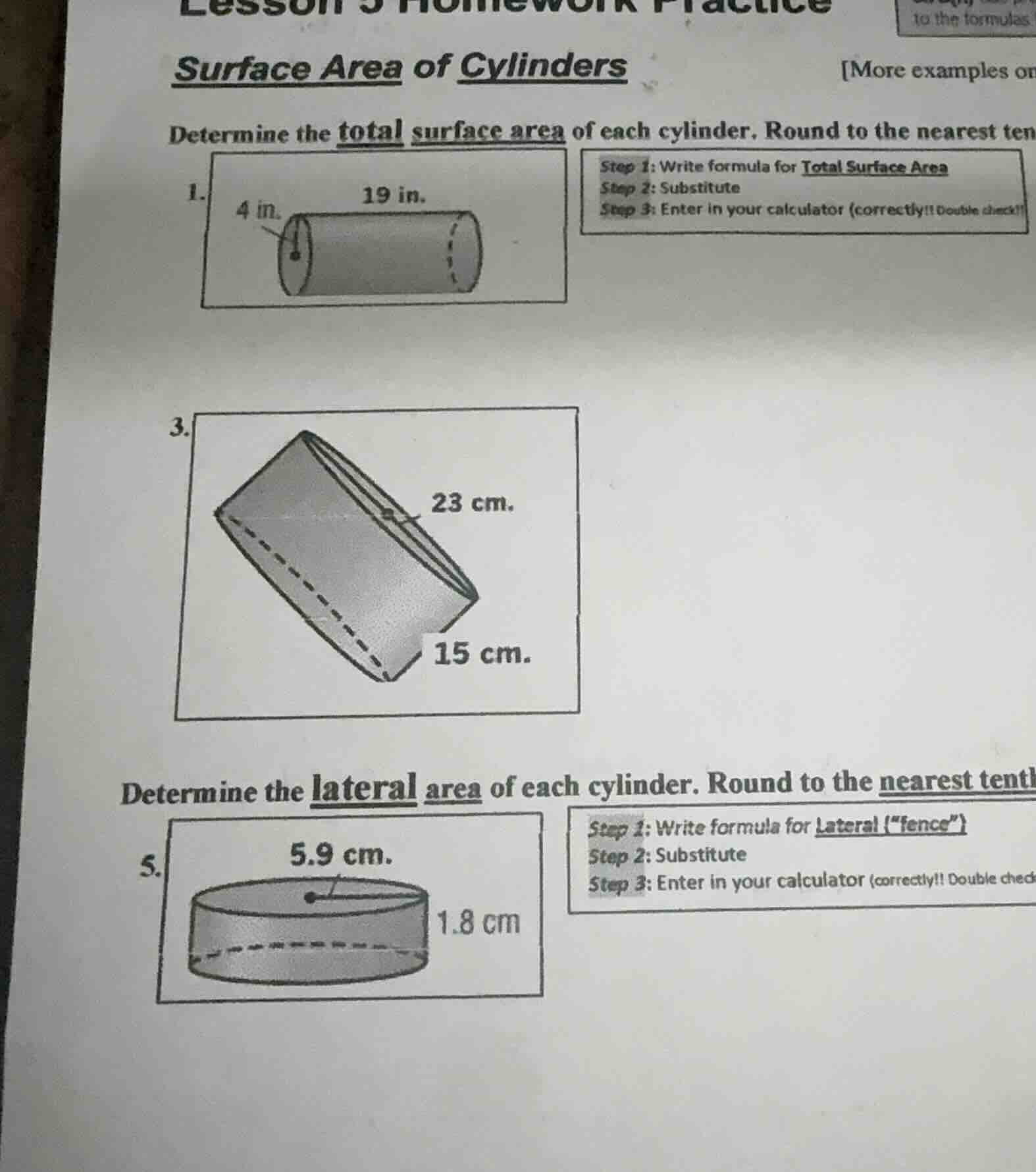
determine the total surface area of each cylinder. round to the nearest ten
1.
4 in. 19 in.
step 1: write formula for total surface area
step 2: substitute
step 3: enter in your calculator (correctly!! double check!!
3.
23 cm.
15 cm.
determine the lateral area of each cylinder. round to the nearest tent
5.
5.9 cm.
1.8 cm
step 1: write formula for lateral (\fence\)
step 2: substitute
step 3: enter in your calculator (correctly!! double check
Problem 1: Total Surface Area of Cylinder (4 in radius, 19 in height)
Step 1: Recall the formula for the total surface area (TSA) of a cylinder.
The formula for the total surface area of a cylinder is \( TSA = 2\pi r^2 + 2\pi rh \), where \( r \) is the radius and \( h \) is the height.
Step 2: Substitute the given values.
Here, \( r = 4 \) in and \( h = 19 \) in.
First, calculate \( 2\pi r^2 \):
\( 2\pi(4)^2 = 2\pi(16) = 32\pi \)
Then, calculate \( 2\pi rh \):
\( 2\pi(4)(19) = 152\pi \)
Now, add these two results together:
\( TSA = 32\pi + 152\pi = 184\pi \)
Step 3: Calculate the numerical value.
Using \( \pi \approx 3.1416 \):
\( TSA \approx 184 \times 3.1416 \approx 577.7664 \)
Rounding to the nearest tenth, we get \( 577.8 \) square inches.
Step 1: Recall the formula for the total surface area (TSA) of a cylinder.
The formula for the total surface area of a cylinder is \( TSA = 2\pi r^2 + 2\pi rh \), where \( r \) is the radius and \( h \) is the height. First, find the radius from the diameter. The diameter \( d = 15 \) cm, so the radius \( r = \frac{d}{2} = \frac{15}{2} = 7.5 \) cm.
Step 2: Substitute the given values.
Here, \( r = 7.5 \) cm and \( h = 23 \) cm.
First, calculate \( 2\pi r^2 \):
\( 2\pi(7.5)^2 = 2\pi(56.25) = 112.5\pi \)
Then, calculate \( 2\pi rh \):
\( 2\pi(7.5)(23) = 345\pi \)
Now, add these two results together:
\( TSA = 112.5\pi + 345\pi = 457.5\pi \)
Step 3: Calculate the numerical value.
Using \( \pi \approx 3.1416 \):
\( TSA \approx 457.5 \times 3.1416 \approx 1437.4 \) (rounded to the nearest tenth)
Step 1: Recall the formula for the lateral surface area (LSA) of a cylinder.
The formula for the lateral surface area of a cylinder is \( LSA = 2\pi rh \), where \( r \) is the radius and \( h \) is the height.
Step 2: Substitute the given values.
Here, \( r = 5.9 \) cm and \( h = 1.8 \) cm.
\( LSA = 2\pi(5.9)(1.8) \)
Step 3: Calculate the numerical value.
First, calculate \( 2 \times 5.9 \times 1.8 = 21.24 \)
Then, multiply by \( \pi \approx 3.1416 \):
\( LSA \approx 21.24 \times 3.1416 \approx 66.7 \) (rounded to the nearest tenth)

Snap & solve any problem in the app
Get step-by-step solutions on Sovi AI
Photo-based solutions with guided steps
Explore more problems and detailed explanations
The total surface area of the cylinder is approximately \( 577.8 \) square inches.