QUESTION IMAGE
Question
svlc algebra 1a - standard (15260)
introduction to compound inequalities
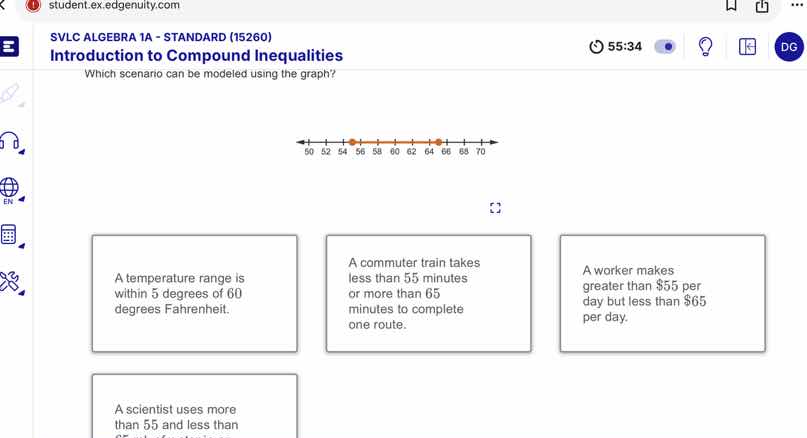
which scenario can be modeled using the graph?
graph with number line from 50 to 70, with orange dots at 55 and 65
a temperature range is within 5 degrees of 60 degrees fahrenheit.
a commuter train takes less than 55 minutes or more than 65 minutes to complete one route.
a worker makes greater than $55 per day but less than $65 per day.
a scientist uses more than 55 and less than
To solve this, we analyze each option by interpreting the graph (assuming the graph has two intervals: one starting around 55 (open circle, so \(x > 55\)) and one starting around 65 (open circle, so \(x > 65\))? Wait, no—wait, the first option: "within 5 degrees of 60" would be \(|x - 60| \leq 5\), which simplifies to \(55 \leq x \leq 65\) (closed circles). But the other options: let's re-examine. Wait, the second option: "less than 55 minutes or more than 65 minutes"—so \(x < 55\) or \(x > 65\). Let's check each:
- First option: "within 5 degrees of 60" → \(60 - 5 = 55\), \(60 + 5 = 65\), so \(55 \leq x \leq 65\) (closed intervals). But if the graph has open circles at 55 and 65, this might not match. Wait, maybe the graph has two separate intervals: one for \(x < 55\) (open circle at 55) and one for \(x > 65\) (open circle at 65). Let's check the second option: "less than 55 minutes or more than 65 minutes" → \(x < 55\) or \(x > 65\), which matches the "or" compound inequality (two separate intervals).
Let's verify other options:
- Third option: "greater than $55 per day but less than $65 per day" → \(55 < x < 65\) (one interval, between 55 and 65), which is a single interval, not two separate ones.
- First option: "within 5 degrees of 60" → \(55 \leq x \leq 65\) (one interval, closed), not two separate.
- Fourth option (partial): "more than 55 and less than"—incomplete, so invalid.
Thus, the second option ("A commuter train takes less than 55 minutes or more than 65 minutes to complete one route") matches the compound inequality with two separate intervals (\(x < 55\) or \(x > 65\)).

Snap & solve any problem in the app
Get step-by-step solutions on Sovi AI
Photo-based solutions with guided steps
Explore more problems and detailed explanations
B. A commuter train takes less than 55 minutes or more than 65 minutes to complete one route.