QUESTION IMAGE
Question
svlc algebra 1a - standard (15260)
representing relationships
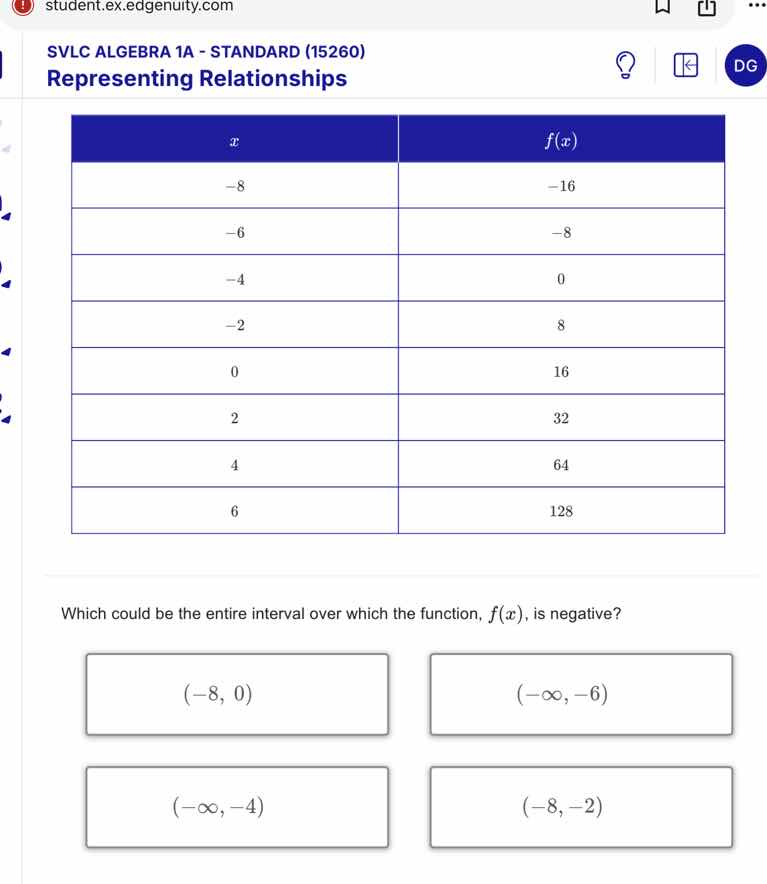
| $x$ | $f(x)$ |
|---|---|
| $-6$ | $-8$ |
| $-4$ | $0$ |
| $-2$ | $8$ |
| $0$ | $16$ |
| $2$ | $32$ |
| $4$ | $64$ |
| $6$ | $128$ |
which could be the entire interval over which the function, $f(x)$, is negative?
$(-8, 0)$ $(-\infty, -6)$
$(-\infty, -4)$ $(-8, -2)$
Step1: Analyze the table for negative \( f(x) \)
Check the \( f(x) \) values: when \( x = -8 \), \( f(x) = -16 \) (negative); \( x = -6 \), \( f(x) = -8 \) (negative); \( x = -4 \), \( f(x) = 0 \) (not negative); \( x = -2 \), \( f(x) = 8 \) (positive), etc. So \( f(x) \) is negative when \( x < -4 \) (since at \( x = -4 \), \( f(x) = 0 \), and for \( x < -4 \) like \( -8, -6 \), \( f(x) \) is negative).
Step2: Evaluate each interval
- For \( (-8, 0) \): At \( x = -2 \) (in this interval), \( f(x) = 8 \) (positive), so invalid.
- For \( (-\infty, -6) \): At \( x = -7 \) (hypothetical, but from table, \( x = -8, -6 \) are negative, but \( x = -6 \) is included? Wait, no, the interval \( (-\infty, -6) \) is all numbers less than -6. But at \( x = -6 \), \( f(x) = -8 \) (negative), but the interval is open. Wait, but let's check the next interval.
- For \( (-\infty, -4) \): All \( x < -4 \). At \( x = -8, -6 \) (less than -4), \( f(x) \) is negative; at \( x = -4 \), \( f(x) = 0 \) (not negative). So this interval includes all \( x \) where \( f(x) \) is negative (since for \( x < -4 \), \( f(x) \) is negative, and at \( x = -4 \), it's 0, and for \( x > -4 \), it's positive or zero then positive).
- For \( (-8, -2) \): At \( x = -2 \) (in this interval), \( f(x) = 8 \) (positive), so invalid.
Wait, wait, let's recheck the table:
\( x \): -8, \( f(x) \): -16 (negative)
\( x \): -6, \( f(x) \): -8 (negative)
\( x \): -4, \( f(x) \): 0 (zero)
\( x \): -2, \( f(x) \): 8 (positive)
So the function is negative when \( x < -4 \) (because at \( x = -4 \), it's zero, and for \( x > -4 \), it's non-negative (zero at -4, then positive). So the interval where \( f(x) \) is negative is \( (-\infty, -4) \), because for all \( x \) in \( (-\infty, -4) \), \( f(x) \) is negative (as seen from \( x = -8, -6 \), and any \( x < -4 \) will have \( f(x) \) negative, since the trend from \( x = -8 \) to \( x = -4 \): \( x \) increases by 2, \( f(x) \) increases by 8 each time? Wait, no, from \( x = -8 \) to \( x = -6 \): \( f(x) \) goes from -16 to -8 (increase by 8); \( x = -6 \) to \( x = -4 \): \( f(x) \) goes from -8 to 0 (increase by 8). So the function is linear? Wait, no, from \( x = 0 \) to \( x = 2 \), \( f(x) \) goes from 16 to 32 (increase by 16); \( x = 2 \) to 4: 32 to 64 (increase by 32); \( x = 4 \) to 6: 64 to 128 (increase by 64). So after \( x = 0 \), it's exponential? Wait, no, the first part (negative \( x \)): from \( x = -8 \) (f=-16), \( x=-6 \) (f=-8), \( x=-4 \) (f=0), \( x=-2 \) (f=8), \( x=0 \) (f=16). So that's a linear relationship: slope \( m = \frac{-8 - (-16)}{-6 - (-8)} = \frac{8}{2} = 4 \). So \( f(x) = 4(x + 8) - 16 \)? Wait, at \( x = -8 \), \( f(x) = -16 \). So \( f(x) = 4x + 16 \)? Let's check: \( x = -8 \): 4(-8) +16 = -32 +16 = -16 (correct). \( x = -6 \): 4(-6)+16 = -24 +16 = -8 (correct). \( x = -4 \): 4(-4)+16 = -16 +16 = 0 (correct). \( x = -2 \): 4(-2)+16 = -8 +16 = 8 (correct). \( x = 0 \): 40 +16 = 16 (correct). Oh! So the function for \( x \leq 0 \) is \( f(x) = 4x + 16 \), and for \( x > 0 \), it's exponential? Wait, no, at \( x = 2 \), \( f(x) = 32 \). 42 +16 = 24, but 32 ≠24. So after \( x = 0 \), it's different. But the negative part is linear: \( f(x) = 4x + 16 \) for \( x \leq 0 \) (since at \( x = 0 \), f=16, which matches). So for \( f(x) < 0 \): \( 4x + 16 < 0 \) → \( 4x < -16 \) → \( x < -4 \). So the interval where \( f(x) < 0 \) is \( (-\infty, -4) \).
Now check the options:
- \( (-8, 0) \): includes \( x = -2 \) (f=8 >0), so no.
- \( (-\infty, -6) \): all \( x < -6 \), but \(…

Snap & solve any problem in the app
Get step-by-step solutions on Sovi AI
Photo-based solutions with guided steps
Explore more problems and detailed explanations
\((-\infty, -4)\)