QUESTION IMAGE
Question
svlc algebra 1a - standard (15260)
representing relationships
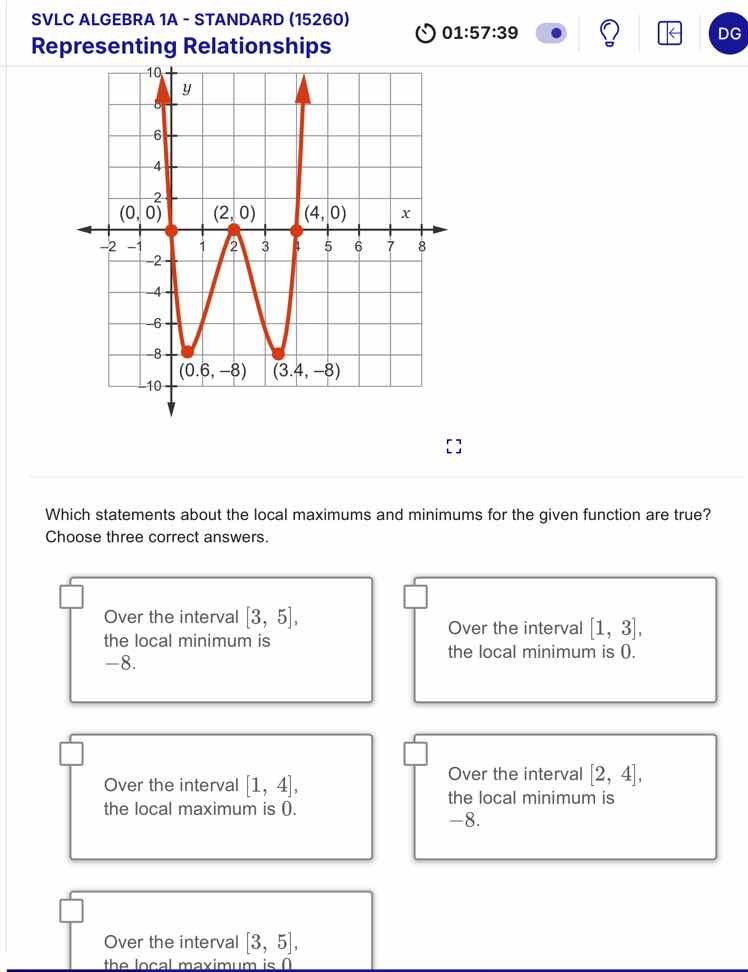
which statements about the local maximums and minimums for the given function are true?
choose three correct answers.
over the interval 3, 5,
the local minimum is
−8.
over the interval 1, 3,
the local minimum is 0.
over the interval 1, 4,
the local maximum is 0.
over the interval 2, 4,
the local minimum is
−8.
over the interval 3, 5,
the local maximum is 0
Response
To solve this, we analyze each interval using the graph:
Analyze Interval [3, 5]:
- The graph has a local minimum at (3.4, -8) and a local maximum (as x approaches 5, the graph rises). So "Over the interval [3, 5], the local minimum is −8" is true.
Analyze Interval [1, 3]:
- The local minimum in [1, 3] is at (0.6, -8) is outside [1,3], and the lowest point in [1,3] is around y=0? No—wait, the graph in [1,3] has a minimum at (2,0)? No, (2,0) is a root (x-intercept), but the local minimum in [1,3] is actually the valley? Wait, no—wait the graph: from x=1 to 3, the graph goes from (1, ?) to (2,0) to (3, ?). Wait, no, the points are (0.6, -8), (2,0), (3.4, -8). So in [1,3], the local minimum is not 0. Wait, maybe I misread. Wait the options:
Wait let's re-examine:
Analyze Interval [1, 4]:
- The local maximum in [1,4]: the graph has peaks? Wait, (2,0) is a root, (0,0) is a root, (4,0) is a root. The local maximums: between (0.6, -8) and (3.4, -8), the graph rises to (2,0) and (4,0)? Wait, (2,0) is a local maximum? Wait, (0,0) is a root, then it drops to (0.6, -8), rises to (2,0), drops to (3.4, -8), rises to (4,0), then rises. So in [1,4], the local maximum is 0 (at x=2 or x=4? Wait x=2 and x=4 are roots, y=0). So "Over the interval [1, 4], the local maximum is 0" is true.
Analyze Interval [2, 4]:
- The graph has a local minimum at (3.4, -8) (within [2,4]). So "Over the interval [2, 4], the local minimum is −8" is true.
Other Options (Incorrect):
- "Over the interval [1, 3], the local minimum is 0": False (the minimum in [1,3] is not 0; the valley at (0.6, -8) is outside [1,3], but in [1,3], the lowest is around y=0? No, (2,0) is a root, but the local minimum in [1,3] is actually the point at x=2? No, (2,0) is a root, not a minimum. So this is false.
- "Over the interval [3, 5], the local maximum is 0": False (the graph rises past x=4, so local maximum in [3,5] is not 0).
So the three correct answers are:
- Over the interval [3, 5], the local minimum is −8.
- Over the interval [1, 4], the local maximum is 0.
- Over the interval [2, 4], the local minimum is −8.

Snap & solve any problem in the app
Get step-by-step solutions on Sovi AI
Photo-based solutions with guided steps
Explore more problems and detailed explanations
- Over the interval [3, 5], the local minimum is −8
- Over the interval [1, 4], the local maximum is 0
- Over the interval [2, 4], the local minimum is −8
(Select these three options.)