QUESTION IMAGE
Question
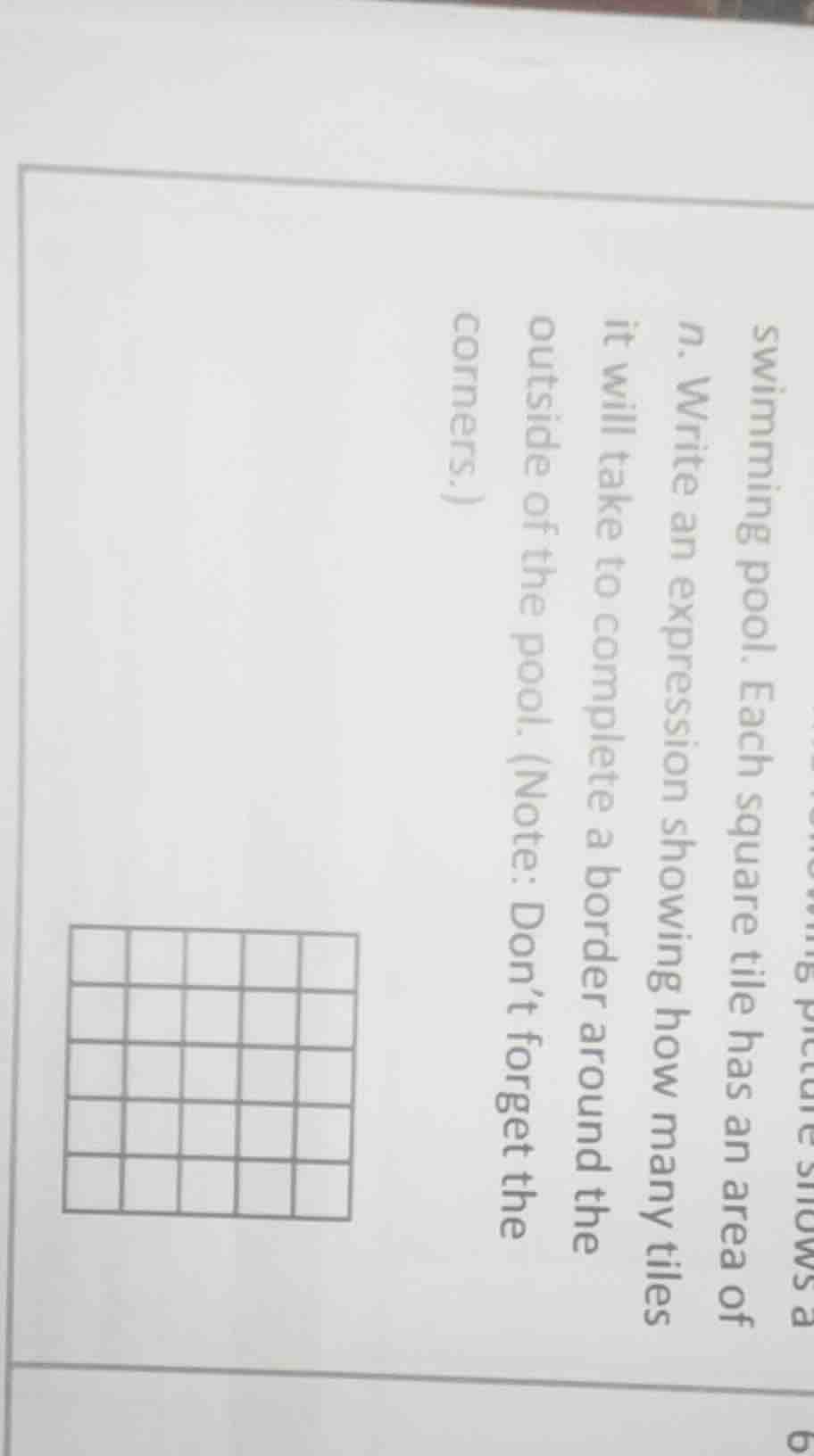
swimming pool. each square tile has an area of n. write an expression showing how many tiles it will take to complete a border around the outside of the pool. (note: dont forget the corners.)
Step1: Analyze the pool's dimensions
From the diagram, the pool is a \( 5 \times 5 \) grid of tiles (assuming each small square is a tile unit for the pool). To add a border, we need to consider the outer layer. The new length and width of the pool with the border will be \( 5 + 2 = 7 \) (adding 1 tile on each side). But wait, actually, for a border around a rectangle (or square) of size \( n \times n \) (here \( n = 5 \)), the number of border tiles can be calculated by considering the perimeter and the corner tiles, but a better way is:
The total number of tiles including the border is \( (n + 2) \times (n + 2) \) (since we add 1 tile on each side, so length and width increase by 2), and the number of tiles in the pool is \( n \times n \). So the number of border tiles is \( (n + 2)^2 - n^2 \).
Wait, but let's check with \( n = 5 \). The pool is \( 5 \times 5 \), so pool tiles: \( 5 \times 5 = 25 \). The bordered area is \( (5 + 2) \times (5 + 2)= 49 \). So border tiles: \( 49 - 25 = 24 \). Alternatively, we can calculate the perimeter - 4 (to avoid double - counting corners) plus 4 corners? Wait no, the formula \( (n + 2)^2 - n^2 \) expands to \( n^2 + 4n + 4 - n^2 = 4n + 4 \). For \( n = 5 \), \( 4\times5 + 4 = 24 \), which matches.
Wait, but the problem says "each square tile has an area of \( n \)"? Wait, maybe I misread. Wait the original problem: "swimming pool. Each square tile has an area of \( n \). Write an expression showing how many tiles it will take to complete a border around the outside of the pool. (Note: Don’t forget the corners.)" Wait, maybe the pool is a square with side length \( s \) (in terms of tiles), and each tile has area \( n \). But from the diagram, the pool is \( 5 \) tiles per side (since the grid is 5x5). Let's assume the pool is a square with side length \( s \) (number of tiles in the pool's side). Then, to add a border, we need to calculate the number of tiles in the border.
Another approach: For a square pool with side length \( s \) (number of tiles), the border tiles can be calculated as follows:
- The top and bottom borders: each has \( s + 2 \) tiles (because we add one tile on each end), so \( 2\times(s + 2) \) tiles.
- The left and right borders: but we have already counted the corner tiles in the top and bottom, so each of these has \( s \) tiles (excluding the top and bottom corners), so \( 2\times s \) tiles.
Total border tiles: \( 2(s + 2)+2s=2s + 4+2s = 4s + 4=4(s + 1) \).
If the pool in the diagram is \( 5 \) tiles per side ( \( s = 5 \) ), then \( 4\times(5 + 1)=24 \), which matches the earlier calculation.
But the problem says "each square tile has an area of \( n \)". Wait, maybe the side length of the pool (in terms of tiles) is, say, \( s \), and we need to find the number of tiles for the border. Let's assume the pool is a square with side length \( s \) (number of tiles). Then the number of border tiles is \( 4(s + 1) \) (or \( 4s+4 \)).
Wait, maybe the pool is a square with side length \( 5 \) (from the diagram, 5x5 grid). Let's confirm with \( s = 5 \):
- Top border: \( 5 + 2 = 7 \) tiles (including left and right corners)
- Bottom border: \( 7 \) tiles
- Left border (excluding top and bottom corners): \( 5 \) tiles
- Right border (excluding top and bottom corners): \( 5 \) tiles
- Total: \( 7 + 7+5 + 5=24 \), and \( 4\times(5 + 1)=24 \), \( 4\times5+4 = 24 \).
So the general formula for a square pool with side length \( s \) (number of tiles) is \( 4(s + 1) \) or \( 4s + 4 \).
But the problem says "each square tile has an area of \( n \)". Wait, maybe there'…

Snap & solve any problem in the app
Get step-by-step solutions on Sovi AI
Photo-based solutions with guided steps
Explore more problems and detailed explanations
If the side length of the pool (in number of tiles) is \( s \), the expression for the number of border tiles is \( \boldsymbol{4(s + 1)} \) (or \( \boldsymbol{4s + 4} \)). If the pool in the diagram has a side length of \( 5 \) (as per the 5x5 grid), substituting \( s = 5 \) gives \( 4\times(5 + 1)=24 \) tiles.