QUESTION IMAGE
Question
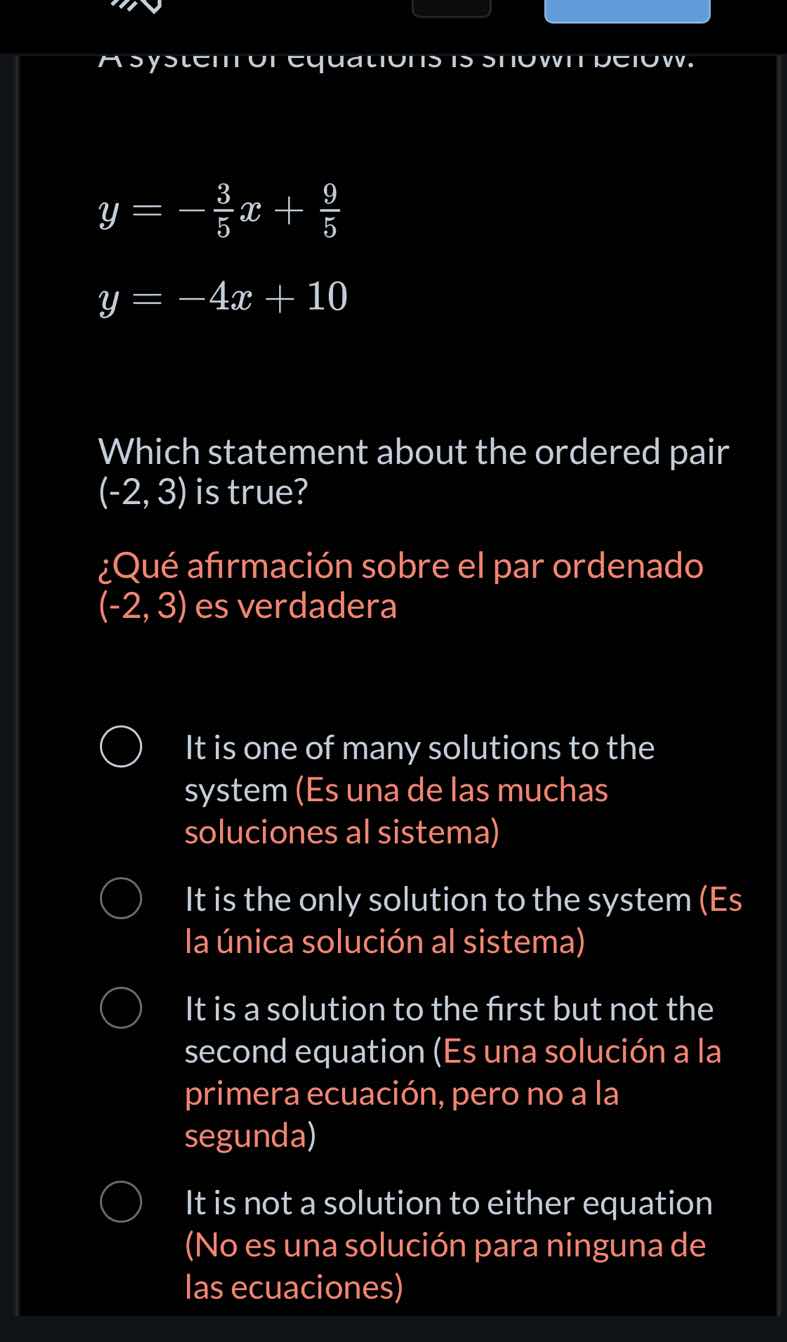
a system of equations is shown below.
$y = -\frac{3}{5}x + \frac{9}{5}$
$y = -4x + 10$
which statement about the ordered pair $(-2, 3)$ is true?
¿qué afirmación sobre el par ordenado $(-2, 3)$ es verdadera
\bigcirc it is one of many solutions to the system (es una de las muchas soluciones al sistema)
\bigcirc it is the only solution to the system (es la única solución al sistema)
\bigcirc it is a solution to the first but not the second equation (es una solución a la primera ecuación, pero no a la segunda)
\bigcirc it is not a solution to either equation (no es una solución para ninguna de las ecuaciones)
Step1: Check first equation
Substitute \( x = -2 \), \( y = 3 \) into \( y = -\frac{3}{5}x + \frac{9}{5} \).
Right - hand side: \( -\frac{3}{5}\times(-2)+\frac{9}{5}=\frac{6}{5}+\frac{9}{5}=\frac{6 + 9}{5}=\frac{15}{5}=3 \).
Left - hand side: \( y = 3 \). So, \( (-2,3) \) satisfies the first equation.
Step2: Check second equation
Substitute \( x=-2 \), \( y = 3 \) into \( y=-4x + 10 \).
Right - hand side: \( -4\times(-2)+10=8 + 10 = 18 \).
Left - hand side: \( y = 3 \). Since \( 3
eq18 \), \( (-2,3) \) does not satisfy the second equation.

Snap & solve any problem in the app
Get step-by-step solutions on Sovi AI
Photo-based solutions with guided steps
Explore more problems and detailed explanations
It is a solution to the first but not the second equation (Es una solución a la primera ecuación, pero no a la segunda)