QUESTION IMAGE
Question
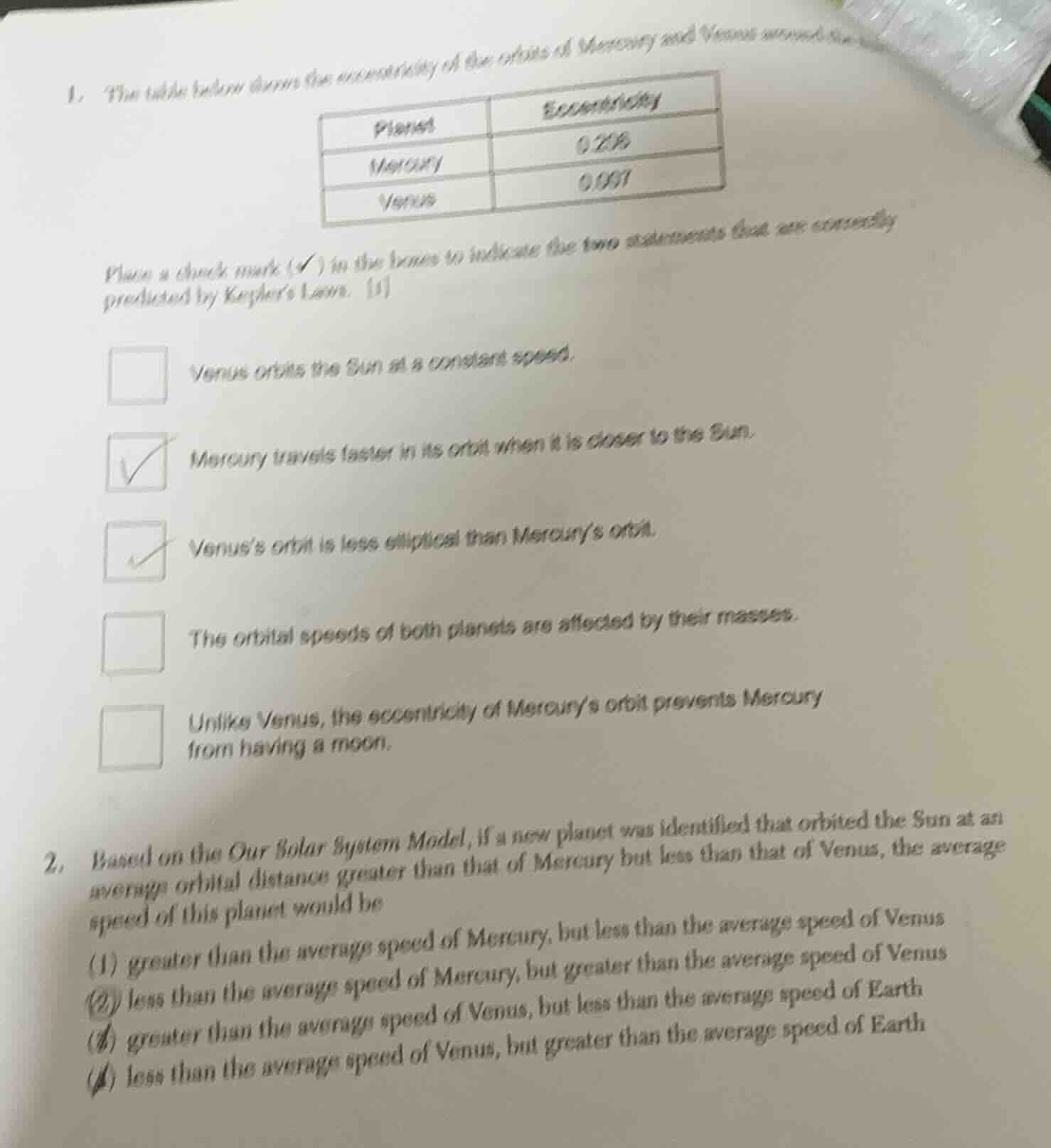
- the table below shows the eccentricity of the orbits of mercury and venus around the sun.
| planet | eccentricity |
|---|---|
| venus | 0.007 |
place a check mark (✓) in the boxes to indicate the two statements that are correctly predicted by kepler’s laws. 1
□ venus orbits the sun at a constant speed.
☑ mercury travels faster in its orbit when it is closer to the sun.
☑ venus’s orbit is less elliptical than mercury’s orbit.
□ the orbital speeds of both planets are affected by their masses.
□ unlike venus, the eccentricity of mercury’s orbit prevents mercury from having a moon.
- based on the our solar system model, if a new planet was identified that orbited the sun at an average orbital distance greater than that of mercury but less than that of venus, the average speed of this planet would be
(1) greater than the average speed of mercury, but less than the average speed of venus
(2) less than the average speed of mercury, but greater than the average speed of venus
(3) greater than the average speed of venus, but less than the average speed of earth
(4) less than the average speed of venus, but greater than the average speed of earth
Step1: Analyze Question 1 statements
Kepler's 2nd law (equal areas in equal time) means planets speed up closer to the Sun. Orbital eccentricity: lower value = less elliptical. Kepler's laws don't link speed to planet mass, orbital speed isn't constant, and eccentricity doesn't prevent moons.
Step2: Confirm correct Q1 statements
- Mercury travels faster closer to the Sun: aligns with Kepler's 2nd law.
- Venus's orbit is less elliptical than Mercury's: since 0.007 < 0.206.
Step3: Analyze Question 2 using Kepler's 3rd law
Kepler's 3rd law states that for orbits around the Sun, closer planets have faster average orbital speeds. The new planet is farther than Mercury, closer than Venus, so its speed is slower than Mercury, faster than Venus.

Snap & solve any problem in the app
Get step-by-step solutions on Sovi AI
Photo-based solutions with guided steps
Explore more problems and detailed explanations
- The correctly predicted statements are:
- ☑️ Mercury travels faster in its orbit when it is closer to the Sun.
- ☑️ Venus's orbit is less elliptical than Mercury's orbit.
- (2) less than the average speed of Mercury, but greater than the average speed of Venus