QUESTION IMAGE
Question
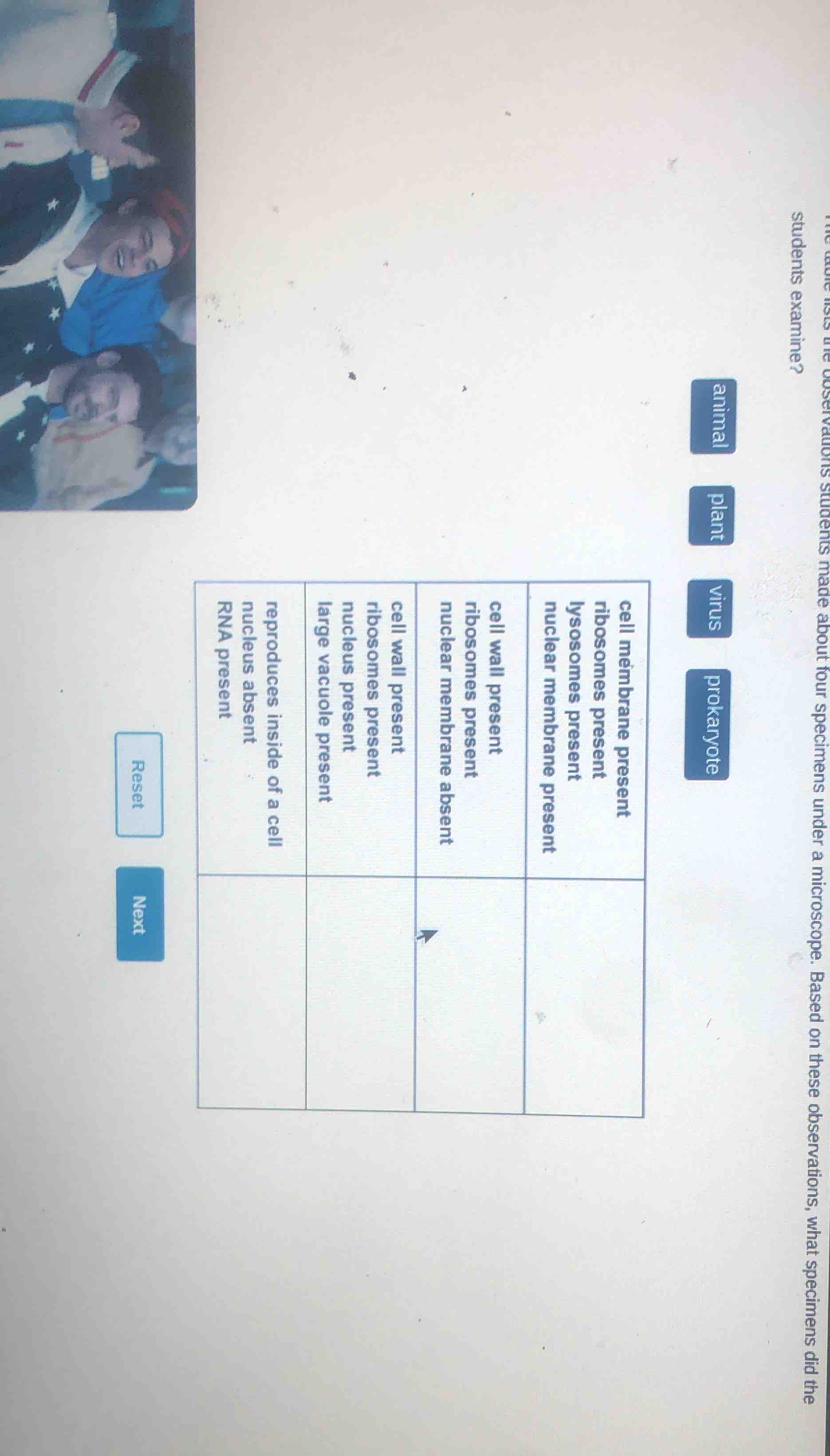
the table lists the observations students made about four specimens under a microscope. based on these observations, what specimens did the students examine?
| cell membrane present
ribosomes present
lysosomes present
nuclear membrane present | cell wall present
ribosomes present
nuclear membrane absent | cell wall present
ribosomes present
nucleus present
large vacuole present | reproduces inside of a cell
nucleus absent
rna present |
options: animal, plant, virus, prokaryote
reset
next
Brief Explanations
- The first column has a cell membrane, ribosomes, lysosomes, and a nuclear membrane (a true nucleus) with no cell wall: this matches the structure of an animal cell, which lacks a cell wall and has lysosomes.
- The second column has a cell wall, ribosomes, and no nuclear membrane (no true nucleus): this is the defining feature of a prokaryote, which has no membrane-bound nucleus but has a cell wall and ribosomes.
- The third column has a cell wall, ribosomes, a true nucleus, and a large vacuole: this matches a plant cell, which has a cell wall, large central vacuole, and membrane-bound nucleus.
- The fourth column describes a particle that reproduces inside a host cell, has RNA, and no nucleus: this is a virus, which is acellular and relies on host cells to replicate.

Snap & solve any problem in the app
Get step-by-step solutions on Sovi AI
Photo-based solutions with guided steps
Explore more problems and detailed explanations
- animal
- prokaryote
- plant
- virus
(Matched to each column in the table from left to right)