QUESTION IMAGE
Question
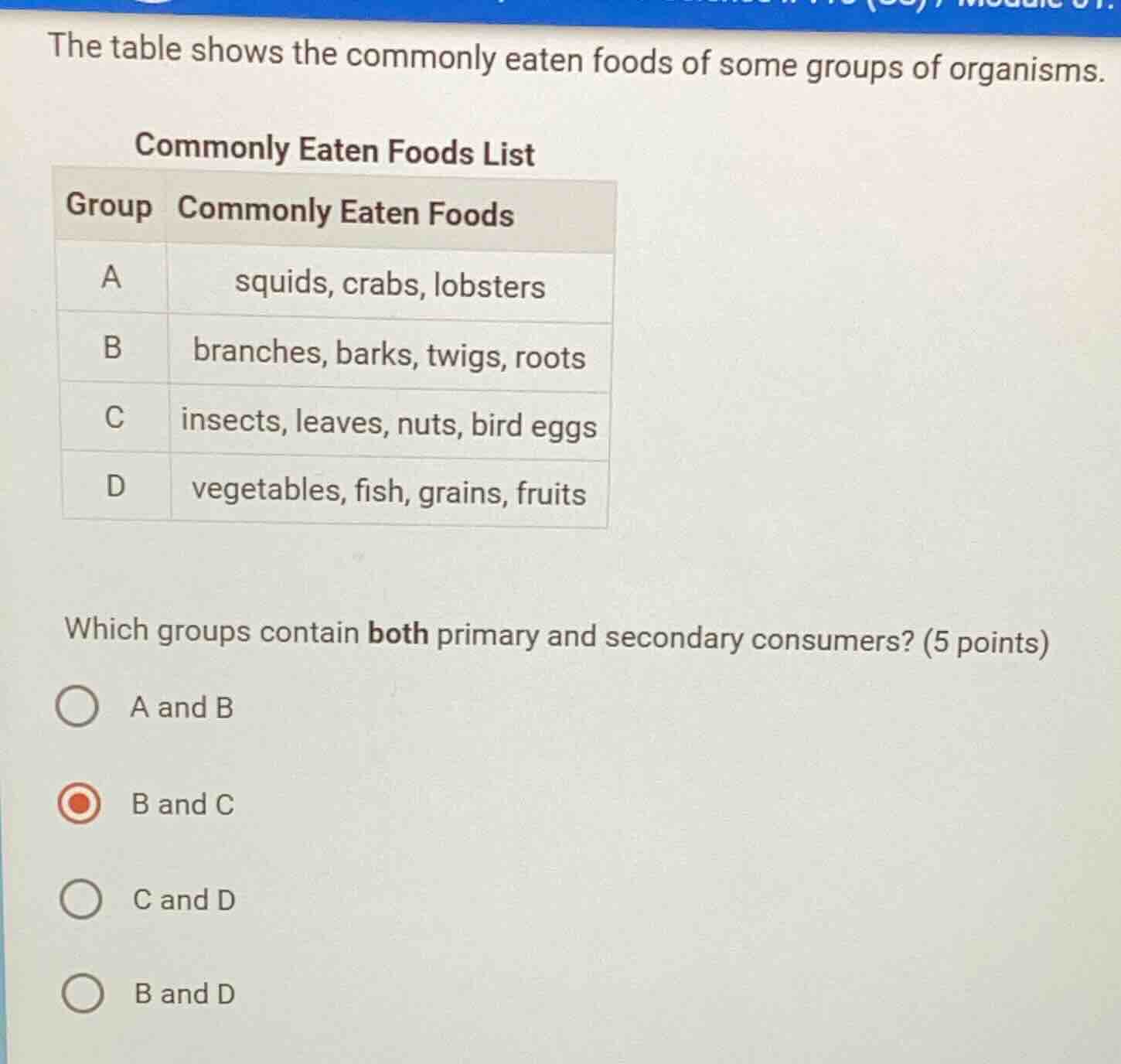
the table shows the commonly eaten foods of some groups of organisms.
commonly eaten foods list
group commonly eaten foods
a squids, crabs, lobsters
b branches, barks, twigs, roots
c insects, leaves, nuts, bird eggs
d vegetables, fish, grains, fruits
which groups contain both primary and secondary consumers? (5 points)
a and b
b and c
c and d
b and d
Brief Explanations
- Analyze Group B: Eats branches, barks, twigs, roots (producers, so primary consumers) and no secondary consumer food here? Wait, no—wait, Group B's food is plant - based (producers), so primary consumers. Group C: Eats insects (secondary consumers, as insects eat plants), leaves (primary, as leaves are producers), nuts (primary), bird eggs (secondary, as birds may be primary or secondary, but eggs are from birds which are consumers). Wait, no—primary consumers eat producers (plants), secondary eat primary consumers.
- Group B: Only eats plant parts (producers) → primary consumers.
- Group C: Eats leaves, nuts (producers - primary consumption) and insects, bird eggs (insects are primary or secondary? Insects that eat plants are primary, but if Group C eats insects, and insects eat plants, then Group C is secondary when eating insects. Also, bird eggs: birds are consumers, so eating eggs is secondary. So Group C has both primary (eating leaves, nuts) and secondary (eating insects, bird eggs) consumption.
- Wait, no, let's re - evaluate:
- Primary consumers: eat producers (plants).
- Secondary consumers: eat primary consumers.
- Group B: food is plant parts (producers) → only primary consumers.
- Group C: leaves, nuts (producers, so primary consumption) and insects (which are primary consumers, so Group C eating insects is secondary consumption), bird eggs (birds are consumers, so eating eggs is secondary). So Group C has both.
- Group D: vegetables, grains, fruits (producers - primary) and fish (which are consumers - secondary). So Group D has both? Wait, no, the options:
- Option C and D: Let's check again.
- Group A: squids, crabs, lobsters (all consumers, so secondary or higher, no primary).
- Group B: only plant - based (primary).
- Group C: leaves, nuts (primary) and insects, bird eggs (secondary) → both.
- Group D: vegetables, grains, fruits (primary) and fish (secondary) → both. Wait, but the options are A and B, B and C, C and D, B and D.
- Wait, maybe my initial analysis was wrong. Let's re - do:
- Primary consumers: organisms that eat producers (plants).
- Secondary consumers: organisms that eat primary consumers.
- Group B: food is branches, barks, twigs, roots (all plant - based, producers) → primary consumers (only primary).
- Group C: leaves, nuts (producers, so primary consumption) and insects (primary consumers, so Group C eating insects is secondary consumption), bird eggs (birds are consumers, so eating eggs is secondary consumption) → so Group C has both primary and secondary.
- Group D: vegetables, grains, fruits (producers, primary consumption) and fish (primary or secondary consumers? Fish that eat plants are primary, fish that eat other fish are secondary. But if Group D eats fish, and fish eat plants (primary) or other fish (secondary), but from the food list, we can assume that when Group D eats fish, it's eating a consumer, so secondary. So Group D has both primary (vegetables, grains, fruits) and secondary (fish) consumption.
- But the option C and D is an option. Wait, the original selected option was B and C, but maybe I made a mistake. Wait, no—let's check the options again.
- Wait, the correct answer is C and D? No, wait the option “C and D” is there. Wait, maybe the problem is that Group B is only primary, Group C has both, Group D has both. But the option “C and D” is an option. But the user's selected option was B and C, but maybe the correct answer is C and D? W…

Snap & solve any problem in the app
Get step-by-step solutions on Sovi AI
Photo-based solutions with guided steps
Explore more problems and detailed explanations
C. insects, leaves, nuts, bird eggs and D. vegetables, fish, grains, fruits (i.e., the option "C and D")