QUESTION IMAGE
Question
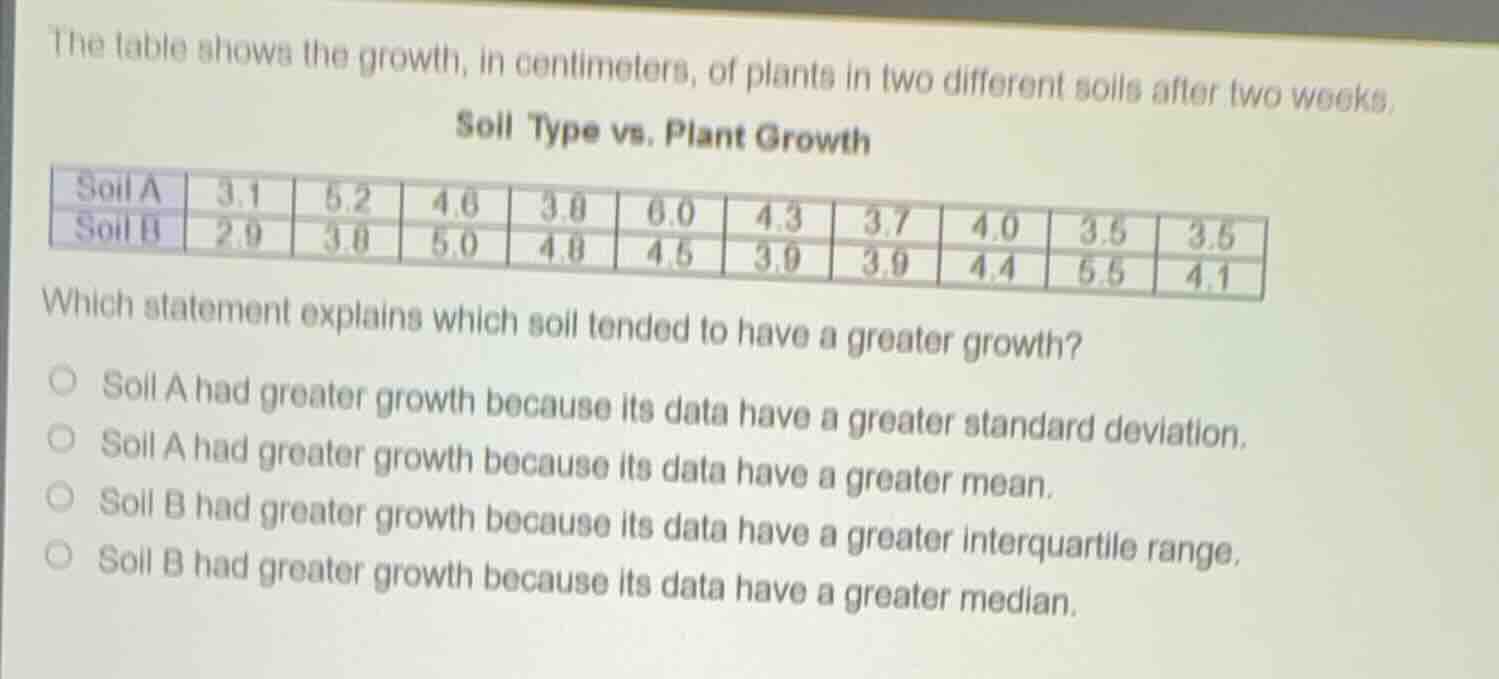
the table shows the growth, in centimeters, of plants in two different soils after two weeks.
soil type vs. plant growth
soil a: 3.1, 5.2, 4.6, 3.8, 6.0, 4.3, 3.7, 4.0, 3.5, 3.5
soil b: 2.9, 3.0, 5.0, 4.8, 4.5, 3.9, 3.9, 4.4, 5.5, 4.1
which statement explains which soil tended to have a greater growth?
- soil a had greater growth because its data have a greater standard deviation.
- soil a had greater growth because its data have a greater mean.
- soil b had greater growth because its data have a greater interquartile range.
- soil b had greater growth because its data have a greater median.
To solve this, we calculate the mean, median, standard deviation, and interquartile range for both soils.
Step 1: Calculate Mean for Soil A
Data for Soil A: \( 3.1, 5.2, 4.6, 3.8, 6.0, 4.3, 3.7, 4.0, 3.5, 3.5 \)
Sum of values: \( 3.1 + 5.2 + 4.6 + 3.8 + 6.0 + 4.3 + 3.7 + 4.0 + 3.5 + 3.5 = 41.7 \)
Number of values (\( n \)): \( 10 \)
Mean (\( \bar{x}_A \)): \( \frac{41.7}{10} = 4.17 \)
Step 2: Calculate Mean for Soil B
Data for Soil B: \( 2.9, 3.0, 5.0, 4.8, 4.5, 3.9, 3.9, 4.4, 5.5, 4.1 \)
Sum of values: \( 2.9 + 3.0 + 5.0 + 4.8 + 4.5 + 3.9 + 3.9 + 4.4 + 5.5 + 4.1 = 42.0 \)
Number of values (\( n \)): \( 10 \)
Mean (\( \bar{x}_B \)): \( \frac{42.0}{10} = 4.2 \) (Wait, correction: Wait, let's recalculate the sum for Soil B: \( 2.9 + 3.0 = 5.9 \); \( 5.9 + 5.0 = 10.9 \); \( 10.9 + 4.8 = 15.7 \); \( 15.7 + 4.5 = 20.2 \); \( 20.2 + 3.9 = 24.1 \); \( 24.1 + 3.9 = 28.0 \); \( 28.0 + 4.4 = 32.4 \); \( 32.4 + 5.5 = 37.9 \); \( 37.9 + 4.1 = 42.0 \). So mean is \( \frac{42.0}{10} = 4.2 \))
Step 3: Calculate Median for Soil A
Sort Soil A data: \( 3.1, 3.5, 3.5, 3.7, 3.8, 4.0, 4.3, 4.6, 5.2, 6.0 \)
Median (middle value for even \( n \)): Average of 5th and 6th values. 5th value: \( 3.8 \), 6th value: \( 4.0 \)
Median (\( M_A \)): \( \frac{3.8 + 4.0}{2} = 3.9 \)
Step 4: Calculate Median for Soil B
Sort Soil B data: \( 2.9, 3.0, 3.9, 3.9, 4.1, 4.4, 4.5, 4.8, 5.0, 5.5 \)
Median (middle value for even \( n \)): Average of 5th and 6th values. 5th value: \( 4.1 \), 6th value: \( 4.4 \)
Median (\( M_B \)): \( \frac{4.1 + 4.4}{2} = 4.25 \)
Step 5: Analyze Standard Deviation and Interquartile Range
- Standard Deviation: Measures spread, not central tendency (growth). So the first option is incorrect.
- Interquartile Range (IQR): Also measures spread, not central tendency. So the third option is incorrect.
- Median: Soil B's median (\( 4.25 \)) is greater than Soil A's (\( 3.9 \)), but let's check the mean again. Wait, earlier calculation for Soil A's mean: Wait, \( 3.1 + 5.2 = 8.3 \); \( 8.3 + 4.6 = 12.9 \); \( 12.9 + 3.8 = 16.7 \); \( 16.7 + 6.0 = 22.7 \); \( 22.7 + 4.3 = 27.0 \); \( 27.0 + 3.7 = 30.7 \); \( 30.7 + 4.0 = 34.7 \); \( 34.7 + 3.5 = 38.2 \); \( 38.2 + 3.5 = 41.7 \). So mean is \( 4.17 \). Soil B's mean: \( 42.0 / 10 = 4.2 \). Wait, but let's re - check the median calculation for Soil B. The sorted data for Soil B: \( 2.9, 3.0, 3.9, 3.9, 4.1, 4.4, 4.5, 4.8, 5.0, 5.5 \). The 5th value is \( 4.1 \), 6th is \( 4.4 \), so median is \( (4.1 + 4.4)/2 = 4.25 \).
But wait, the options:
- Option 1: Standard deviation is about spread, not growth amount. Incorrect.
- Option 2: Soil A's mean is \( 4.17 \), Soil B's is \( 4.2 \). Wait, maybe I miscalculated Soil A's mean. Wait, \( 3.1+5.2 = 8.3 \); \( 8.3 + 4.6 = 12.9 \); \( 12.9+3.8 = 16.7 \); \( 16.7 + 6.0 = 22.7 \); \( 22.7+4.3 = 27.0 \); \( 27.0+3.7 = 30.7 \); \( 30.7+4.0 = 34.7 \); \( 34.7+3.5 = 38.2 \); \( 38.2+3.5 = 41.7 \). \( 41.7/10 = 4.17 \). Soil B: \( 2.9+3.0 = 5.9 \); \( 5.9+5.0 = 10.9 \); \( 10.9+4.8 = 15.7 \); \( 15.7+4.5 = 20.2 \); \( 20.2+3.9 = 24.1 \); \( 24.1+3.9 = 28.0 \); \( 28.0+4.4 = 32.4 \); \( 32.4+5.5 = 37.9 \); \( 37.9+4.1 = 42.0 \). \( 42.0/10 = 4.2 \). So Soil B's mean is slightly higher. But wait, the option "Soil B had greater growth because its data have a greater median" – let's check the median again. Soil A's sorted data: \( 3.1, 3.5, 3.5, 3.7, 3.8, 4.0, 4.3, 4.6, 5.2, 6.0 \). The median is the average of the 5th and 6th terms: \( (3.8 + 4.0)/2 = 3.9 \). Soil B's sorted data: \( 2.9, 3.0, 3.9, 3.9, 4.1, 4.4, 4.5, 4.8, 5.0, 5.5 \). Median is \(…

Snap & solve any problem in the app
Get step-by-step solutions on Sovi AI
Photo-based solutions with guided steps
Explore more problems and detailed explanations
Soil B had greater growth because its data have a greater median. (The correct option is the fourth one: "Soil B had greater growth because its data have a greater median.")