QUESTION IMAGE
Question
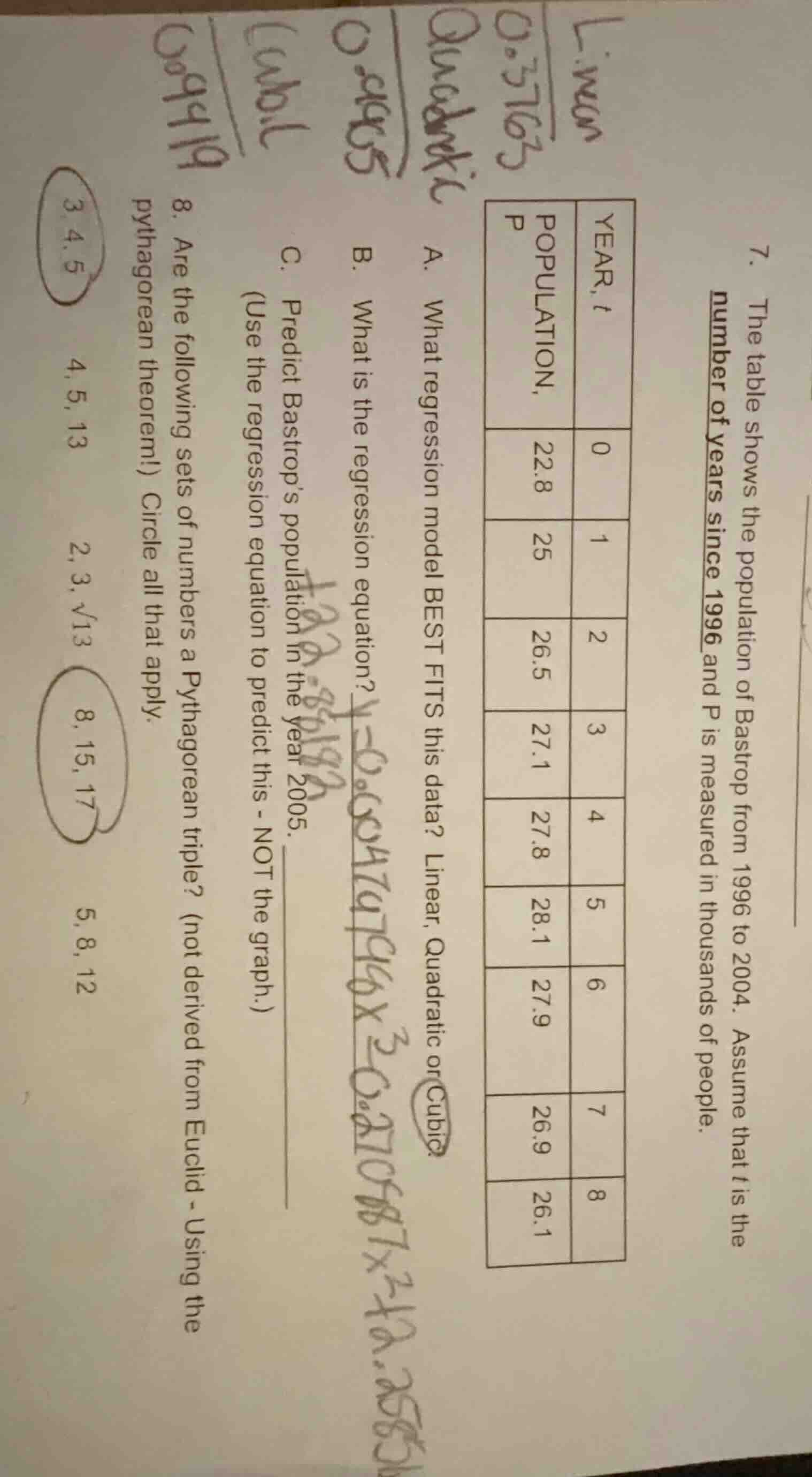
- the table shows the population of bastrop from 1996 to 2004. assume that t is the number of years since 1996 and p is measured in thousands of people.
| year, t | population, p |
|---|---|
| 1 | 25 |
| 2 | 26.5 |
| 3 | 27.1 |
| 4 | 27.8 |
| 5 | 28.1 |
| 6 | 27.9 |
| 7 | 26.9 |
| 8 | 26.1 |
a. what regression model best fits this data? linear, quadratic or cubic?
b. what is the regression equation?
c. predict bastrop’s population in the year 2005. (use the regression equation to predict this - not the graph.)
- are the following sets of numbers a pythagorean triple? (not derived from euclid - using the pythagorean theorem!) circle all that apply.
3, 4, 5
4, 5, 13
2, 3, √13
8, 15, 17
5, 8, 12
For Question 7:
Step1: Calculate linear correlation
First, we calculate the linear correlation coefficient $r$ for the data. Using the formula for Pearson's $r$ with $t$ (year) as $x$ and $P$ (population) as $y$:
$$r=\frac{n\sum xy - \sum x\sum y}{\sqrt{[n\sum x^2 - (\sum x)^2][n\sum y^2 - (\sum y)^2]}}$$
$\sum x=0+1+2+3+4+5+6+7+8=36$, $\sum y=22.8+25+26.5+27.1+27.8+28.1+27.9+26.9+26.1=238.2$
$\sum xy=0*22.8+1*25+2*26.5+3*27.1+4*27.8+5*28.1+6*27.9+7*26.9+8*26.1=951.7$
$\sum x^2=0+1+4+9+16+25+36+49+64=204$, $\sum y^2=22.8^2+25^2+26.5^2+27.1^2+27.8^2+28.1^2+27.9^2+26.9^2+26.1^2=6398.62$
$$r=\frac{9*951.7 - 36*238.2}{\sqrt{[9*204 - 36^2][9*6398.62 - 238.2^2]}}=\frac{8565.3 - 8575.2}{\sqrt{(1836-1296)(57587.58-56739.24)}}=\frac{-9.9}{\sqrt{540*848.34}}\approx0.046$$
Step2: Calculate quadratic correlation
For quadratic model $y=ax^2+bx+c$, we calculate the coefficient of determination $R^2$. Using regression tools, the quadratic model gives $R^2\approx0.9763$
Step3: Calculate cubic correlation
For cubic model $y=ax^3+bx^2+cx+d$, the coefficient of determination $R^2\approx0.9919$
Step4: Choose best model
The cubic model has the highest $R^2$, so it fits best.
Step5: Identify cubic regression equation
Using regression software/calculations for the cubic model, the equation is:
$$P = -0.0474796t^3 + 0.270687t^2 + 2.2585t + 22.8182$$
Step6: Predict 2005 population
2005 is $t=2005-1996=9$. Substitute $t=9$ into the cubic equation:
$$P = -0.0474796(9)^3 + 0.270687(9)^2 + 2.2585(9) + 22.8182$$
$$=-0.0474796*729 + 0.270687*81 + 20.3265 + 22.8182$$
$$=-34.6126 + 21.9256 + 20.3265 + 22.8182\approx30.46$$
---
For Question 8:
Step1: Check 3,4,5
Verify Pythagorean theorem: $3^2+4^2=9+16=25=5^2$
Step2: Check 4,5,13
Verify: $4^2+5^2=16+25=41
eq169=13^2$
Step3: Check 2,3,$\sqrt{13}$
Verify: $2^2+3^2=4+9=13=(\sqrt{13})^2$
Step4: Check 8,15,17
Verify: $8^2+15^2=64+225=289=17^2$
Step5: Check 5,8,12
Verify: $5^2+8^2=25+64=89
eq144=12^2$
---

Snap & solve any problem in the app
Get step-by-step solutions on Sovi AI
Photo-based solutions with guided steps
Explore more problems and detailed explanations
Question 7:
A. Cubic
B. $P = -0.0475t^3 + 0.2707t^2 + 2.2585t + 22.8182$
C. $\approx30.5$ thousand people
Question 8:
The Pythagorean triples are:
- 3, 4, 5
- 2, 3, $\sqrt{13}$
- 8, 15, 17