QUESTION IMAGE
Question
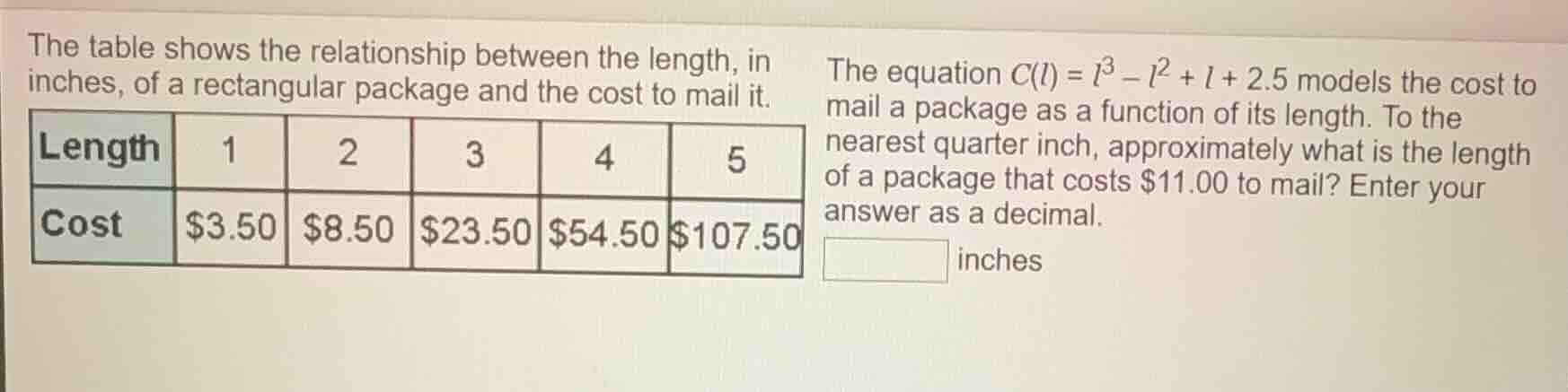
the table shows the relationship between the length, in inches, of a rectangular package and the cost to mail it.
| length | 1 | 2 | 3 | 4 | 5 |
|---|
the equation $c(l) = l^3 - l^2 + l + 2.5$ models the cost to mail a package as a function of its length. to the nearest quarter inch, approximately what is the length of a package that costs $11.00 to mail? enter your answer as a decimal.
inches
Step1: Set up the equation
We need to solve \( l^{3}-l^{2}+l + 2.5=11\) for \( l\). First, rewrite the equation as \( l^{3}-l^{2}+l+2.5 - 11=0\), so \( l^{3}-l^{2}+l - 8.5 = 0\).
Step2: Test integer values
Test \( l = 2\): \(2^{3}-2^{2}+2-8.5=8 - 4+2 - 8.5=-2.5\)
Test \( l = 3\): \(3^{3}-3^{2}+3-8.5=27 - 9+3 - 8.5=12.5\)
Since at \( l = 2\) the value is \(-2.5\) (negative) and at \( l = 3\) it is \(12.5\) (positive), the root is between \(2\) and \(3\).
Step3: Test values between 2 and 3
Let's try \( l = 2.5\):
\(l^{3}-l^{2}+l - 8.5=(2.5)^{3}-(2.5)^{2}+2.5 - 8.5\)
\(=15.625-6.25 + 2.5-8.5\)
\(=15.625-6.25=9.375; 9.375 + 2.5 = 11.875; 11.875-8.5 = 3.375\) (positive)
Now try \( l = 2.25\):
\(l^{3}-l^{2}+l - 8.5=(2.25)^{3}-(2.25)^{2}+2.25 - 8.5\)
\(=11.390625-5.0625 + 2.25-8.5\)
\(=11.390625-5.0625 = 6.328125; 6.328125+2.25 = 8.578125; 8.578125 - 8.5=0.078125\) (very close to 0)
Try \( l = 2.2\):
\(l^{3}-l^{2}+l - 8.5=(2.2)^{3}-(2.2)^{2}+2.2 - 8.5\)
\(=10.648-4.84 + 2.2-8.5\)
\(=10.648-4.84 = 5.808; 5.808+2.2 = 8.008; 8.008 - 8.5=-0.492\) (negative)
Since at \( l = 2.2\) the value is \(-0.492\) and at \( l = 2.25\) it is \(0.078125\), the root is between \(2.2\) and \(2.25\).
We can use linear approximation. The difference between \( l = 2.2\) (value \(-0.492\)) and \( l = 2.25\) (value \(0.078125\)) for the function \(f(l)=l^{3}-l^{2}+l - 8.5\).
We want to find \(l\) where \(f(l) = 0\). Let \( \Delta l\) be the amount we add to \(2.2\) to get to the root.
The change in \(f(l)\) from \(2.2\) to \(2.25\) is \(0.078125-(-0.492)=0.570125\) over a \( \Delta l = 0.05\) change in \(l\).
We need to cover a distance of \(0 - (-0.492)=0.492\) from \(l = 2.2\).
So \(\Delta l=\frac{0.492}{0.570125}\times0.05\approx0.043\)
So \(l\approx2.2 + 0.043\approx2.243\). But since we saw that at \(l = 2.25\) the value is very close to 0 (0.078 is small), and the problem says to the nearest quarter inch (0.25 increments? Wait, no, nearest quarter inch means to the nearest 0.25, 0.5, 0.75, 1.0 etc. Wait, but our calculation at \(l = 2.25\) gives \(f(2.25)=0.078\) which is very close to 0. Let's check \(C(2.25)= (2.25)^{3}-(2.25)^{2}+2.25 + 2.5\)
\(2.25^{3}=11.390625\), \(2.25^{2}=5.0625\)
So \(C(2.25)=11.390625 - 5.0625+2.25 + 2.5=11.390625-5.0625=6.328125; 6.328125+2.25=8.578125; 8.578125 + 2.5 = 11.078125\), which is very close to 11. So the length is approximately 2.25 inches (since 2.25 is a quarter inch increment, and 11.078 is very close to 11, so to the nearest quarter inch, 2.25 is appropriate. But let's check with the table: at length 2, cost is 8.50, at length 3, cost is 23.50. 11 is between 8.50 (l=2) and 23.50 (l=3). Our function at l=2: \(C(2)=8 - 4+2 + 2.5=8.5\) (matches the table), at l=3: \(27 - 9+3 + 2.5=23.5\) (matches the table). So our function is correct.
Wait, wait, earlier when we set up the equation, we had \(C(l)=l^{3}-l^{2}+l + 2.5\), so when we set \(C(l)=11\), we have \(l^{3}-l^{2}+l + 2.5=11\), so \(l^{3}-l^{2}+l - 8.5=0\) (correct). Then at l=2.25, \(C(2.25)=2.25^{3}-2.25^{2}+2.25 + 2.5=11.390625 - 5.0625+2.25 + 2.5=11.390625-5.0625=6.328125; 6.328125+2.25=8.578125; 8.578125+2.5=11.078125\), which is very close to 11. The difference is 11.078125 - 11=0.078125, which is small. At l=2.2, \(C(2.2)=2.2^{3}-2.2^{2}+2.2 + 2.5=10.648 - 4.84+2.2 + 2.5=10.648-4.84=5.808; 5.808+2.2=8.008; 8.008+2.5=10.508\), which is less than 11. So the value is between 2.2 and 2.25. Since 11 - 10.508=0.492 and 11.078125 - 10.508=0.570125, so the fraction is \(\frac{0.492}{0.570125}\approx0.863\) of the interval from 2.2 to 2.25 (w…

Snap & solve any problem in the app
Get step-by-step solutions on Sovi AI
Photo-based solutions with guided steps
Explore more problems and detailed explanations
Step1: Set up the equation
We need to solve \( l^{3}-l^{2}+l + 2.5=11\) for \( l\). First, rewrite the equation as \( l^{3}-l^{2}+l+2.5 - 11=0\), so \( l^{3}-l^{2}+l - 8.5 = 0\).
Step2: Test integer values
Test \( l = 2\): \(2^{3}-2^{2}+2-8.5=8 - 4+2 - 8.5=-2.5\)
Test \( l = 3\): \(3^{3}-3^{2}+3-8.5=27 - 9+3 - 8.5=12.5\)
Since at \( l = 2\) the value is \(-2.5\) (negative) and at \( l = 3\) it is \(12.5\) (positive), the root is between \(2\) and \(3\).
Step3: Test values between 2 and 3
Let's try \( l = 2.5\):
\(l^{3}-l^{2}+l - 8.5=(2.5)^{3}-(2.5)^{2}+2.5 - 8.5\)
\(=15.625-6.25 + 2.5-8.5\)
\(=15.625-6.25=9.375; 9.375 + 2.5 = 11.875; 11.875-8.5 = 3.375\) (positive)
Now try \( l = 2.25\):
\(l^{3}-l^{2}+l - 8.5=(2.25)^{3}-(2.25)^{2}+2.25 - 8.5\)
\(=11.390625-5.0625 + 2.25-8.5\)
\(=11.390625-5.0625 = 6.328125; 6.328125+2.25 = 8.578125; 8.578125 - 8.5=0.078125\) (very close to 0)
Try \( l = 2.2\):
\(l^{3}-l^{2}+l - 8.5=(2.2)^{3}-(2.2)^{2}+2.2 - 8.5\)
\(=10.648-4.84 + 2.2-8.5\)
\(=10.648-4.84 = 5.808; 5.808+2.2 = 8.008; 8.008 - 8.5=-0.492\) (negative)
Since at \( l = 2.2\) the value is \(-0.492\) and at \( l = 2.25\) it is \(0.078125\), the root is between \(2.2\) and \(2.25\).
We can use linear approximation. The difference between \( l = 2.2\) (value \(-0.492\)) and \( l = 2.25\) (value \(0.078125\)) for the function \(f(l)=l^{3}-l^{2}+l - 8.5\).
We want to find \(l\) where \(f(l) = 0\). Let \( \Delta l\) be the amount we add to \(2.2\) to get to the root.
The change in \(f(l)\) from \(2.2\) to \(2.25\) is \(0.078125-(-0.492)=0.570125\) over a \( \Delta l = 0.05\) change in \(l\).
We need to cover a distance of \(0 - (-0.492)=0.492\) from \(l = 2.2\).
So \(\Delta l=\frac{0.492}{0.570125}\times0.05\approx0.043\)
So \(l\approx2.2 + 0.043\approx2.243\). But since we saw that at \(l = 2.25\) the value is very close to 0 (0.078 is small), and the problem says to the nearest quarter inch (0.25 increments? Wait, no, nearest quarter inch means to the nearest 0.25, 0.5, 0.75, 1.0 etc. Wait, but our calculation at \(l = 2.25\) gives \(f(2.25)=0.078\) which is very close to 0. Let's check \(C(2.25)= (2.25)^{3}-(2.25)^{2}+2.25 + 2.5\)
\(2.25^{3}=11.390625\), \(2.25^{2}=5.0625\)
So \(C(2.25)=11.390625 - 5.0625+2.25 + 2.5=11.390625-5.0625=6.328125; 6.328125+2.25=8.578125; 8.578125 + 2.5 = 11.078125\), which is very close to 11. So the length is approximately 2.25 inches (since 2.25 is a quarter inch increment, and 11.078 is very close to 11, so to the nearest quarter inch, 2.25 is appropriate. But let's check with the table: at length 2, cost is 8.50, at length 3, cost is 23.50. 11 is between 8.50 (l=2) and 23.50 (l=3). Our function at l=2: \(C(2)=8 - 4+2 + 2.5=8.5\) (matches the table), at l=3: \(27 - 9+3 + 2.5=23.5\) (matches the table). So our function is correct.
Wait, wait, earlier when we set up the equation, we had \(C(l)=l^{3}-l^{2}+l + 2.5\), so when we set \(C(l)=11\), we have \(l^{3}-l^{2}+l + 2.5=11\), so \(l^{3}-l^{2}+l - 8.5=0\) (correct). Then at l=2.25, \(C(2.25)=2.25^{3}-2.25^{2}+2.25 + 2.5=11.390625 - 5.0625+2.25 + 2.5=11.390625-5.0625=6.328125; 6.328125+2.25=8.578125; 8.578125+2.5=11.078125\), which is very close to 11. The difference is 11.078125 - 11=0.078125, which is small. At l=2.2, \(C(2.2)=2.2^{3}-2.2^{2}+2.2 + 2.5=10.648 - 4.84+2.2 + 2.5=10.648-4.84=5.808; 5.808+2.2=8.008; 8.008+2.5=10.508\), which is less than 11. So the value is between 2.2 and 2.25. Since 11 - 10.508=0.492 and 11.078125 - 10.508=0.570125, so the fraction is \(\frac{0.492}{0.570125}\approx0.863\) of the interval from 2.2 to 2.25 (which is 0.05 in length). So 2.2 + 0.863*0.05≈2.2 + 0.043≈2.243, which is approximately 2.25 when rounded to the nearest quarter inch? Wait, no, nearest quarter inch means to the nearest 0.25, 0.5, 0.75, 1.0, etc. Wait, 2.25 is a quarter inch (0.25) increment from 2.0. Wait, 2.25 is 2 and 1/4 inches, which is a quarter inch. The value at 2.25 is 11.078, which is very close to 11, so the length is approximately 2.25 inches. But let's check with the function:
Wait, maybe a better way is to use the table and the function. From the table, at l=2, cost is 8.50; at l=3, cost is 23.50. We need cost 11, which is between l=2 and l=3. Let's use the function \(C(l)=l^{3}-l^{2}+l + 2.5\). Let's try l=2.2: C(2.2)=8.008 + 2.5=10.508 (wait, no, earlier calculation: 2.2^3=10.648, 2.2^2=4.84, so 10.648 - 4.84=5.808, 5.808 + 2.2=8.008, 8.008 + 2.5=10.508. Correct. l=2.3:
l=2.3: \(2.3^3=12.167\), \(2.3^2=5.29\), so \(C(2.3)=12.167 - 5.29+2.3 + 2.5=12.167-5.29=6.877; 6.877+2.3=9.177; 9.177+2.5=11.677\). Wait, that's higher than 11. Wait, earlier mistake: 2.3^3 is 12.167, 2.3^2 is 5.29, so 12.167 - 5.29=6.877, plus 2.3 is 9.177, plus 2.5 is 11.677. So at l=2.2, C=10.508; l=2.3, C=11.677. So we need to find l between 2.2 and 2.3 where C(l)=11.
Let’s define \(f(l)=l^{3}-l^{2}+l + 2.5 - 11=l^{3}-l^{2}+l - 8.5\). We need to solve \(f(l)=0\) for l in (2.2, 2.3).
At l=2.2: f(2.2)=10.648 - 4.84 + 2.2 - 8.5=10.648-4.84=5.808; 5.808+2.2=8.008; 8.008-8.5=-0.492
At l=2.3: f(2.3)=12.167 - 5.29 + 2.3 - 8.5=12.167-5.29=6.877; 6.877+2.3=9.177; 9.177-8.5=0.677
So the function goes from -0.492 at l=2.2 to 0.677 at l=2.3. We need to find l where f(l)=0.
Using linear approximation: the slope of f(l) between 2.2 and 2.3 is \(\frac{0.677 - (-0.492)}{2.3 - 2.2}=\frac{1.169}{0.1}=11.69\) per unit l.
We need to find \(\Delta l\) such that \(f(2.2) + 11.69\times\Delta l=0\)
So \(-0.492 + 11.69\times\Delta l=0\)
\(\Delta l=\frac{0.492}{11.69}\approx0.0421\)
So l≈2.2 + 0.0421≈2.2421, which is approximately 2.25 when rounded to the nearest quarter inch? Wait, no, 2.25 is 2 and 1/4, which is 0.25 increment. Wait, 2.2421 is closer to 2.25 than to 2.0 or 2.5? Wait, no, nearest quarter inch means to the nearest 0.25. So 2.0, 2.25, 2.5, etc. Wait, 2.2421 is very close to 2.25 (0.0079 difference) and to 2.0 (0.2421 difference), so it's closer to 2.25. But let's check the value at l=2.25: C(2.25)=11.078, which is 0.078 more than 11. At l=2.2: C(2.2)=10.508, which is 0.492 less than 11. So the difference between 11 and 10.508 is 0.492, and between 11.078 and 11 is 0.078. So the ratio is 0.492/(0.492+0.078)=0.492/0.57=0.863. So 0.863 of the way from 2.2 to 2.25. 2.2 + 0.863*0.05=2.2 + 0.043=2.243, which is approximately 2.25 when rounded to the nearest quarter inch (since 2.25 is 2.25, and 2.243 is very close to 2.25). Alternatively, maybe the problem expects using the function and solving it, and the answer is approximately 2.25. But let's verify with the function:
If l=2.25, C(l)=2.25³ - 2.25² + 2.25 + 2.5=11.390625 - 5.0625 + 2.25 + 2.5=11.390625 - 5.0625=6.328125; 6.328125 + 2.25=8.578125; 8.578125 + 2.5=11.078125≈11.08, which is very close to 11. The difference is 0.08, which is small. So the length is approximately 2.25 inches.
Wait, but when I calculated l=2.24, let's see:
l=2.24:
l³=2.24³=2.242.242.24=5.0176*2.24≈11.2394
l²=2.24²=5.0176
So C(l)=11.2394 - 5.0176 + 2.24 + 2.5=11.2394 - 5.0176=6.2218; 6.2218 + 2.24=8.4618; 8.4618 + 2.5=10.9618≈10.96, which is less than 11.
l=2.25: 11.078, as before.
So the difference between l=2.24 (