QUESTION IMAGE
Question
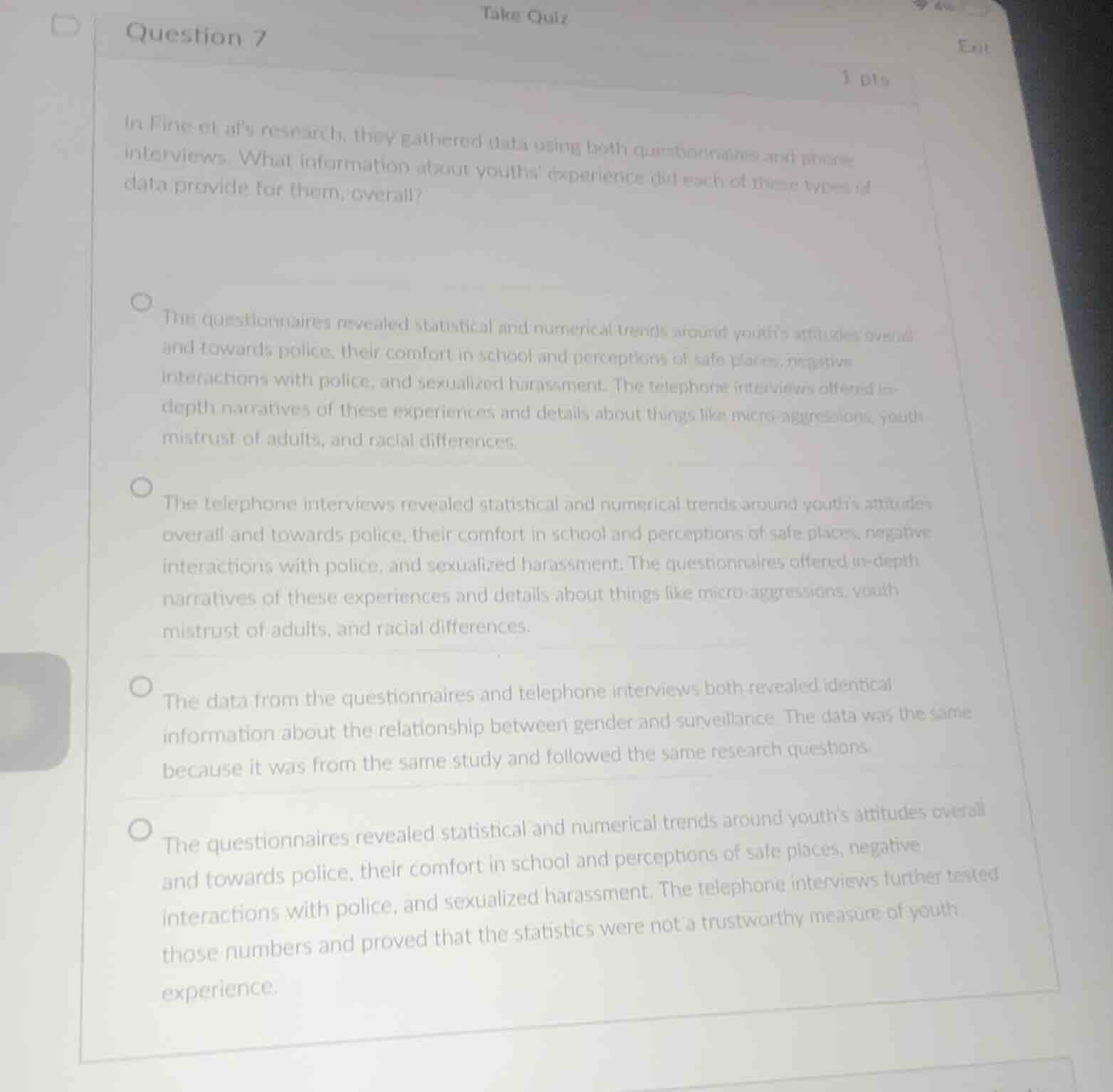
take quizexitquestion 71 ptsin fine et als research, they gathered data using both questionnaires and phone interviews. what information about youths experience did each of these types of data provide for them, overall?the questionnaires revealed statistical and numerical trends around youths attitudes overall and towards police, their comfort in school and perceptions of safe places, negative interactions with police, and sexualized harassment. the telephone interviews offered in-depth narratives of these experiences and details about things like micro-aggressions, youth mistrust of adults, and racial differences.the telephone interviews revealed statistical and numerical trends around youths attitudes overall and towards police, their comfort in school and perceptions of safe places, negative interactions with police, and sexualized harassment. the questionnaires offered in-depth narratives of these experiences and details about things like micro-aggressions, youth mistrust of adults, and racial differences.the data from the questionnaires and telephone interviews both revealed identical information about the relationship between gender and surveillance. the data was the same because it was from the same study and followed the same research questions.the questionnaires revealed statistical and numerical trends around youths attitudes overall and towards police, their comfort in school and perceptions of safe places, negative interactions with police, and sexualized harassment. the telephone interviews further tested those numbers and proved that the statistics were not a trustworthy measure of youth experience.
Questionnaires are quantitative research tools, so they produce statistical/numerical trends about broad youth experiences and attitudes. Telephone interviews are qualitative, so they provide in-depth, detailed narratives of individual experiences, including nuanced details like micro-aggressions. The other options reverse these roles, claim identical data (which is incorrect for mixed-methods research), or frame interviews as disproving statistics (not the purpose of this mixed-methods design).

Snap & solve any problem in the app
Get step-by-step solutions on Sovi AI
Photo-based solutions with guided steps
Explore more problems and detailed explanations
The questionnaires revealed statistical and numerical trends around youth's attitudes overall and towards police, their comfort in school and perceptions of safe places, negative interactions with police, and sexualized harassment. The telephone interviews offered in-depth narratives of these experiences and details about things like micro-aggressions, youth mistrust of adults, and racial differences.