QUESTION IMAGE
Question
a tale of two cities
by charles dickens (adapted excerpt)
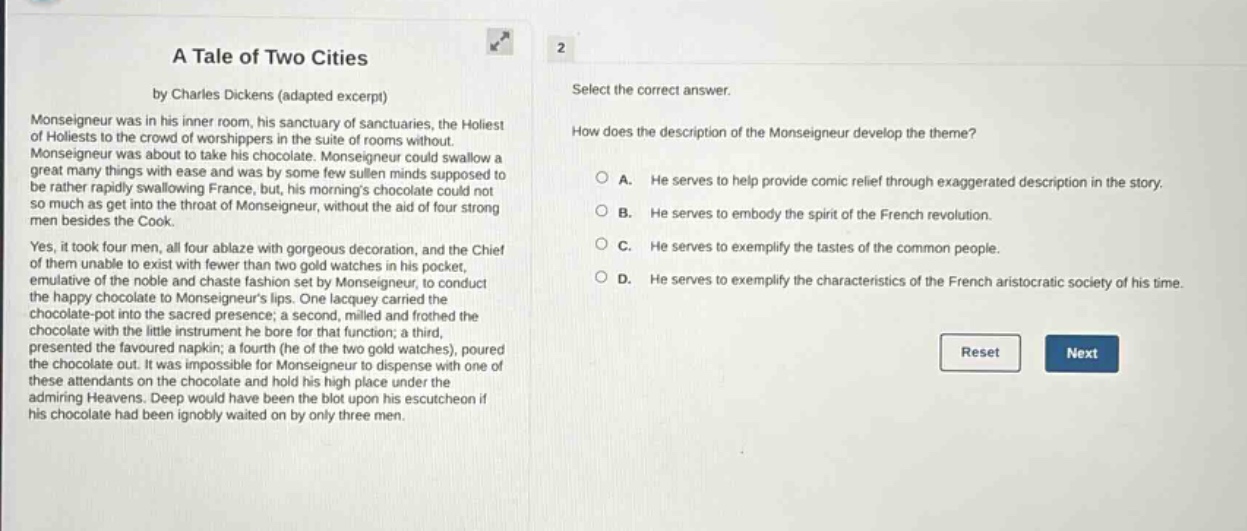
monseigneur was in his inner room, his sanctuary of sanctuaries, the holiest of holiests to the crowd of worshippers in the suite of rooms without. monseigneur was about to take his chocolate. monseigneur could swallow a great many things with ease and was by some few sullen minds supposed to be rather rapidly swallowing france, but, his morning chocolate could not so much as get into the throat of monseigneur, without the aid of four strong men besides the cook.
yes, it took four men, all four ablaze with gorgeous decoration, and the chief of them unable to exist with fewer than two gold watches in his pocket, emulative of the noble and chaste fashion set by monseigneur, to conduct the happy chocolate to monseigneur’s lips. one lacquey carried the chocolate - pot into the sacred presence; a second, milled and frothed the chocolate with the little instrument he bore for that function; a third, presented the favoured napkin; a fourth (he of the two gold watches), poured the chocolate out. it was impossible for monseigneur to dispense with one of these attendants on the chocolate and hold his high place under the admiring heavens. deep would have been the blot upon his escutcheon if his chocolate had been ignobly waited on by only three men.
2
select the correct answer.
how does the description of the monseigneur develop the theme?
a. he serves to help provide comic relief through exaggerated description in the story.
b. he serves to embody the spirit of the french revolution.
c. he serves to exemplify the tastes of the common people.
d. he serves to exemplify the characteristics of the french aristocratic society of his time.
The excerpt describes Monseigneur’s excessive luxury—needing four men to serve his chocolate, attendants with gold watches, and obsession with status. These details reflect the extravagance and elitism of French aristocrats before the Revolution, aligning with option D. Options A (comic relief) is incorrect as the tone is critical; B (revolution spirit) is wrong because he represents the old regime; C (common people’s tastes) is opposite to his aristocratic excess.

Snap & solve any problem in the app
Get step-by-step solutions on Sovi AI
Photo-based solutions with guided steps
Explore more problems and detailed explanations
D. He serves to exemplify the characteristics of the French aristocratic society of his time.