QUESTION IMAGE
Question
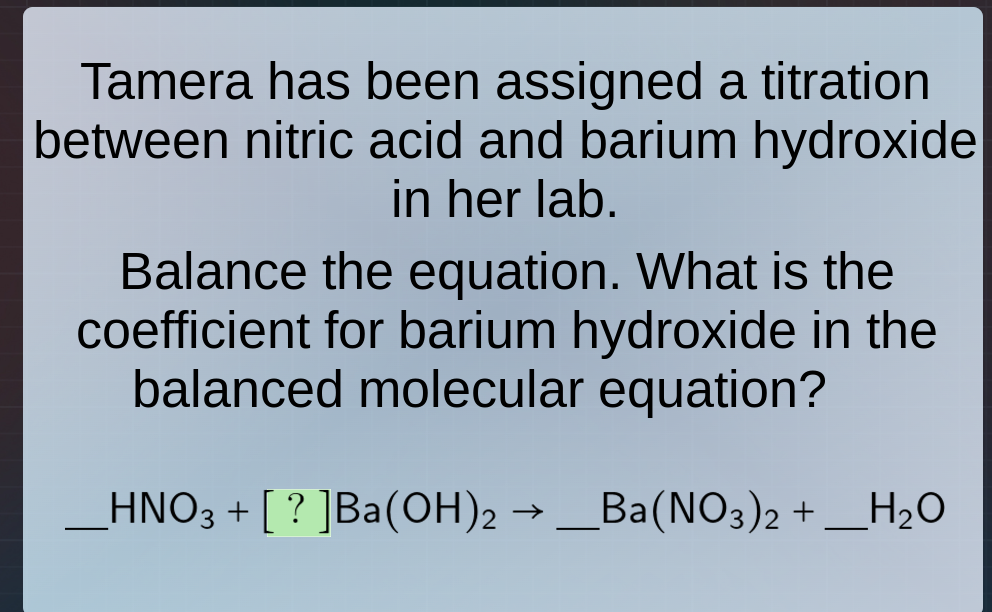
tamera has been assigned a titration between nitric acid and barium hydroxide in her lab. balance the equation. what is the coefficient for barium hydroxide in the balanced molecular equation? hno₃ + ?ba(oh)₂ → ba(no₃)₂ + __h₂o
Step1: Balance Ba atoms
On the left, Ba is in \( \text{Ba(OH)}_2 \), and on the right, it's in \( \text{Ba(NO}_3\text{)}_2 \). So the coefficient of \( \text{Ba(OH)}_2 \) and \( \text{Ba(NO}_3\text{)}_2 \) should be related. Let's start with Ba: there's 1 Ba on left (in \( \text{Ba(OH)}_2 \)) and 1 on right (in \( \text{Ba(NO}_3\text{)}_2 \))? Wait, no, \( \text{Ba(NO}_3\text{)}_2 \) has 1 Ba, \( \text{Ba(OH)}_2 \) has 1 Ba. Now for \( \text{NO}_3^- \): on the right, \( \text{Ba(NO}_3\text{)}_2 \) has 2 \( \text{NO}_3^- \) ions. So on the left, \( \text{HNO}_3 \) provides \( \text{NO}_3^- \), so we need 2 \( \text{HNO}_3 \) to get 2 \( \text{NO}_3^- \). So set coefficient of \( \text{HNO}_3 \) to 2. Now, \( \text{HNO}_3 \): 2 \( \text{HNO}_3 \) gives 2 H. On the right, \( \text{H}_2\text{O} \) has H. The \( \text{OH}^- \) from \( \text{Ba(OH)}_2 \): each \( \text{Ba(OH)}_2 \) has 2 \( \text{OH}^- \). Let's look at O and H. \( \text{H}^+ \) from \( \text{HNO}_3 \) and \( \text{OH}^- \) from \( \text{Ba(OH)}_2 \) form \( \text{H}_2\text{O} \). So 2 \( \text{H}^+ \) (from 2 \( \text{HNO}_3 \)) and 2 \( \text{OH}^- \) (from 1 \( \text{Ba(OH)}_2 \), since each \( \text{Ba(OH)}_2 \) has 2 \( \text{OH}^- \)): 2 \( \text{H}^+ + 2 \text{OH}^- = 2 \text{H}_2\text{O} \). Wait, let's write the equation step by step.
First, write the unbalanced equation: \( \text{HNO}_3 + \text{Ba(OH)}_2
ightarrow \text{Ba(NO}_3\text{)}_2 + \text{H}_2\text{O} \)
Balance \( \text{NO}_3^- \): \( \text{Ba(NO}_3\text{)}_2 \) has 2 \( \text{NO}_3^- \), so \( \text{HNO}_3 \) needs coefficient 2: \( 2\text{HNO}_3 + \text{Ba(OH)}_2
ightarrow \text{Ba(NO}_3\text{)}_2 + \text{H}_2\text{O} \)
Now balance H and O: \( 2\text{HNO}_3 \) has 2 H, \( \text{Ba(OH)}_2 \) has 2 OH (so 2 H from OH? Wait, \( \text{HNO}_3 \) is \( \text{H}^+ + \text{NO}_3^- \), \( \text{Ba(OH)}_2 \) is \( \text{Ba}^{2+} + 2\text{OH}^- \). The reaction is acid-base neutralization: \( \text{H}^+ + \text{OH}^-
ightarrow \text{H}_2\text{O} \), and \( \text{Ba}^{2+} + 2\text{NO}_3^-
ightarrow \text{Ba(NO}_3\text{)}_2 \). So the overall reaction: \( 2\text{HNO}_3 + \text{Ba(OH)}_2
ightarrow \text{Ba(NO}_3\text{)}_2 + 2\text{H}_2\text{O} \). Let's check atoms:
- Ba: 1 (left, \( \text{Ba(OH)}_2 \)) and 1 (right, \( \text{Ba(NO}_3\text{)}_2 \)) – balanced.
- N: 2 (left, 2 \( \text{HNO}_3 \)) and 2 (right, \( \text{Ba(NO}_3\text{)}_2 \)) – balanced.
- O: In \( 2\text{HNO}_3 \): 23=6 O; in \( \text{Ba(OH)}_2 \): 2 O; total left O: 6+2=8. On right: \( \text{Ba(NO}_3\text{)}_2 \): 23=6 O; \( 2\text{H}_2\text{O} \): 2*1=2 O; total right O: 6+2=8 – balanced.
- H: In \( 2\text{HNO}_3 \): 2 H; in \( \text{Ba(OH)}_2 \): 2 H (from 2 OH); total left H: 4. On right: \( 2\text{H}_2\text{O} \): 2*2=4 H – balanced.
So the balanced equation is \( 2\text{HNO}_3 + 1\text{Ba(OH)}_2
ightarrow 1\text{Ba(NO}_3\text{)}_2 + 2\text{H}_2\text{O} \). So the coefficient for \( \text{Ba(OH)}_2 \) is 1. Wait, let's confirm again. Wait, \( \text{Ba(OH)}_2 \) has 2 OH, \( \text{HNO}_3 \) has 1 H. So to neutralize 2 OH, we need 2 H, which comes from 2 HNO3. So 2 HNO3 + 1 Ba(OH)2 → 1 Ba(NO3)2 + 2 H2O. Yes, that's correct. So the coefficient of Ba(OH)2 is 1.

Snap & solve any problem in the app
Get step-by-step solutions on Sovi AI
Photo-based solutions with guided steps
Explore more problems and detailed explanations
1