QUESTION IMAGE
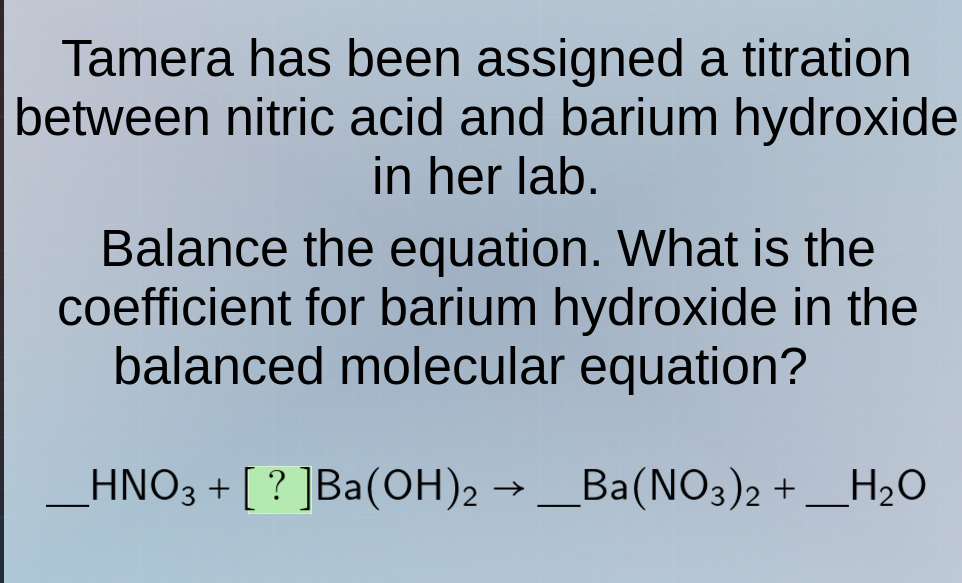
Question
tamera has been assigned a titration between nitric acid and barium hydroxide in her lab. balance the equation. what is the coefficient for barium hydroxide in the balanced molecular equation? \underline{\quad}hno₃ + ?ba(oh)₂ → \underline{\quad}ba(no₃)₂ + \underline{\quad}h₂o
Step1: Balance nitrate ions
On the right, \( \text{Ba(NO}_3\text{)}_2 \) has 2 nitrate (\( \text{NO}_3^- \)) ions. So, \( \text{HNO}_3 \) needs a coefficient of 2 to balance nitrates: \( 2\text{HNO}_3 + \text{Ba(OH)}_2
ightarrow \text{Ba(NO}_3\text{)}_2 + \text{H}_2\text{O} \)
Step2: Balance barium atoms
Barium is already balanced (1 on each side), so \( \text{Ba(OH)}_2 \) coefficient remains 1 for now? Wait, no, check hydrogen and oxygen. Wait, after balancing nitrates, let's check hydrogen. Left: \( 2\text{HNO}_3 \) has 2 H, \( \text{Ba(OH)}_2 \) has 2 H (from \( 2\text{OH}^- \)), total 4 H. Right: \( \text{H}_2\text{O} \) needs coefficient 2 to have 4 H? Wait, no, let's redo.
Wait, correct approach:
- List atoms: H, N, O, Ba.
- Ba: Left: 1 (in \( \text{Ba(OH)}_2 \)), Right: 1 (in \( \text{Ba(NO}_3\text{)}_2 \)) → balanced for Ba if we keep \( \text{Ba(OH)}_2 \) as 1, but \( \text{Ba(NO}_3\text{)}_2 \) has 2 \( \text{NO}_3 \), so \( \text{HNO}_3 \) must be 2 (to get 2 \( \text{NO}_3 \)): \( 2\text{HNO}_3 + \text{Ba(OH)}_2
ightarrow \text{Ba(NO}_3\text{)}_2 + \text{H}_2\text{O} \)
- Now H: Left: \( 2\text{HNO}_3 \) has 2 H, \( \text{Ba(OH)}_2 \) has 2 H (from 2 OH⁻) → total 4 H. Right: \( \text{H}_2\text{O} \) has 2 H per molecule, so need 2 \( \text{H}_2\text{O} \) to get 4 H? Wait, no: \( 2\text{HNO}_3 + \text{Ba(OH)}_2
ightarrow \text{Ba(NO}_3\text{)}_2 + 2\text{H}_2\text{O} \)
Check O: Left: \( 2\text{HNO}_3 \) has \( 2\times3 = 6 \) O, \( \text{Ba(OH)}_2 \) has \( 2\times1 = 2 \) O (from 2 OH⁻) → total 8 O. Right: \( \text{Ba(NO}_3\text{)}_2 \) has \( 2\times3 = 6 \) O, \( 2\text{H}_2\text{O} \) has \( 2\times1 = 2 \) O → total 8 O. Balanced!
Wait, so coefficients: \( 2\text{HNO}_3 + 1\text{Ba(OH)}_2
ightarrow 1\text{Ba(NO}_3\text{)}_2 + 2\text{H}_2\text{O} \)
Wait, but let's verify again:
- Ba: 1 on left (Ba(OH)₂), 1 on right (Ba(NO₃)₂) → good.
- NO₃⁻: 2 on left (2 HNO₃), 2 on right (Ba(NO₃)₂) → good.
- H: 2 (from HNO₃) + 2 (from Ba(OH)₂) = 4; on right, 2 H₂O has 4 H → good.
- O: 2×3 (HNO₃) + 2×1 (Ba(OH)₂) = 6 + 2 = 8; on right, 2×3 (Ba(NO₃)₂) + 2×1 (H₂O) = 6 + 2 = 8 → good.
So the coefficient for \( \text{Ba(OH)}_2 \) is 1? Wait, no, wait the equation: \( 2\text{HNO}_3 + 1\text{Ba(OH)}_2
ightarrow 1\text{Ba(NO}_3\text{)}_2 + 2\text{H}_2\text{O} \)
Wait, but let's check the original equation. The user's equation is \( \_\_\text{HNO}_3 + [?]\text{Ba(OH)}_2
ightarrow \_\_\text{Ba(NO}_3\text{)}_2 + \_\_\text{H}_2\text{O} \)
After balancing, we have 2 HNO₃, 1 Ba(OH)₂, 1 Ba(NO₃)₂, 2 H₂O. So the coefficient for Ba(OH)₂ is 1? Wait, no, wait maybe I made a mistake. Wait, let's do it step by step with each atom:
- Barium (Ba): Only in Ba(OH)₂ (left) and Ba(NO₃)₂ (right). So coefficient of Ba(OH)₂ should be equal to coefficient of Ba(NO₃)₂ (since each has 1 Ba). Let's let coefficient of Ba(OH)₂ be x, then Ba(NO₃)₂ is also x.
- Nitrate (NO₃⁻): In Ba(NO₃)₂, there are 2 NO₃⁻ per formula unit, so total NO₃⁻ on right is 2x. On left, HNO₃ has 1 NO₃⁻ per formula unit, so coefficient of HNO₃ is 2x (to get 2x NO₃⁻).
- Hydrogen (H): In HNO₃, coefficient 2x → 2x H. In Ba(OH)₂, coefficient x → 2x H (from 2 OH⁻ per Ba(OH)₂). Total H on left: 2x + 2x = 4x. On right, H₂O has 2 H per formula unit, so coefficient of H₂O is 2x (to get 4x H: 2x * 2 = 4x).
- Oxygen (O): In HNO₃, 2x formula units → 32x = 6x O. In Ba(OH)₂, x formula units → 2x O (from 2 OH⁻). Total O left: 6x + 2x = 8x. On right: Ba(NO₃)₂ has 6x O (32x), H₂O has 2x O (1*2x). Total O right: 6x + 2x = 8x. Balanced for any x. Let's take x=1 (simplest):
- HNO₃: 2*…

Snap & solve any problem in the app
Get step-by-step solutions on Sovi AI
Photo-based solutions with guided steps
Explore more problems and detailed explanations
1