QUESTION IMAGE
Question
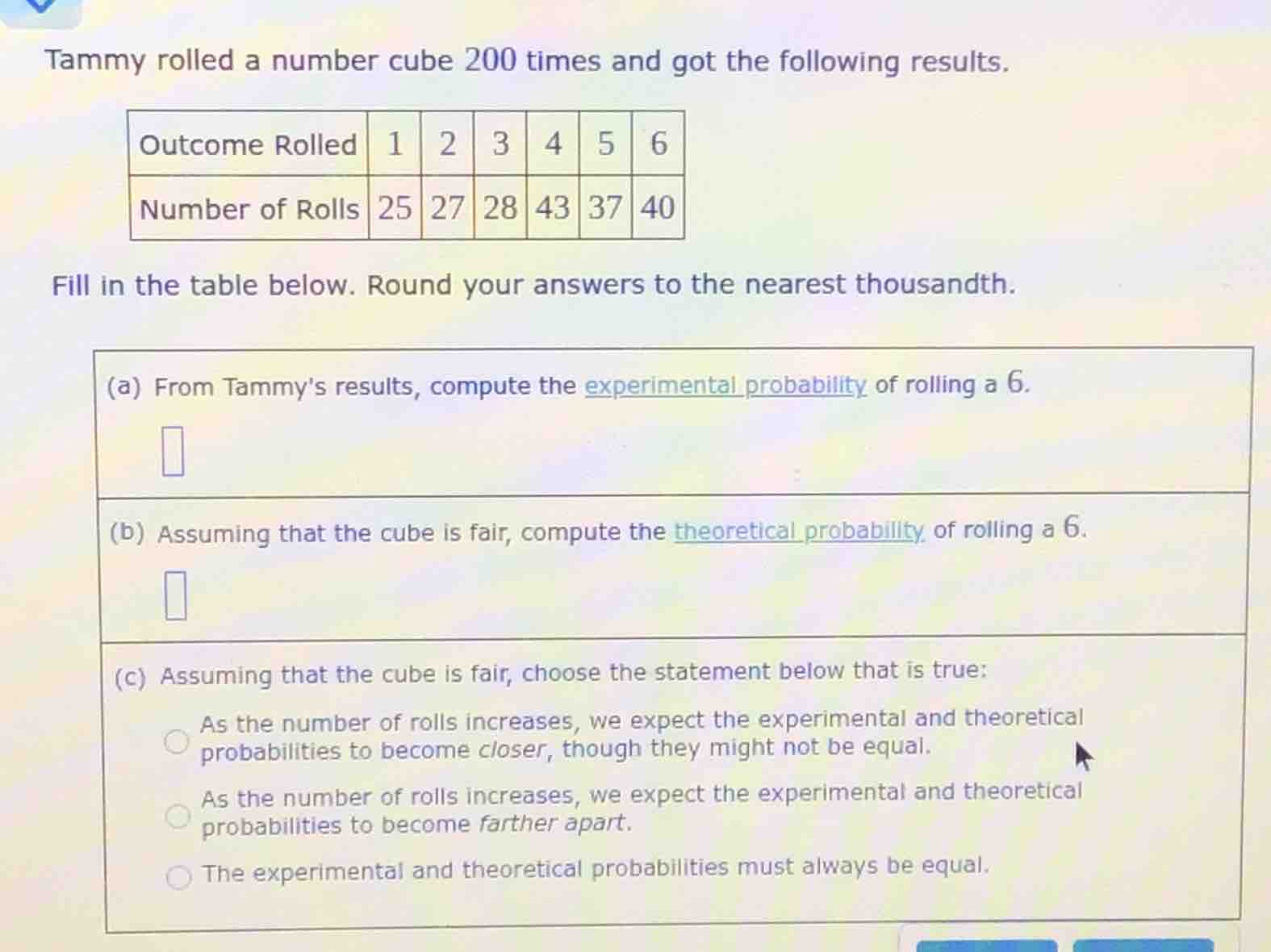
tammy rolled a number cube 200 times and got the following results.
| outcome rolled | 1 | 2 | 3 | 4 | 5 | 6 |
|---|
fill in the table below. round your answers to the nearest thousandth.
(a) from tammys results, compute the experimental probability of rolling a 6.
(b) assuming that the cube is fair, compute the theoretical probability of rolling a 6.
(c) assuming that the cube is fair, choose the statement below that is true:
- as the number of rolls increases, we expect the experimental and theoretical probabilities to become closer, though they might not be equal.
- as the number of rolls increases, we expect the experimental and theoretical probabilities to become farther apart.
- the experimental and theoretical probabilities must always be equal.
Step1: Calculate experimental probability
Experimental probability is the number of times 6 was rolled divided by total rolls.
$\text{Experimental Probability} = \frac{40}{200} = 0.200$
Step2: Calculate theoretical probability
For a fair cube, there is 1 favorable outcome (6) out of 6 total outcomes.
$\text{Theoretical Probability} = \frac{1}{6} \approx 0.167$
Step3: Identify true probability statement
By the law of large numbers, more trials make experimental probability approach theoretical probability.

Snap & solve any problem in the app
Get step-by-step solutions on Sovi AI
Photo-based solutions with guided steps
Explore more problems and detailed explanations
(a) $0.200$
(b) $0.167$
(c) As the number of rolls increases, we expect the experimental and theoretical probabilities to become closer, though they might not be equal.