QUESTION IMAGE
Question
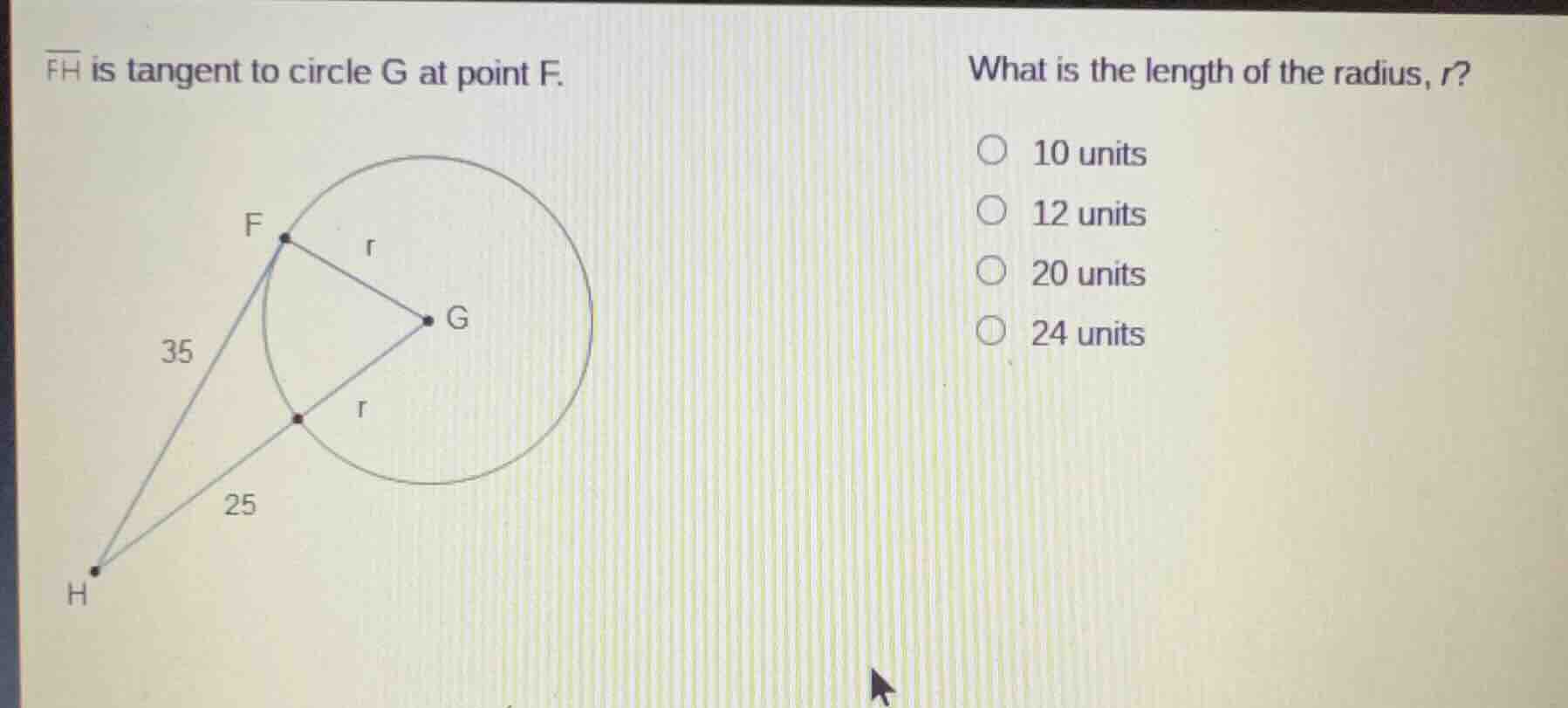
$\overline{fh}$ is tangent to circle g at point f. what is the length of the radius, $r$? \bigcirc 10 units \bigcirc 12 units \bigcirc 20 units \bigcirc 24 units (with a diagram showing circle g, point f on the circle, point h outside, fh = 35, the segment from h to the other intersection point with the circle is 25, and radius r from g to f and g to the other point)
Step1: Recall tangent - radius property
A tangent to a circle is perpendicular to the radius at the point of tangency. So, $\angle GFH = 90^{\circ}$, which means triangle $GFH$ is a right - triangle with hypotenuse $GH$ and legs $GF = r$ and $FH = 35$.
First, we need to find the length of $GH$. We know that the length of the segment from the external point $H$ to the center $G$ is the sum of the length of the tangent - external segment and the radius? Wait, no. Wait, the length of $GH$ is the length of the segment from $H$ to $G$. The length of the segment from $H$ to the point of intersection with the circle (let's call that point $P$) is 25, and the radius is $r$, so $GH=25 + r$.
Step2: Apply Pythagorean theorem
In right - triangle $GFH$, by the Pythagorean theorem, $GF^{2}+FH^{2}=GH^{2}$. Substituting $GF = r$, $FH = 35$ and $GH=25 + r$ into the Pythagorean theorem, we get:
$r^{2}+35^{2}=(r + 25)^{2}$
Expand the right - hand side: $(r + 25)^{2}=r^{2}+50r+625$
So the equation becomes:
$r^{2}+1225=r^{2}+50r + 625$
Subtract $r^{2}$ from both sides of the equation:
$1225=50r+625$
Subtract 625 from both sides:
$1225 - 625=50r$
$600 = 50r$
Step3: Solve for $r$
Divide both sides by 50:
$r=\frac{600}{50}=12$

Snap & solve any problem in the app
Get step-by-step solutions on Sovi AI
Photo-based solutions with guided steps
Explore more problems and detailed explanations
12 units