QUESTION IMAGE
Question
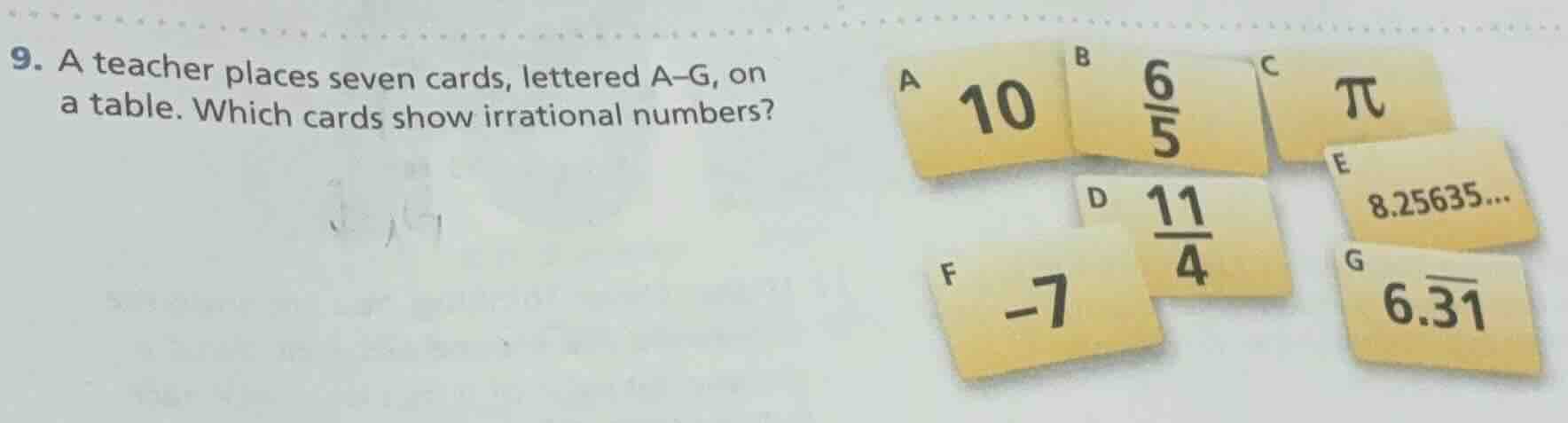
- a teacher places seven cards, lettered a–g, on a table. which cards show irrational numbers?
Step1: Recall irrational number definition
Irrational numbers are non - repeating, non - terminating decimals and cannot be expressed as a fraction \(\frac{p}{q}\) (\(p,q\) integers, \(q
eq0\)). Rational numbers include integers, fractions, terminating decimals, and repeating decimals.
Step2: Analyze each card
- Card A: \(10\) is an integer, so it is rational.
- Card B: \(\frac{6}{5}=1.2\), a terminating decimal (rational).
- Card C: \(\pi = 3.1415926\cdots\) is a non - repeating, non - terminating decimal, so it is irrational.
- Card D: \(\frac{11}{4}=2.75\), a terminating decimal (rational).
- Card E: \(8.25635\cdots\) is a non - repeating, non - terminating decimal, so it is irrational.
- Card F: \(- 7\) is an integer, so it is rational.
- Card G: \(6.\overline{31}\) is a repeating decimal (rational).

Snap & solve any problem in the app
Get step-by-step solutions on Sovi AI
Photo-based solutions with guided steps
Explore more problems and detailed explanations
C. \(\boldsymbol{\pi}\), E. \(\boldsymbol{8.25635\cdots}\)