QUESTION IMAGE
Question
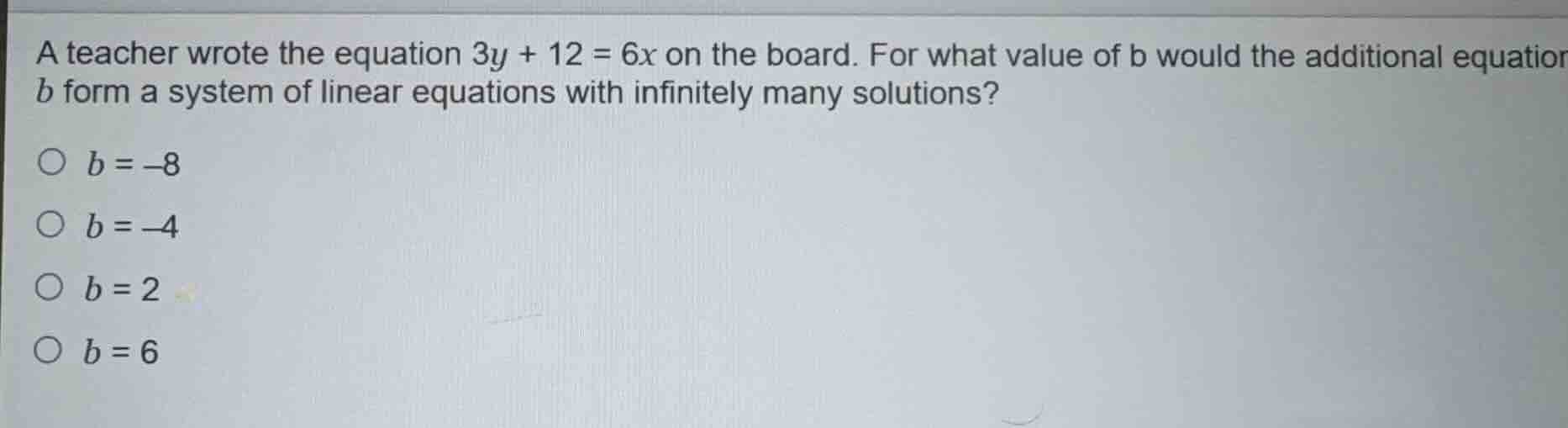
a teacher wrote the equation 3y + 12 = 6x on the board. for what value of b would the additional equatior b form a system of linear equations with infinitely many solutions?
○ b = -8
○ b = -4
○ b = 2
○ b = 6
Step1: Recall the condition for infinitely many solutions
A system of linear equations \(a_1x + b_1y = c_1\) and \(a_2x + b_2y = c_2\) has infinitely many solutions when \(\frac{a_1}{a_2}=\frac{b_1}{b_2}=\frac{c_1}{c_2}\). First, we need to rewrite the given equation \(3y + 12 = 6x\) in standard form \(Ax+By = C\). Rearranging, we get \(6x-3y=12\). Let's assume the additional equation is of the form \(2x - y=b\) (since we can see a pattern of dividing by 3, but we will check). Multiply the equation \(2x - y=b\) by 3, we get \(6x-3y = 3b\). For the system to have infinitely many solutions, the right - hand sides must be equal, so \(3b = 12\), then \(b = 4\)? Wait, maybe I made a wrong assumption. Wait, let's check the options. Wait, maybe the additional equation is \(2x - y=b\) (since if we divide \(6x - 3y=12\) by 3, we get \(2x - y = 4\)? No, wait \(6x-3y = 12\) divided by 3 is \(2x - y=4\), but the options don't have 4. Wait, maybe the additional equation is \(- 2x + y=b\). Let's rewrite \(6x-3y = 12\) as \(-6x + 3y=-12\), divide by 3: \(-2x + y=-4\). So if the additional equation is \(-2x + y=b\), then for infinitely many solutions, \(b=-4\).
Step2: Verify the condition
The two equations are \(6x-3y = 12\) and \(-2x + y=b\). Multiply the second equation by 3: \(-6x+3y = 3b\). For the system to have infinitely many solutions, the two equations must be equivalent. So \(6x-3y=12\) and \(-6x + 3y=3b\) must represent the same line. The first equation can be written as \(6x-3y-12 = 0\), the second as \(-6x + 3y-3b=0\) or \(6x-3y + 3b=0\). For them to be the same line, the constants must satisfy \(12=-3b\) (since the coefficients of \(x\) and \(y\) are proportional: \(\frac{6}{6}=\frac{-3}{-3}=\frac{-12}{3b}\)). So \(\frac{-12}{3b}=1\), then \(3b=-12\), so \(b=-4\). Wait, but in the options, we have \(b = - 4\) as an option (the second option: \(b=-4\)).
Wait, let's check again. The given equation: \(3y+12 = 6x\) can be rewritten as \(6x-3y=12\). Let the other equation be \(2x - y=b\) multiplied by - 3: \(-6x + 3y=-3b\). The first equation is \(6x-3y = 12\) or \(-6x + 3y=-12\). So for \(-6x + 3y=-3b\) and \(-6x + 3y=-12\) to be the same, we need \(-3b=-12\), so \(b = 4\)? No, I am confused. Wait, maybe the additional equation is \(2x - y=b\). The first equation \(6x-3y = 12\) can be simplified by dividing by 3: \(2x - y = 4\). So if the additional equation is \(2x - y=b\), then for infinitely many solutions, \(b = 4\), but that's not an option. Wait, maybe the additional equation is \(-2x + y=b\). The first equation \(6x-3y = 12\) can be rewritten as \(-2x + y=-4\) (divide \(6x-3y = 12\) by - 3: \(-2x + y=-4\)). So if the additional equation is \(-2x + y=b\), then \(b=-4\) for infinitely many solutions.

Snap & solve any problem in the app
Get step-by-step solutions on Sovi AI
Photo-based solutions with guided steps
Explore more problems and detailed explanations
\(b=-4\) (the option \(b = - 4\))