QUESTION IMAGE
Question
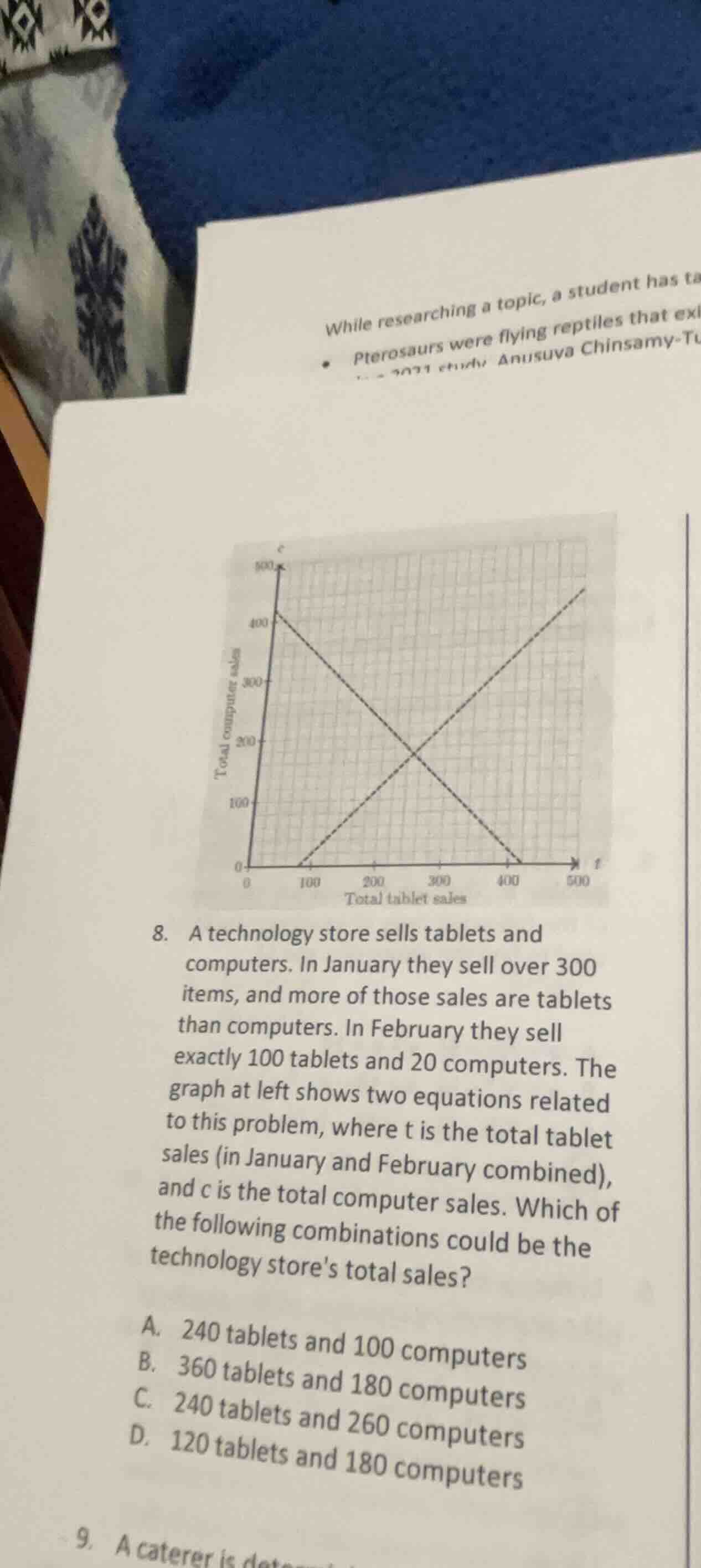
- a technology store sells tablets and computers. in january they sell over 300 items, and more of those sales are tablets than computers. in february they sell exactly 100 tablets and 20 computers. the graph at left shows two equations related to this problem, where t is the total tablet sales (in january and february combined), and c is the total computer sales. which of the following combinations could be the technology stores total sales?
a. 240 tablets and 100 computers
b. 360 tablets and 180 computers
c. 240 tablets and 260 computers
d. 120 tablets and 180 computers
Step1: Define combined variables
Let $t$ = total tablet sales (Jan + Feb), $c$ = total computer sales (Jan + Feb).
Step2: Extract Feb sales constraints
February sales: 100 tablets, 20 computers. So January tablet sales = $t - 100$, January computer sales = $c - 20$.
Step3: Apply January sales rules
- January total items > 300: $(t - 100) + (c - 20) > 300$ → $t + c > 420$
- January tablets > computers: $t - 100 > c - 20$ → $t - c > 80$
Step4: Test each option
- Option A: $t=240, c=100$
$t+c=340
gtr 420$ → Fails first rule.
- Option B: $t=360, c=180$
$t+c=540 > 420$; $t-c=360-180=180 > 80$ → Passes both rules.
- Option C: $t=240, c=260$
$t-c=240-260=-20
gtr 80$ → Fails second rule.
- Option D: $t=120, c=180$
$t+c=300
gtr 420$; $t-c=120-180=-60
gtr 80$ → Fails both rules.

Snap & solve any problem in the app
Get step-by-step solutions on Sovi AI
Photo-based solutions with guided steps
Explore more problems and detailed explanations
B. 360 tablets and 180 computers