QUESTION IMAGE
Question
tectonic plates and crustal features #2
answer the following questions about tectonic plates and crustal features.
- many processes on earth occur at or near tectonic plate boundaries. which geological events are most common along tectonic plate boundaries?
a erosion and deposition
b hurricanes and tornadoes
c earthquakes and volcanoes
d tidal waves and sedimentation
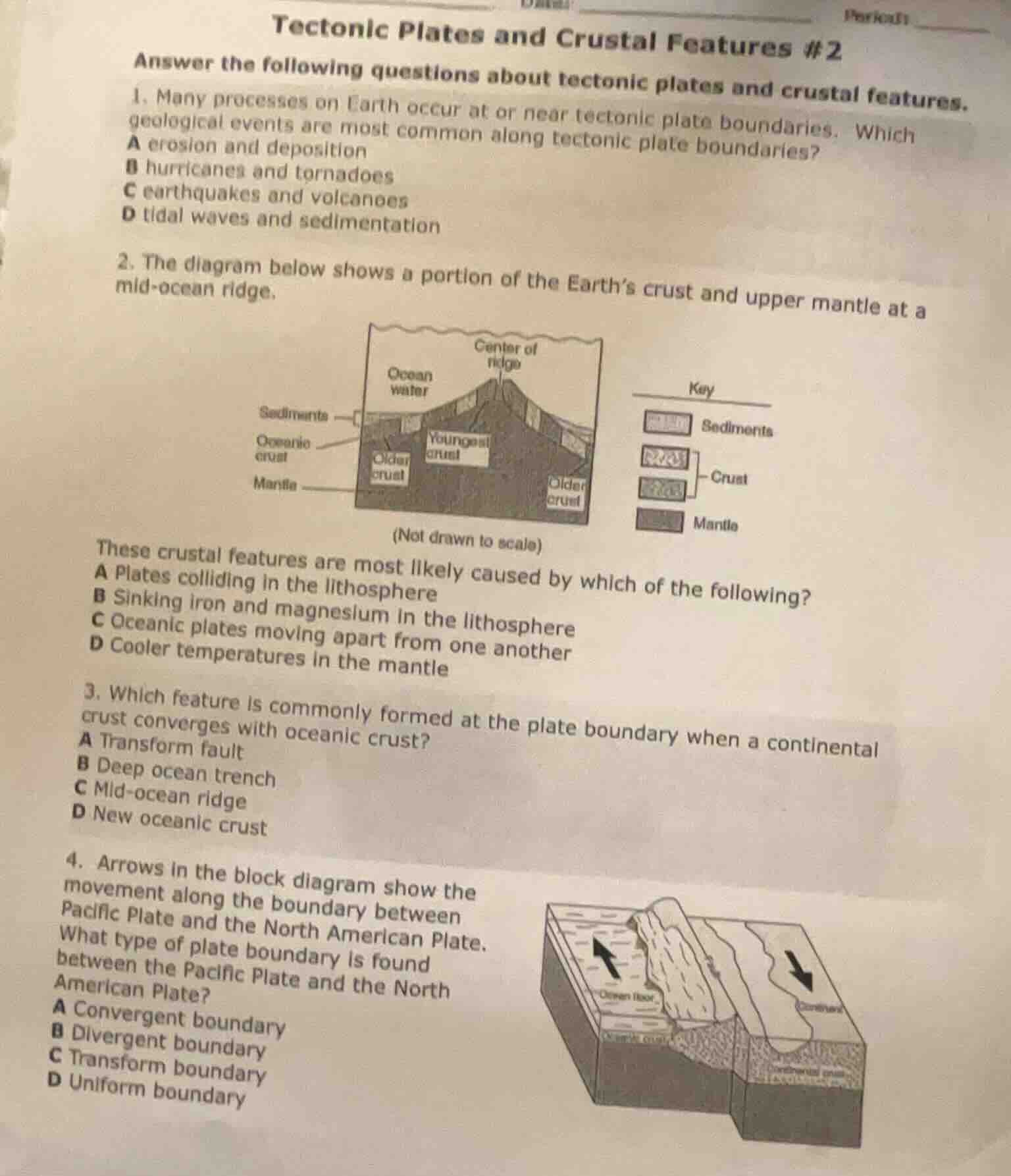
- the diagram below shows a portion of the earth’s crust and upper mantle at a mid - ocean ridge.
(image of a mid - ocean ridge diagram with labels: sediments, oceanic crust, mantle, center of ridge, youngest crust, older crust; key: sediments, crust, mantle)
(not drawn to scale)
these crustal features are most likely caused by which of the following?
a plates colliding in the lithosphere
b sinking iron and magnesium in the lithosphere
c oceanic plates moving apart from one another
d cooler temperatures in the mantle
- which feature is commonly formed at the plate boundary when a continental crust converges with oceanic crust?
a transform fault
b deep ocean trench
c mid - ocean ridge
d new oceanic crust
- arrows in the block diagram show the movement along the boundary between pacific plate and the north american plate. what type of plate boundary is found between the pacific plate and the north american plate?
a convergent boundary
b divergent boundary
c transform boundary
d uniform boundary
(image of a block diagram showing plate movement between pacific plate and north american plate)
- Tectonic plate boundaries experience intense geologic activity; earthquakes and volcanoes are directly linked to the movement and interaction of these plates.
- Mid-ocean ridges form at divergent boundaries where oceanic plates move apart, allowing new crust to form at the ridge center (youngest crust there, older crust further away).
- When continental crust (less dense) converges with oceanic crust (denser), the oceanic crust subducts, creating a deep ocean trench at the boundary.
- The diagram shows plates sliding past each other horizontally, which defines a transform boundary (exemplified by the Pacific-North American Plate boundary at the San Andreas Fault).

Snap & solve any problem in the app
Get step-by-step solutions on Sovi AI
Photo-based solutions with guided steps
Explore more problems and detailed explanations
- C earthquakes and volcanoes
- C Oceanic plates moving apart from one another
- B Deep ocean trench
- C Transform boundary