QUESTION IMAGE
Question
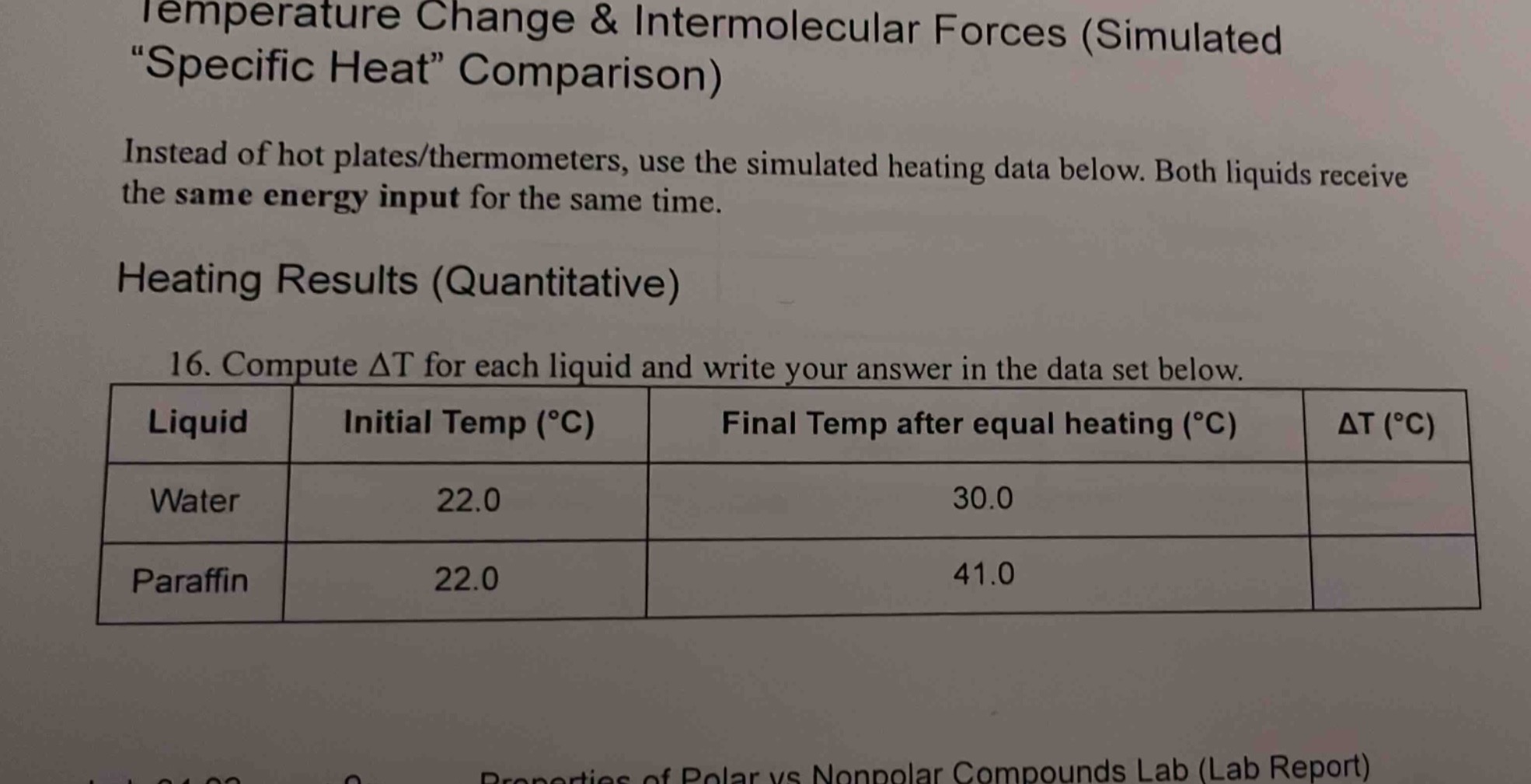
temperature change & intermolecular forces (simulated \specific heat\ comparison)
instead of hot plates/thermometers, use the simulated heating data below. both liquids receive the same energy input for the same time.
heating results (quantitative)
- compute $\delta t$ for each liquid and write your answer in the data set below.
| liquid | initial temp (°c) | final temp after equal heating (°c) | $\delta t$ (°c) |
|---|---|---|---|
| paraffin | 22.0 | 41.0 |
properties of polar vs nonpolar compounds lab (lab report)
Step1: Calculate ΔT for Water
The formula for temperature change is \( \Delta T = \text{Final Temp} - \text{Initial Temp} \). For water, initial temp is \( 22.0^\circ\text{C} \) and final temp is \( 30.0^\circ\text{C} \). So, \( \Delta T = 30.0 - 22.0 = 8.0 \).
Step2: Calculate ΔT for Paraffin
Using the same formula, for paraffin, initial temp is \( 22.0^\circ\text{C} \) and final temp is \( 41.0^\circ\text{C} \). So, \( \Delta T = 41.0 - 22.0 = 19.0 \).

Snap & solve any problem in the app
Get step-by-step solutions on Sovi AI
Photo-based solutions with guided steps
Explore more problems and detailed explanations
For Water, \( \Delta T = 8.0^\circ\text{C} \); For Paraffin, \( \Delta T = 19.0^\circ\text{C} \)
Filling the table:
| Liquid | Initial Temp (\(^\circ\text{C}\)) | Final Temp after equal heating (\(^\circ\text{C}\)) | \( \Delta T \) (\(^\circ\text{C}\)) |
|---|---|---|---|
| Paraffin | 22.0 | 41.0 | 19.0 |