QUESTION IMAGE
Question
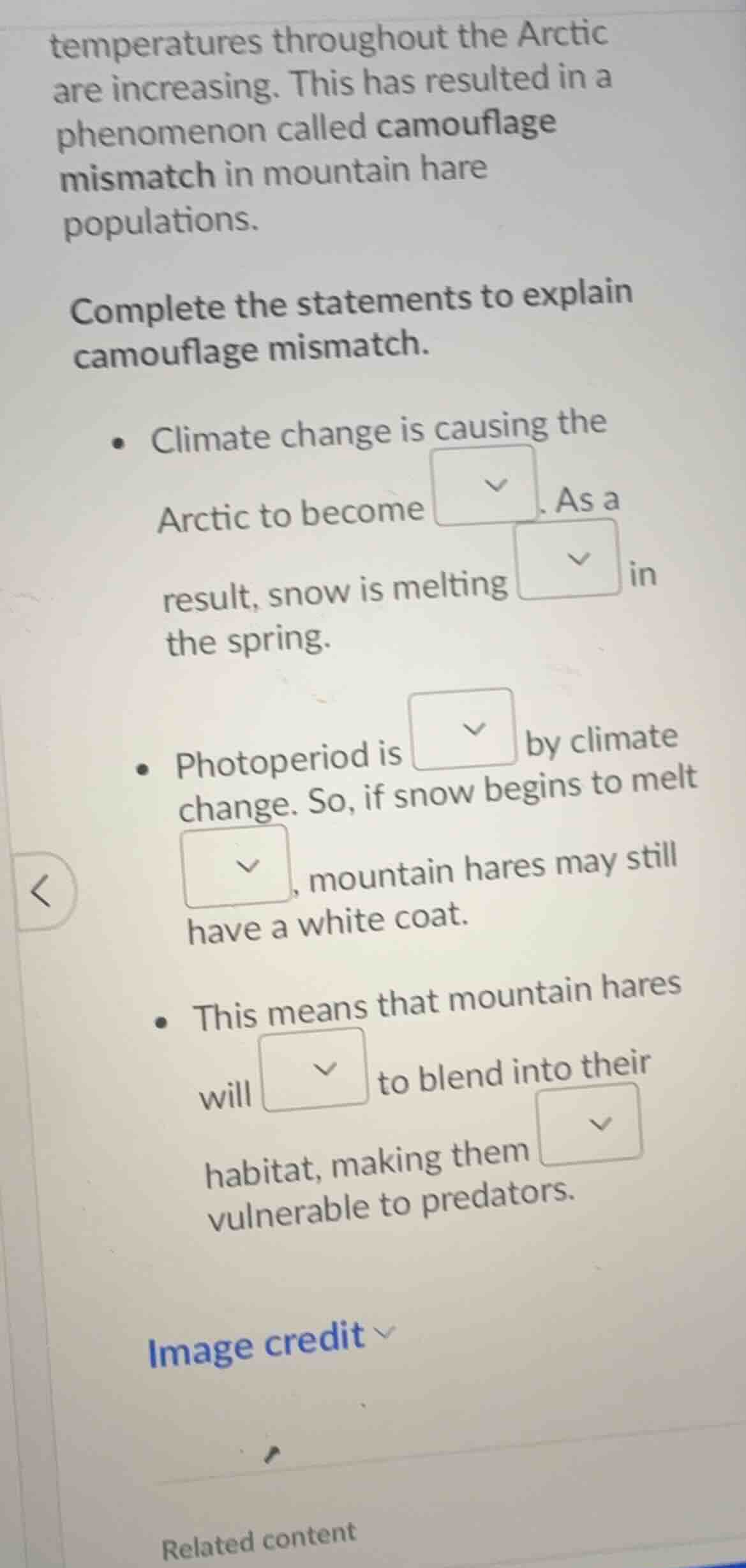
temperatures throughout the arctic are increasing. this has resulted in a phenomenon called camouflage mismatch in mountain hare populations. complete the statements to explain camouflage mismatch. - climate change is causing the arctic to become dropdown. as a result, snow is melting dropdown in the spring. - photoperiod is dropdown by climate change. so, if snow begins to melt dropdown, mountain hares may still have a white coat. - this means that mountain hares will dropdown to blend into their habitat, making them dropdown vulnerable to predators. image credit related content
- Climate change causes the Arctic to warm (become warmer). Warmer temperatures lead to earlier snow melting in spring.
- Photoperiod (day length) is unaffected by climate change. So if snow melts earlier, hares with white coats (adapted to snow) will mismatch with the now snow - free (or less snowy) environment.
- If hares can't blend in (fail to camouflage), they are more visible to predators.
For the first blank: "warmer" (Climate change increases Arctic temperatures, so it becomes warmer).
For the second blank: "earlier" (Warmer temperatures make snow melt sooner in spring).
For the third blank: "unaffected" (Photoperiod depends on Earth's rotation and orbit, not climate change).
For the fourth blank: "earlier" (If snow melts earlier, and photoperiod doesn't change, hares' coat change timing (triggered by photoperiod) doesn't match snow melt, so they still have white coats when snow is gone).
For the fifth blank: "fail" (They can't blend in as their white coat doesn't match the non - snowy environment).
For the sixth blank: "more visible" (Not blending in makes them easier for predators to see).

Snap & solve any problem in the app
Get step-by-step solutions on Sovi AI
Photo-based solutions with guided steps
Explore more problems and detailed explanations
- Climate change is causing the Arctic to become $\boldsymbol{\text{warmer}}$. As a result, snow is melting $\boldsymbol{\text{earlier}}$ in the spring.
- Photoperiod is $\boldsymbol{\text{unaffected}}$ by climate change. So, if snow begins to melt $\boldsymbol{\text{earlier}}$, mountain hares may still have a white coat.
- This means that mountain hares will $\boldsymbol{\text{fail}}$ to blend into their habitat, making them $\boldsymbol{\text{more visible}}$ to predators.