QUESTION IMAGE
Question
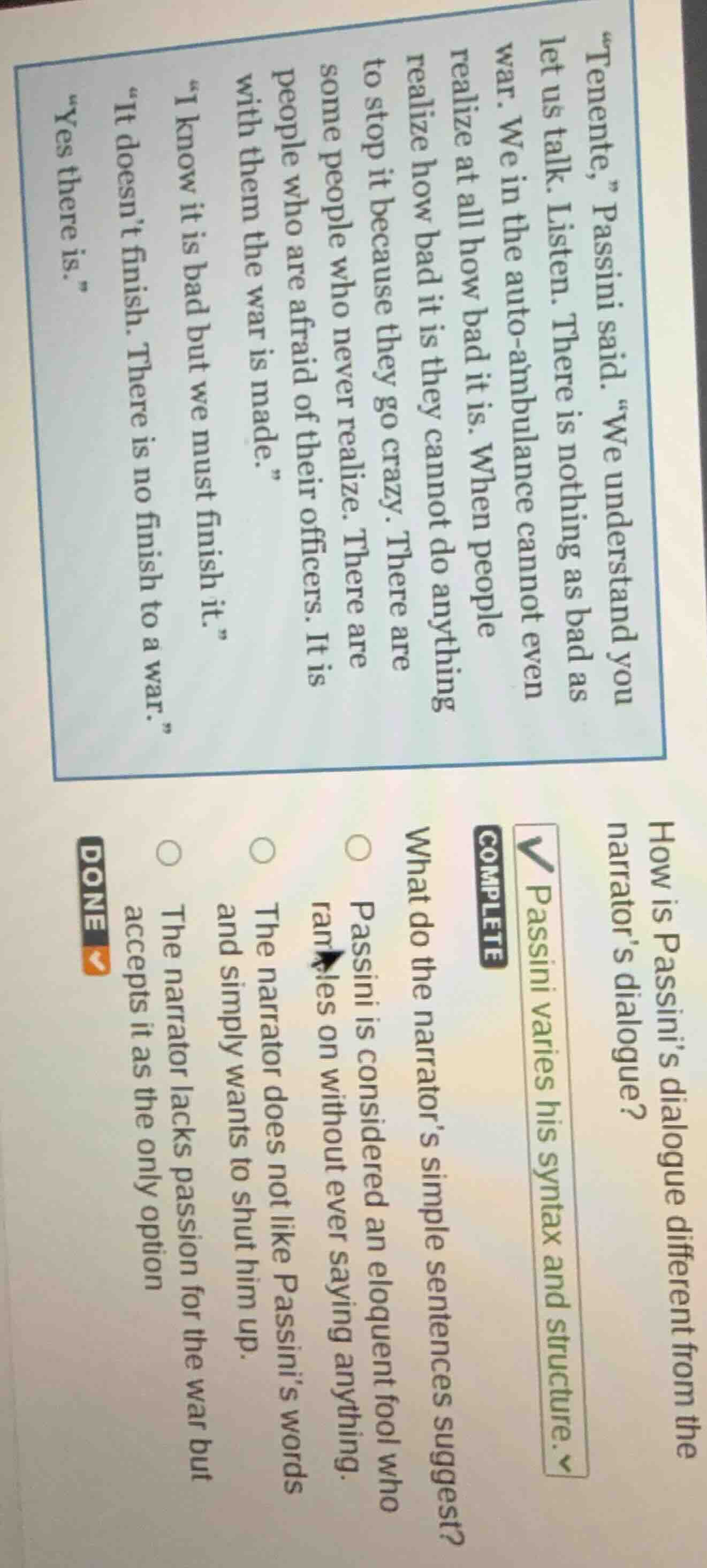
“tenente,” passini said. “we understand you let us talk. listen. there is nothing as bad as war. we in the auto - ambulance cannot even realize at all how bad it is. when people realize how bad it is they cannot do anything to stop it because they go crazy. there are some people who never realize. there are people who are afraid of their officers. it is with them the war is made.”
“i know it is bad but we must finish it.”
“it doesn’t finish. there is no finish to a war.”
“yes there is.”
how is passini’s dialogue different from the narrator’s dialogue?
what do the narrator’s simple sentences suggest?
○ passini is considered an eloquent fool who rambles on without ever saying anything.
○ the narrator does not like passini’s words and simply wants to shut him up.
○ the narrator lacks passion for the war but accepts it as the only option
- Passini's dialogue uses longer, flowing statements with varied structure to express his passionate anti-war views, while the narrator's lines are short, simple, and repetitive (e.g., "Yes there is."), showing the contrast in their speech styles.
- The narrator's short, resigned responses ("I know it is bad but we must finish it." "Yes there is.") show he recognizes the war's harm but has accepted continuing it as unavoidable, with no fiery opposition like Passini's.

Snap & solve any problem in the app
Get step-by-step solutions on Sovi AI
Photo-based solutions with guided steps
Explore more problems and detailed explanations
- Passini varies his syntax and structure.
- The narrator lacks passion for the war but accepts it as the only option