QUESTION IMAGE
Question
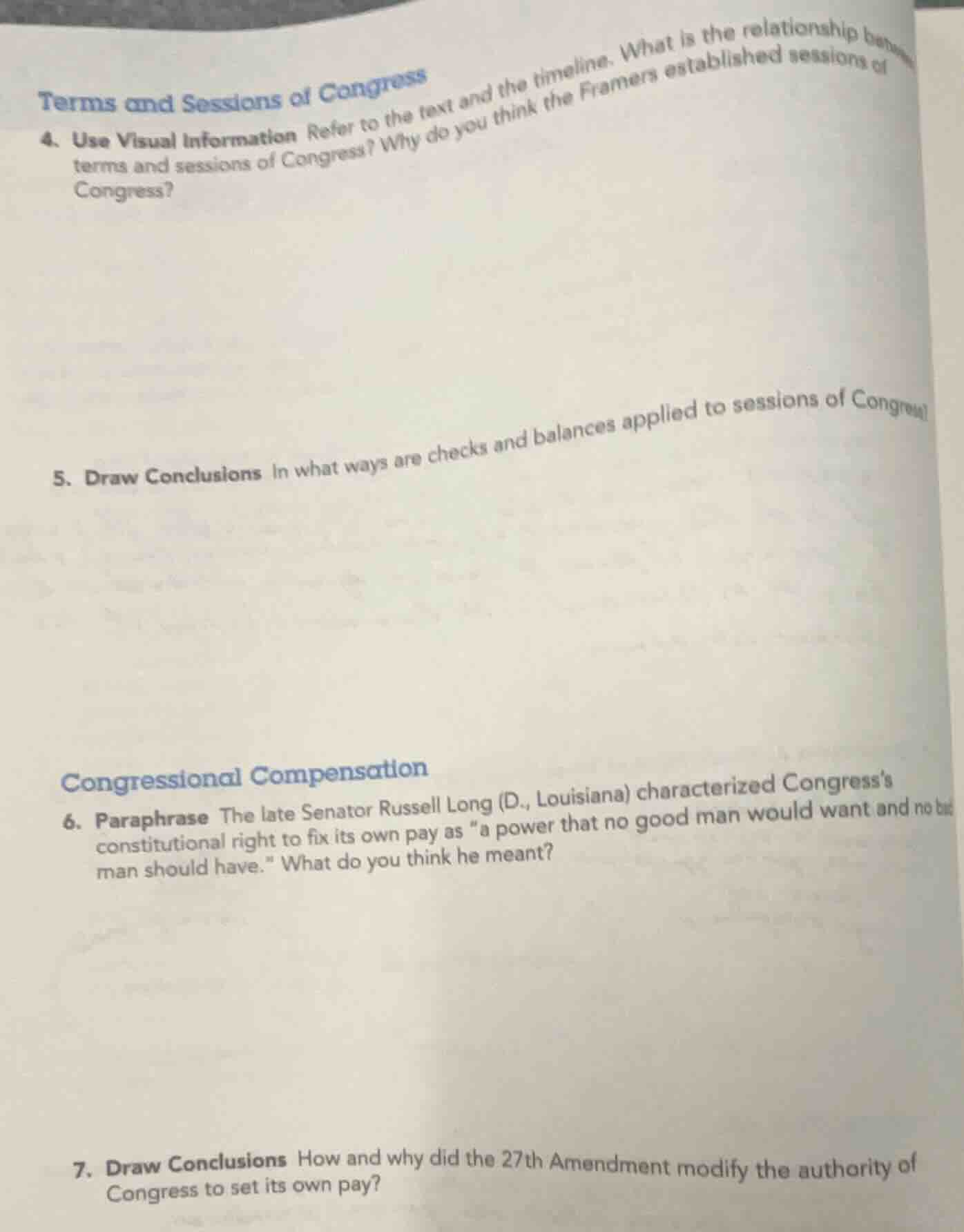
terms and sessions of congress
- use visual information refer to the text and the timeline. what is the relationship betweenterms and sessions of congress? why do you think the framers established sessions ofcongress?
- draw conclusions in what ways are checks and balances applied to sessions of congress?
congressional compensation
- paraphrase the late senator russell long (d., louisiana) characterized congresssconstitutional right to fix its own pay as \a power that no good man would want and no badman should have.\ what do you think he meant?
- draw conclusions how and why did the 27th amendment modify the authority ofcongress to set its own pay?
For Question 4:
A term of Congress is a 2-year cycle for the entire legislative body; each term is split into 1 annual sessions (1 per year of the term). The Framers established sessions to create a regular, structured period for Congress to conduct legislative business, ensuring consistent governance, allowing time for debate, lawmaking, and oversight of the executive branch, while aligning with the electoral cycle for accountability.
For Question 5:
Checks and balances apply to congressional sessions in several ways:
- The President can veto bills passed during a session, forcing Congress to override the veto with a 2/3 vote in both chambers.
- The Supreme Court can rule laws passed in congressional sessions unconstitutional.
- Congress checks itself: one chamber can block legislation from the other, and both must agree on bills before they reach the President.
- The President can call special sessions of Congress to address urgent issues, limiting Congress's control over its own schedule.
For Question 6:
Senator Long meant that the power for Congress to set its own pay creates a clear conflict of interest. A person acting with integrity (a "good man") would not want the ability to give themselves raises without external oversight, as it prioritizes personal gain over public trust. A "bad man" would exploit this power to enrich themselves at the public's expense, so the authority should not exist to prevent this abuse.
For Question 7:
How: The 27th Amendment prohibits Congress from giving itself a pay raise that takes effect during the current session or term. Any pay increase passed by Congress only applies to the next elected session of Congress.
Why: It was ratified to eliminate the conflict of interest of lawmakers voting to increase their own salaries immediately, ensuring that elected officials must face voter accountability before any pay raise takes effect, as voters can reject them in the next election if they disagree with the proposed pay change.

Snap & solve any problem in the app
Get step-by-step solutions on Sovi AI
Photo-based solutions with guided steps
Explore more problems and detailed explanations
Question 4:
- Relationship: A 2-year congressional term contains 2 annual sessions (one per year).
- Rationale: Framers established sessions to create a structured, regular period for lawmaking, oversight, and accountability to voters, ensuring consistent governance aligned with the electoral cycle.
Question 5:
- Presidential veto of session-passed bills (override requires 2/3 congressional vote).
- Judicial review of laws enacted in sessions.
- Internal congressional checks: one chamber blocks the other's legislation.
- President can call special congressional sessions.
Question 6:
Senator Long was highlighting a conflict of interest: ethical lawmakers would not want the power to self-appoint pay raises, while unethical lawmakers would abuse this power for personal gain, so the authority is inherently problematic.
Question 7:
- How: It delayed any congressional pay raise from taking effect until the next elected session of Congress, preventing immediate self-pay increases.
- Why: To eliminate the conflict of interest of lawmakers voting to raise their own salaries without first facing voter accountability.