QUESTION IMAGE
Question
a test of courage
a test of courage
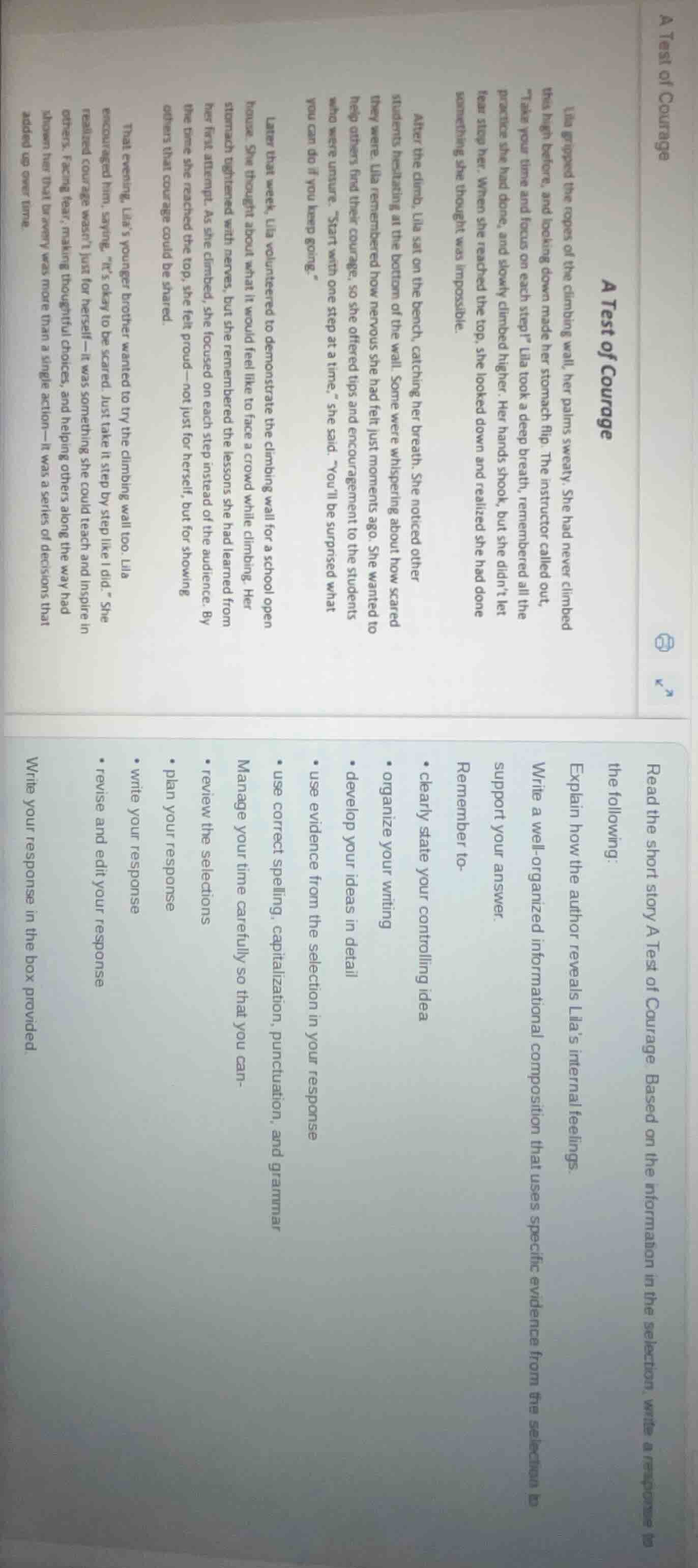
lila gripped the ropes of the climbing wall, her palms sweaty. she had never climbed this high before, and looking down made her stomach flip. the instructor called out, “take your time and focus on each step!” lila took a deep breath, remembered all the practice she had done, and slowly climbed higher. her hands shook, but she didn’t let fear stop her. when she reached the top, she looked down and realized she had done something she thought was impossible.
after the climb, lila sat on the bench, catching her breath. she noticed other students hesitating at the bottom of the wall. some were whispering about how scared they were. lila remembered how nervous she had felt just moments ago. she wanted to help others find their courage, so she offered tips and encouragement to the students who were unsure. “start with one step at a time,” she said. “you’ll be surprised what you can do if you keep going.”
later that week, lila volunteered to demonstrate the climbing wall for a school open house. she thought about what it would feel like to face a crowd while climbing. her stomach tightened with nerves, but she remembered the lessons she had learned from her first attempt. as she climbed, she focused on each step instead of the audience. by the time she reached the top, she felt proud—not just for herself, but for showing others that courage could be shared.
that evening, lila’s younger brother wanted to try the climbing wall too. lila encouraged him, saying, “it’s okay to be scared. just take it step by step like i did.” she realized courage wasn’t just for herself—it was something she could teach and inspire in others. facing fear, making thoughtful choices, and helping others along the way had shown her that bravery was more than a single action—it was a series of decisions that added up over time.
read the short story a test of courage. based on the information in the selection, write a response to the following:
explain how the author reveals lila’s internal feelings.
write a well - organized informational composition that uses specific evidence from the selection to support your answer.
remember to-
- clearly state your controlling idea
- organize your writing
- develop your ideas in detail
- use evidence from the selection in your response
- use correct spelling, capitalization, punctuation, and grammar
- manage your time carefully so that you can-
- review the selections
- plan your response
- write your response
- revise and edit your response
write your response in the box provided.
The author reveals Lila's internal feelings through direct physical cues, her internal reflections, and her actions toward others. First, physical details like "palms sweaty" and "stomach flip" show her initial fear of the climbing wall. When she climbs, "her hands shook" and "stomach tightened with nerves" further highlight her anxiety. Then, her internal thoughts, such as realizing she'd done the "impossible" after reaching the top, and worrying about performing in front of a crowd later, expose her sense of accomplishment and lingering nervousness. Finally, her choice to encourage other nervous students and her brother shows her growth: she now understands courage is shared, reflecting her shift from personal fear to confident empathy.

Snap & solve any problem in the app
Get step-by-step solutions on Sovi AI
Photo-based solutions with guided steps
Explore more problems and detailed explanations
The author reveals Lila's internal feelings through physical cues, internal reflections, and her actions toward others:
- Initial Fear and Anxiety: Physical details like "her palms sweaty," "stomach flip," "hands shook," and "stomach tightened with nerves" directly show her fear and nervousness when facing the climbing wall and later preparing to demonstrate it for a crowd.
- Sense of Accomplishment: When she reaches the top of the wall, her realization that she "had done something she thought was impossible" reveals her surprise and pride in overcoming her fear.
- Growth and Empathy: Her choice to offer tips and encouragement to other nervous students, and later to reassure her younger brother about being scared, shows she has moved past her own fear to understand courage as a shared, step-by-step process, reflecting her mature, confident mindset.