QUESTION IMAGE
Question
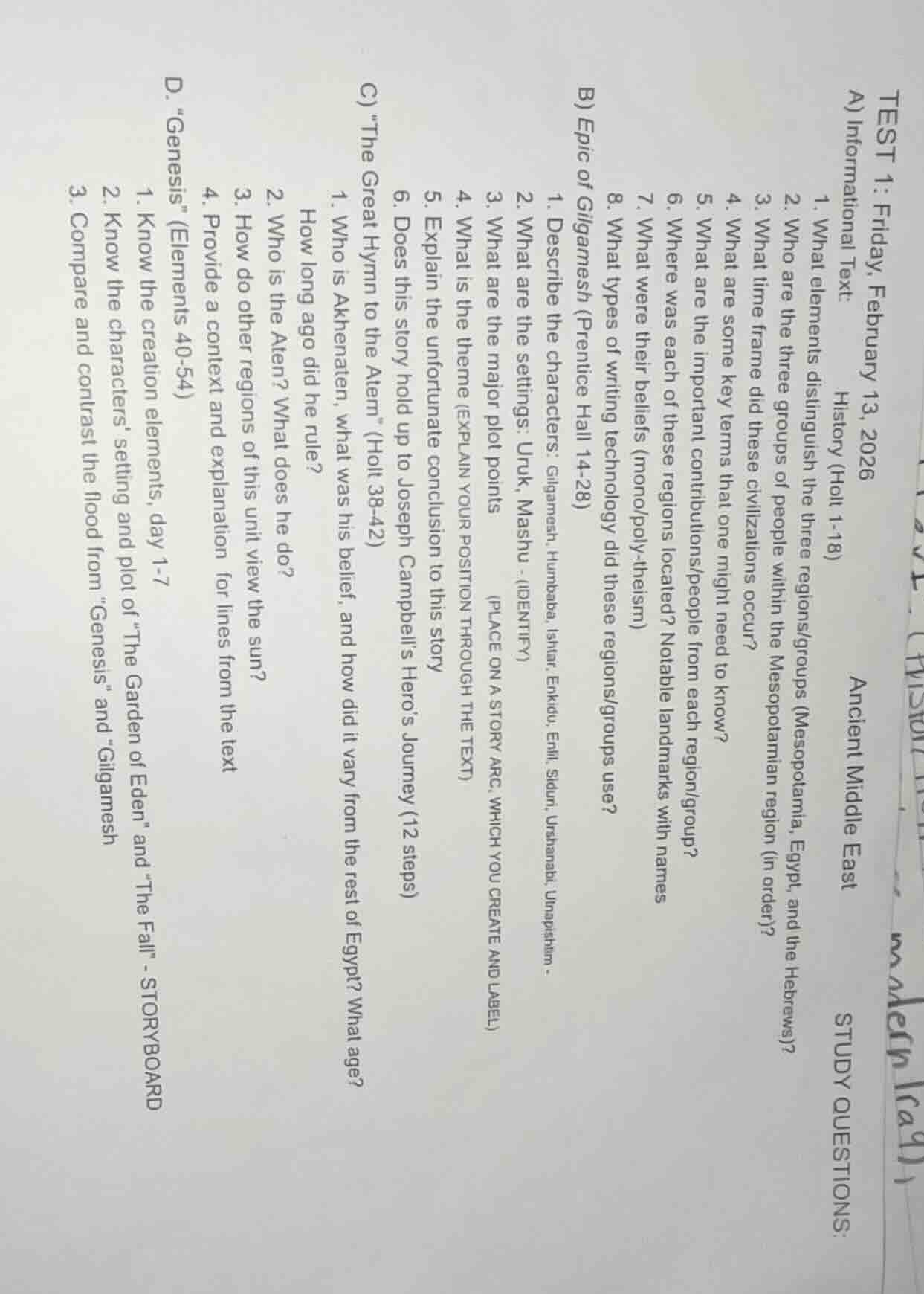
test 1: friday, february 13, 2026study questions:ancient middle easta) informational text: history (holt 1-18)1. what elements distinguish the three regions/groups (mesopotamia, egypt, and the hebrews)?2. who are the three groups of people within the mesopotamian region (in order)?3. what time frame did these civilizations occur?4. what are some key terms that one might need to know?5. what are the important contributions/people from each region/group?6. where was each of these regions located? notable landmarks with names7. what were their beliefs (mono/poly-theism)8. what types of writing technology did these regions/groups use?b) epic of gilgamesh (prentice hall 14-28)1. describe the characters: gilgamesh, humbaba, ishtar, enkidu, enlil, siduri, urshanabi, utnapishtim -2. what are the settings: uruk, mashu - (identify)3. what are the major plot points (place on a story arc, which you create and label)4. what is the theme (explain your position through the text)5. explain the unfortunate conclusion to this story6. does this story hold up to joseph campbells heros journey (12 steps)c) \the great hymn to the atem\ (holt 38-42)1. who is akhenaten, what was his belief, and how did it vary from the rest of egypt? what age?how long ago did he rule?2. who is the aten? what does he do?3. how do other regions of this unit view the sun?4. provide a context and explanation for lines from the textd. \genesis\ (elements 40-54)1. know the creation elements, day 1-72. know the characters setting and plot of \the garden of eden\ and \the fall\ - storyboard3. compare and contrast the flood from \genesis\ and \gilgamesh\
Section A: Informational Text: History (Holt 1-18)
- Distinguishing elements: Mesopotamia: Tigris/Euphrates rivers, city-states, cuneiform writing; Egypt: Nile river, centralized pharaonic rule, hieroglyphs; Hebrews: Monotheistic (Yahweh), nomadic then settled kingdom, Torah scripture.
- Mesopotamian groups (ordered): Sumerians (earliest, 3500 BCE), Akkadians (2334 BCE), Babylonians (1894 BCE), Assyrians (911 BCE), Neo-Babylonians (626 BCE).
- Time frame: Mesopotamia: ~3500 BCE to 539 BCE; Egypt: ~3100 BCE to 30 BCE; Hebrews: ~2000 BCE (nomadic) onwards.
- Key terms: Cuneiform (Mesopotamian writing), Pharaoh (Egyptian ruler), Monotheism (Hebrew belief), Ziggurat (Mesopotamian temple), Pyramid (Egyptian tomb), Torah (Hebrew sacred text).
- Contributions:
- Mesopotamia: Cuneiform writing, 60-base number system, Code of Hammurabi.
- Egypt: Hieroglyphs, 365-day calendar, pyramid engineering, papyrus.
- Hebrews: Monotheistic Judaism, ethical legal system (Ten Commandments).
- Locations:
- Mesopotamia: Modern-day Iraq, between Tigris and Euphrates rivers; key landmark: Ziggurat of Ur.
- Egypt: Nile River valley, modern Egypt; key landmark: Great Pyramids of Giza.
- Hebrews: Initially Canaan (modern Israel/Palestine), later Babylon (exile), then Judea; key landmark: Solomon's Temple (Jerusalem).
- Beliefs:
- Mesopotamia: Polytheistic (gods like Enlil, Inanna), anthropomorphic deities, pessimistic afterlife view.
- Egypt: Polytheistic (Ra, Osiris), pharaoh as divine, optimistic afterlife view (mummification).
- Hebrews: Monotheistic (Yahweh), covenant-based faith, ethical focus.
- Writing technology:
- Mesopotamia: Cuneiform, carved into clay tablets.
- Egypt: Hieroglyphs, written on papyrus or stone.
- Hebrews: Hebrew script, written on scrolls (later parchment).
Section B: Epic of Gilgamesh (Prentice Hall 14-28)
- Characters:
- Gilgamesh: Arrogant king of Uruk, semi-divine, seeks immortality after Enkidu's death.
- Humbaba: Guardian of the Cedar Forest, defeated by Gilgamesh and Enkidu.
- Ishtar: Mesopotamian love/war goddess, rejected by Gilgamesh, sends the Bull of Heaven as punishment.
- Enkidu: Wild man created to counter Gilgamesh, becomes his loyal friend, dies as divine punishment.
- Enlil: Supreme Mesopotamian god, sentences Enkidu to death.
- Siduri: Tavern keeper who advises Gilgamesh to accept mortality.
- Urshanabi: Ferryman who helps Gilgamesh reach Utnapishtim.
- Utnapishtim: Survivor of the flood, granted immortality, tests Gilgamesh's worth.
- Settings:
- Uruk: Ancient Mesopotamian city, Gilgamesh's kingdom.
- Mashu: Mountain pass between the mortal world and the edge of the universe.
- Major plot points:
- Gilgamesh oppresses Uruk's people; gods create Enkidu to challenge him.
- Gilgamesh and Enkidu fight, then become friends.
- The pair journey to defeat Humbaba in the Cedar Forest.
- Ishtar is rejected by Gilgamesh; she sends the Bull of Heaven, which the pair kill.
- Gods sentence Enkidu to death; he dies, leaving Gilgamesh grief-stricken.
- Gilgamesh journeys to find Utnapishtim, the immortal flood survivor.
- Utnapishtim tests Gilgamesh (he fails a sleep test), but reveals a plant that restores youth.
- A snake steals the plant; Gilgamesh returns to Uruk, accepting his mortality.
- Theme: The inevitability of human mortality and the importance of finding purpose in a finite life. Gilgamesh's journey from…

Snap & solve any problem in the app
Get step-by-step solutions on Sovi AI
Photo-based solutions with guided steps
Explore more problems and detailed explanations
Section A: Informational Text: History (Holt 1-18)
- Mesopotamia: Tigris/Euphrates rivers, city-states, cuneiform; Egypt: Nile river, centralized pharaonic rule, hieroglyphs; Hebrews: Monotheism, Torah, covenant faith.
- Sumerians, Akkadians, Babylonians, Assyrians, Neo-Babylonians.
- Mesopotamia: ~3500–539 BCE; Egypt: ~3100–30 BCE; Hebrews: ~2000 BCE onwards.
- Cuneiform, Pharaoh, Monotheism, Ziggurat, Pyramid, Torah.
- Mesopotamia: Cuneiform, Code of Hammurabi; Egypt: Hieroglyphs, 365-day calendar; Hebrews: Monotheistic Judaism, Ten Commandments.
- Mesopotamia: Modern Iraq, Ziggurat of Ur; Egypt: Nile Valley, Great Pyramids of Giza; Hebrews: Canaan/Judea, Solomon's Temple.
- Mesopotamia: Polytheistic; Egypt: Polytheistic, divine pharaoh; Hebrews: Monotheistic.
- Mesopotamia: Cuneiform on clay tablets; Egypt: Hieroglyphs on papyrus; Hebrews: Hebrew script on scrolls.
Section B: Epic of Gilgamesh (Prentice Hall 14-28)
- Gilgamesh: Arrogant semi-divine king; Enkidu: Wild man turned loyal friend; Humbaba: Cedar Forest guardian; Ishtar: Rejected goddess; Utnapishtim: Immortal flood survivor.
- Uruk (Gilgamesh's kingdom), Mashu (mountain pass to the underworld).
- Gilgamesh oppresses Uruk; Enkidu is created; they fight and befriend; defeat Humbaba/Bull of Heaven; Enkidu dies; Gilgamesh seeks immortality; fails tests; returns to Uruk accepting mortality.
- The inevitability of human mortality and finding purpose in finite life.
- Gilgamesh fails to gain immortality and loses the youth-restoring plant, but gains wisdom about mortality.
- Yes, it aligns: Ordinary World (Uruk), Call to Adventure (Enkidu's creation), Ordeals (defeating Humbaba, grieving Enkidu), Reward (youth plant), Return with Elixir (wisdom).
Section C: "The Great Hymn to the Aten" (Holt 38-42)
- Akhenaten (1353-1336 BCE) was an Egyptian pharaoh who enforced radical monotheism (worship of only Aten), breaking from traditional Egyptian polytheism.
- Aten is the sun disk, the sole universal creator god; Akhenaten framed himself and Nefertiti as the only intermediaries between Aten and humans.
- Mesopotamia saw the sun (Shamash) as one of many gods; Hebrews saw the sun as a creation of Yahweh, not a deity.
- The lines praise Aten as the sole source of all life on Earth, reflecting Akhenaten's monotheistic reform, which rejected Egypt's traditional pantheon.
Section D: "Genesis" (Elements 40-54)
- Day 1: Light/dark; Day 2: Sky/water; Day 3: Land/plants; Day 4: Sun/moon/stars; Day 5: Aquatic/flying animals; Day 6: Land animals/humans; Day 7: God rests.
- Setting: Perfect Garden of Eden; Characters: God, Adam, Eve, Serpent; Plot: Forbidden fruit eaten, curses given, expulsion from Eden.
- Similarities: Divine flood wipes out corrupt humans; righteous man builds a boat to save family/animals; bird sent to find dry land; post-flood sacrifice. Differences: Genesis: Monotheistic Yahweh sends flood for wickedness, Noah gets a covenant; Gilgamesh: Polytheistic gods send flood for noise, Utnapishtim gets immortality.