QUESTION IMAGE
Question
thematics 7 - 7 - full year
pic 6 mid - topic assessment
due
feb 6 - 11:45 pm
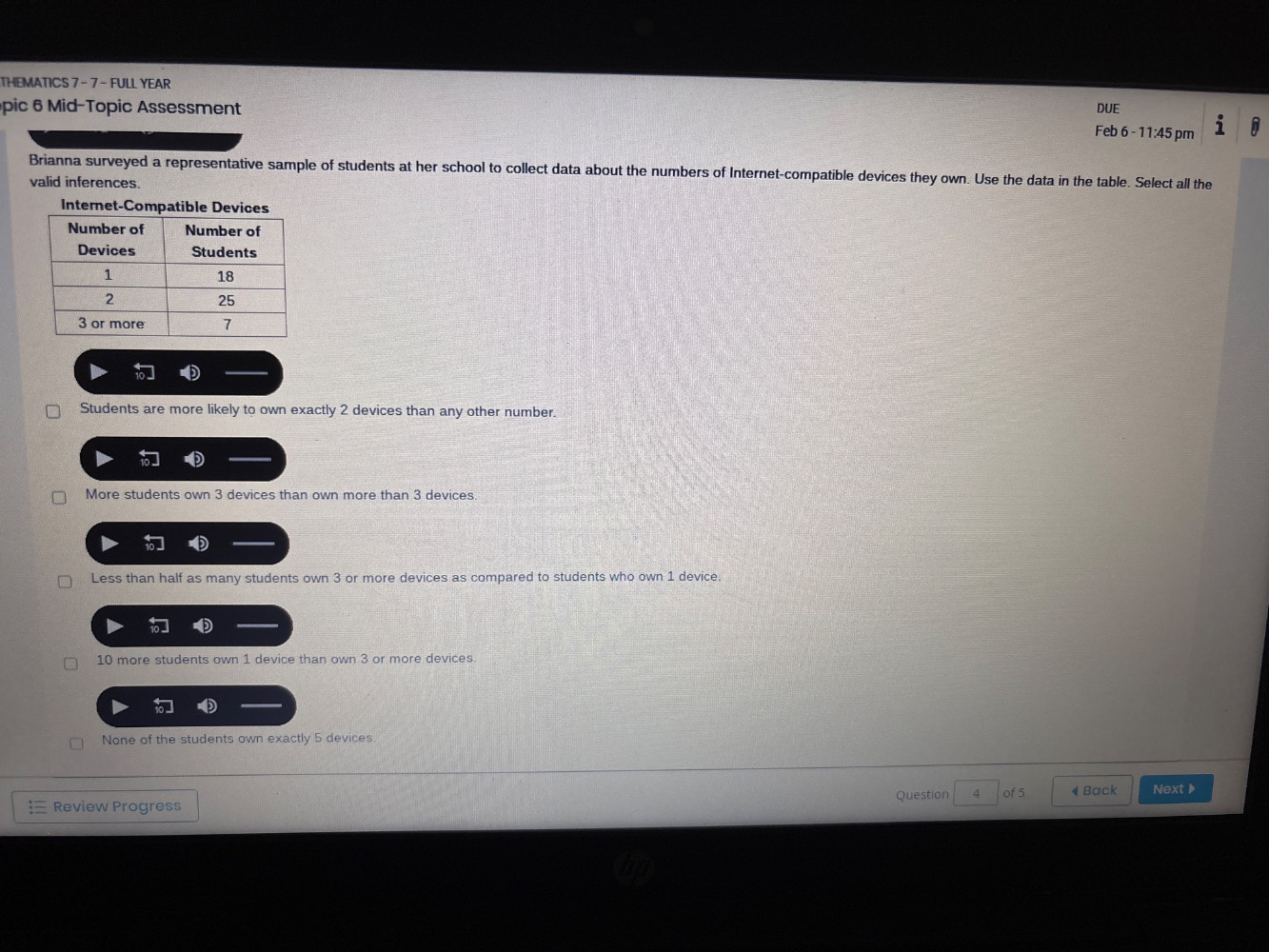
brianna surveyed a representative sample of students at her school to collect data about the numbers of internet - compatible devices they own. use the data in the table. select all the valid inferences.
internet - compatible devices
| number of devices | number of students |
|---|---|
| 2 | 25 |
| 3 or more | 7 |
- students are more likely to own exactly 2 devices than any other number.
- more students own 3 devices than own more than 3 devices.
- less than half as many students own 3 or more devices as compared to students who own 1 device.
- 10 more students own 1 device than own 3 or more devices.
- none of the students own exactly 5 devices.
question 4 of 5
Step1: Analyze each statement
- Statement 1: Students are more likely to own exactly 2 devices than any other number.
- Number of students with 1 device: 18; with 2 devices: 25; with 3 or more: 7. Since 25 > 18 > 7, this is true.
- Statement 2: More students own 3 devices than own more than 3 devices.
- The category "3 or more" includes 3, 4, 5, etc. We don't have data for "more than 3" separately, but the "3 or more" has 7 students. We can't say more own 3 than more than 3 (since "more than 3" is part of "3 or more" and we don't know the split), so this is false.
- Statement 3: Less than half as many students own 3 or more devices as compared to students who own 1 device.
- Half of 18 is 9. Number of students with 3 or more is 7, which is less than 9. So this is true.
- Statement 4: 10 more students own 1 device than own 3 or more devices.
- Difference: 18 - 7 = 11, not 10. So this is false.
- Statement 5: None of the students own exactly 5 devices.
- The "3 or more" category includes devices like 3, 4, 5, etc. We don't know if any student owns exactly 5 (they could be in the "3 or more" group), so we can't infer this. So this is false.

Snap & solve any problem in the app
Get step-by-step solutions on Sovi AI
Photo-based solutions with guided steps
Explore more problems and detailed explanations
- Students are more likely to own exactly 2 devices than any other number.
- Less than half as many students own 3 or more devices as compared to students who own 1 device.