QUESTION IMAGE
Question
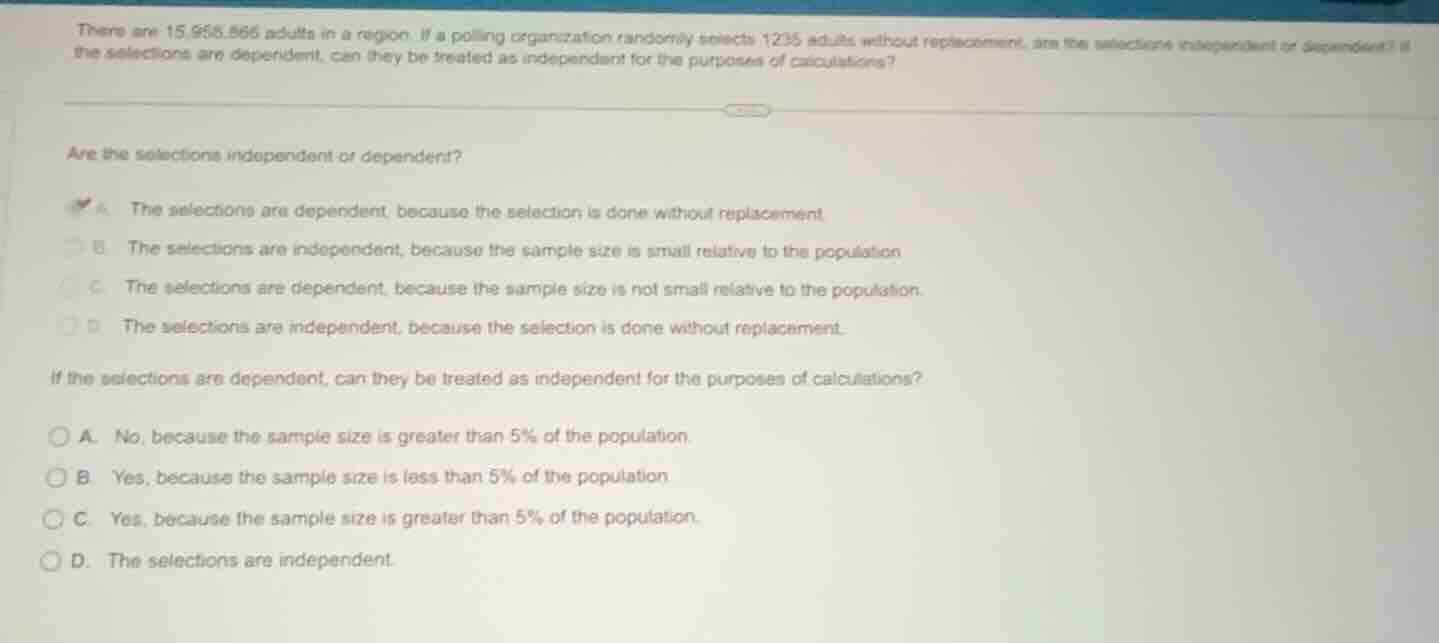
there are 15,656,866 adults in a region. if a polling organization randomly selects 1235 adults without replacement, are the selections independent or dependent? if the selections are dependent, can they be treated as independent for the purposes of calculations?
are the selections independent or dependent?
a. the selections are dependent, because the selection is done without replacement.
b. the selections are independent, because the sample size is small relative to the population.
c. the selections are dependent, because the sample size is not small relative to the population.
d. the selections are independent, because the selection is done without replacement.
if the selections are dependent, can they be treated as independent for the purposes of calculations?
a. no, because the sample size is greater than 5% of the population.
b. yes, because the sample size is less than 5% of the population.
c. yes, because the sample size is greater than 5% of the population.
d. the selections are independent.
First Question (Are the selections independent or dependent?)
- For the first part, when sampling without replacement, each selection affects the next (since the population size decreases), so selections are dependent. Option A correctly states this (selection without replacement causes dependence). Option B is wrong as sample size small relative to population relates to treating as independent for calculation, not the initial dependence. Option C is wrong as the reason for dependence is without replacement, not sample size relative to population. Option D is wrong as without replacement causes dependence, not independence.
- To check if we can treat dependent selections as independent, we use the 5% rule: if sample size \( n \leq 0.05N \) (where \( N \) is population size), we can treat them as independent. Here, \( N = 15555866 \), \( n = 1235 \). Calculate \( 0.05\times15555866 = 777793.3 \). Since \( 1235 < 777793.3 \) (sample size is less than 5% of population), we can treat them as independent. Option B is correct. Option A is wrong (sample size is less than 5% of population). Option C is wrong (reasoning is reversed). Option D is wrong as we already established selections are dependent initially.

Snap & solve any problem in the app
Get step-by-step solutions on Sovi AI
Photo-based solutions with guided steps
Explore more problems and detailed explanations
A. The selections are dependent, because the selection is done without replacement.