QUESTION IMAGE
Question
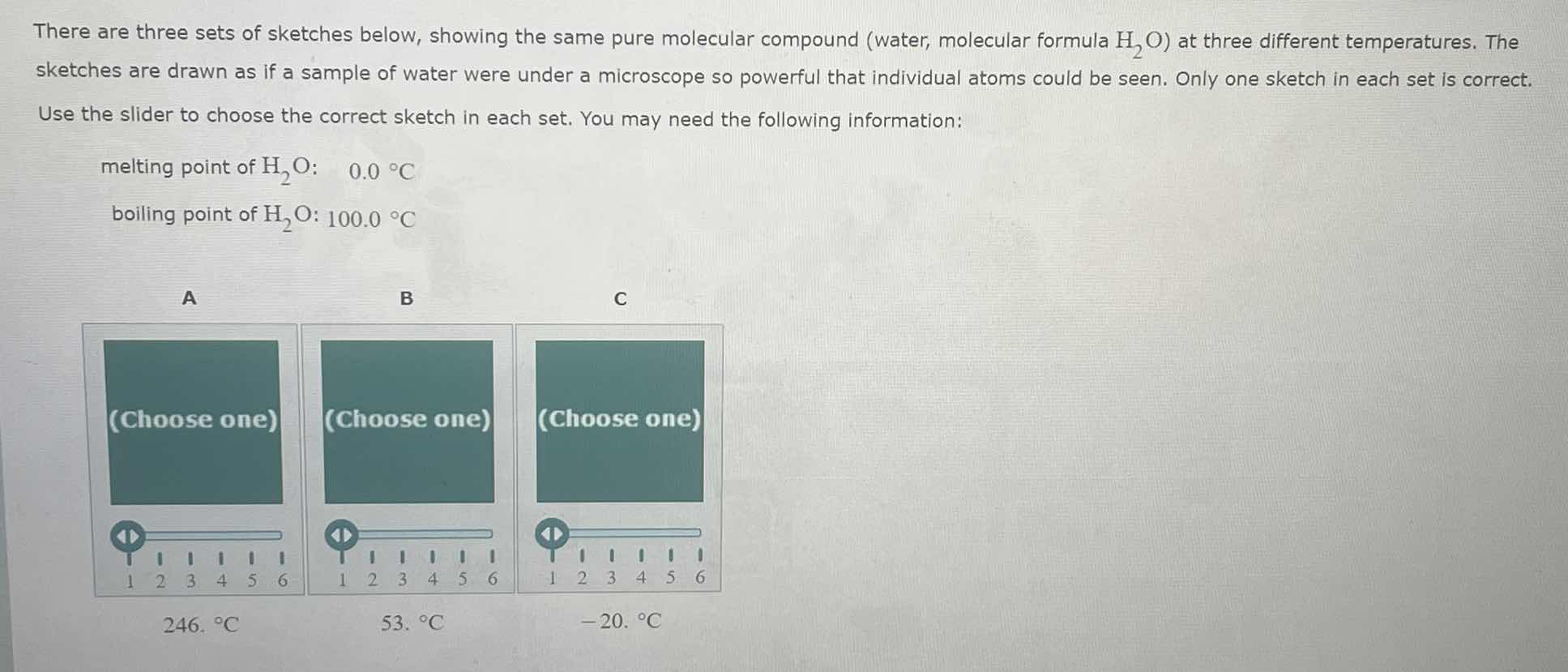
there are three sets of sketches below, showing the same pure molecular compound (water, molecular formula $\ce{h_{2}o}$) at three different temperatures. the sketches are drawn as if a sample of water were under a microscope so powerful that individual atoms could be seen. only one sketch in each set is correct. use the slider to choose the correct sketch in each set. you may need the following information: melting point of $\ce{h_{2}o}$: $0.0\\ \unit{^{\circ}c}$; boiling point of $\ce{h_{2}o}$: $100.0\\ \unit{^{\circ}c}$. (images of three sets of sketches labeled a, b, c with sliders for choosing, temperatures below: a: $246.\\ \unit{^{\circ}c}$, b: $53.\\ \unit{^{\circ}c}$, c: $-20.\\ \unit{^{\circ}c}$)
To solve this, we analyze the states of water at each temperature using its melting (0.0 °C) and boiling (100.0 °C) points:
For Set A (246 °C):
246 °C is above the boiling point (100.0 °C), so water is a gas. In a gas, molecules are far apart and move freely. So the sketch for A should show molecules with large spacing (consistent with gas behavior).
For Set B (53 °C):
53 °C is between melting (0.0 °C) and boiling (100.0 °C), so water is a liquid. In a liquid, molecules are close but can slide past each other (moderate spacing, more movement than solid). So the sketch for B should show molecules with moderate spacing (consistent with liquid behavior).
For Set C (-20 °C):
-20 °C is below the melting point (0.0 °C), so water is a solid (ice). In a solid, molecules are closely packed in a fixed, ordered structure. So the sketch for C should show molecules with tight, ordered spacing (consistent with solid behavior).
Final Choices (assuming sketch options correspond to state behavior):
- A (246 °C): Choose the sketch with gas-like (far-apart molecules).
- B (53 °C): Choose the sketch with liquid-like (moderate spacing, sliding).
- C (-20 °C): Choose the sketch with solid-like (tight, ordered packing).
(Note: The exact sketch number depends on the visual options, but the logic is based on state behavior at each temperature.)

Snap & solve any problem in the app
Get step-by-step solutions on Sovi AI
Photo-based solutions with guided steps
Explore more problems and detailed explanations
To solve this, we analyze the states of water at each temperature using its melting (0.0 °C) and boiling (100.0 °C) points:
For Set A (246 °C):
246 °C is above the boiling point (100.0 °C), so water is a gas. In a gas, molecules are far apart and move freely. So the sketch for A should show molecules with large spacing (consistent with gas behavior).
For Set B (53 °C):
53 °C is between melting (0.0 °C) and boiling (100.0 °C), so water is a liquid. In a liquid, molecules are close but can slide past each other (moderate spacing, more movement than solid). So the sketch for B should show molecules with moderate spacing (consistent with liquid behavior).
For Set C (-20 °C):
-20 °C is below the melting point (0.0 °C), so water is a solid (ice). In a solid, molecules are closely packed in a fixed, ordered structure. So the sketch for C should show molecules with tight, ordered spacing (consistent with solid behavior).
Final Choices (assuming sketch options correspond to state behavior):
- A (246 °C): Choose the sketch with gas-like (far-apart molecules).
- B (53 °C): Choose the sketch with liquid-like (moderate spacing, sliding).
- C (-20 °C): Choose the sketch with solid-like (tight, ordered packing).
(Note: The exact sketch number depends on the visual options, but the logic is based on state behavior at each temperature.)