QUESTION IMAGE
Question
thermal energy
name
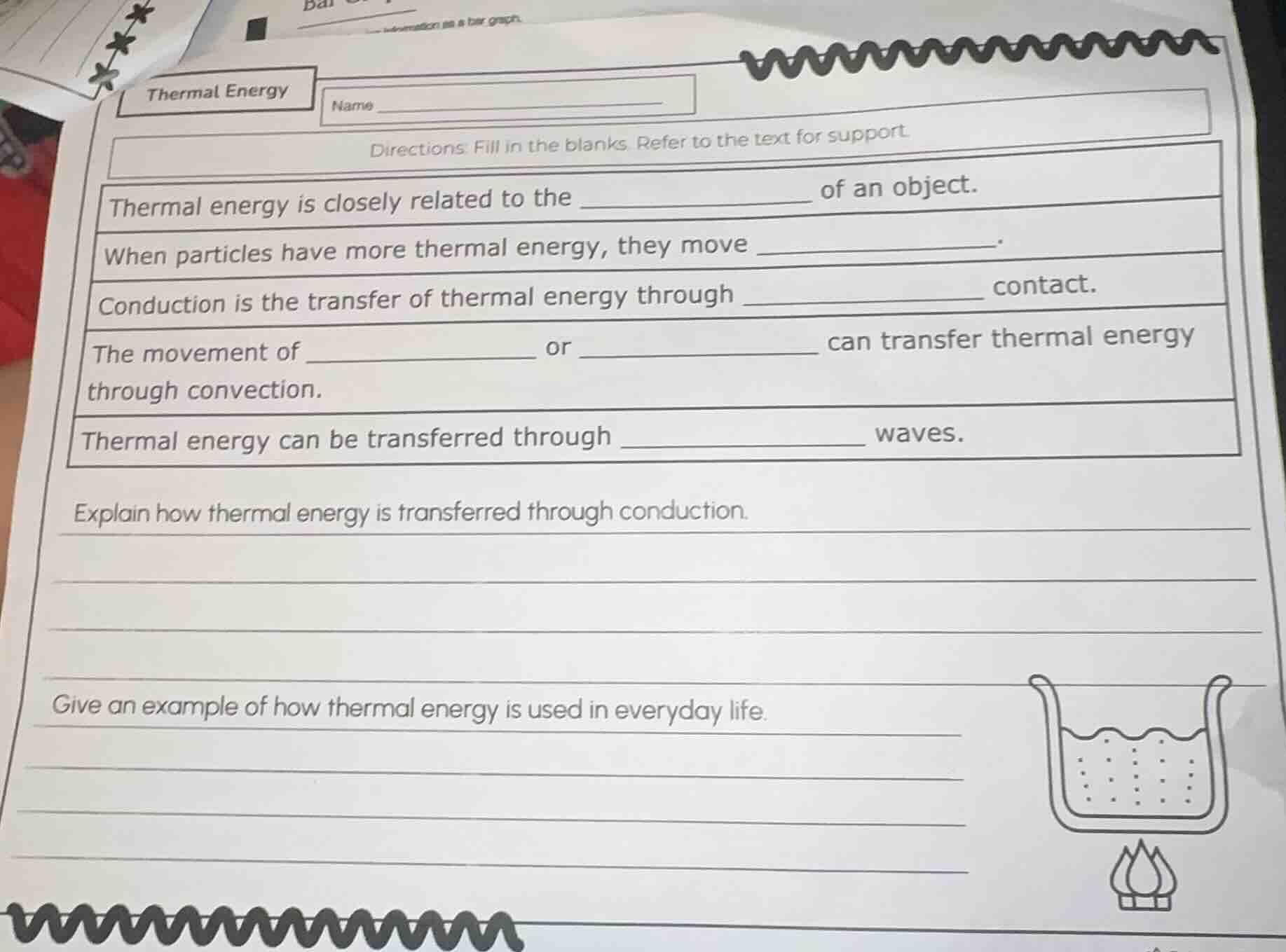
directions: fill in the blanks. refer to the text for support.
thermal energy is closely related to the ____________ of an object.
when particles have more thermal energy, they move ____________.
conduction is the transfer of thermal energy through ____________ contact.
the movement of __________ or __________ can transfer thermal energy through convection.
thermal energy can be transferred through ____________ waves.
explain how thermal energy is transferred through conduction.
_____________________________________________________________________
_____________________________________________________________________
_____________________________________________________________________
give an example of how thermal energy is used in everyday life.
_____________________________________________________________________
_____________________________________________________________________
_____________________________________________________________________
Fill - in - the - blanks Answers:
- Thermal energy is closely related to the temperature of an object. (Thermal energy is the total kinetic energy of the particles in an object, and temperature is a measure of the average kinetic energy of the particles, so they are closely related.)
- When particles have more thermal energy, they move faster. (More thermal energy means higher kinetic energy for the particles, so their speed of movement increases.)
- Conduction is the transfer of thermal energy through direct contact. (Conduction occurs when heat is transferred from one particle to another through physical contact, like a spoon in a hot soup getting hot.)
- The movement of liquids or gases can transfer thermal energy through convection. (Convection is the transfer of heat by the movement of fluids (liquids and gases) as warmer, less dense fluid rises and cooler, denser fluid sinks.)
- Thermal energy can be transferred through electromagnetic waves. (Radiation is the transfer of heat through electromagnetic waves, such as infrared radiation from the sun.)
of Conduction:
In conduction, when an object is heated, the particles at the heated part gain thermal energy and start to vibrate faster. These vibrating particles then collide with neighboring particles, transferring their kinetic energy (thermal energy) to them. This process continues, with the thermal energy being passed from particle to particle throughout the object, even without the bulk movement of the material. For example, when you hold a metal rod over a flame, the end in the flame gets hot first, and then the heat is conducted along the rod to your hand because the metal particles are closely packed and can easily transfer the energy through collisions.
One example is using a microwave oven to heat food. The microwave oven emits electromagnetic waves (microwaves) which are absorbed by the water molecules in the food. This absorption of the waves' energy increases the thermal energy of the water molecules, which then transfer the heat to the rest of the food, warming it up. Another example is the heating of a room by a radiator. The radiator heats the air in contact with it (through conduction), and then this warm air rises, and cooler air moves in to be heated, creating a convection current that warms the entire room.

Snap & solve any problem in the app
Get step-by-step solutions on Sovi AI
Photo-based solutions with guided steps
Explore more problems and detailed explanations
In conduction, heated particles vibrate faster and collide with neighboring particles, transferring thermal energy. This energy transfer occurs particle - to - particle through direct contact, without bulk material movement.