QUESTION IMAGE
Question
thermal energy
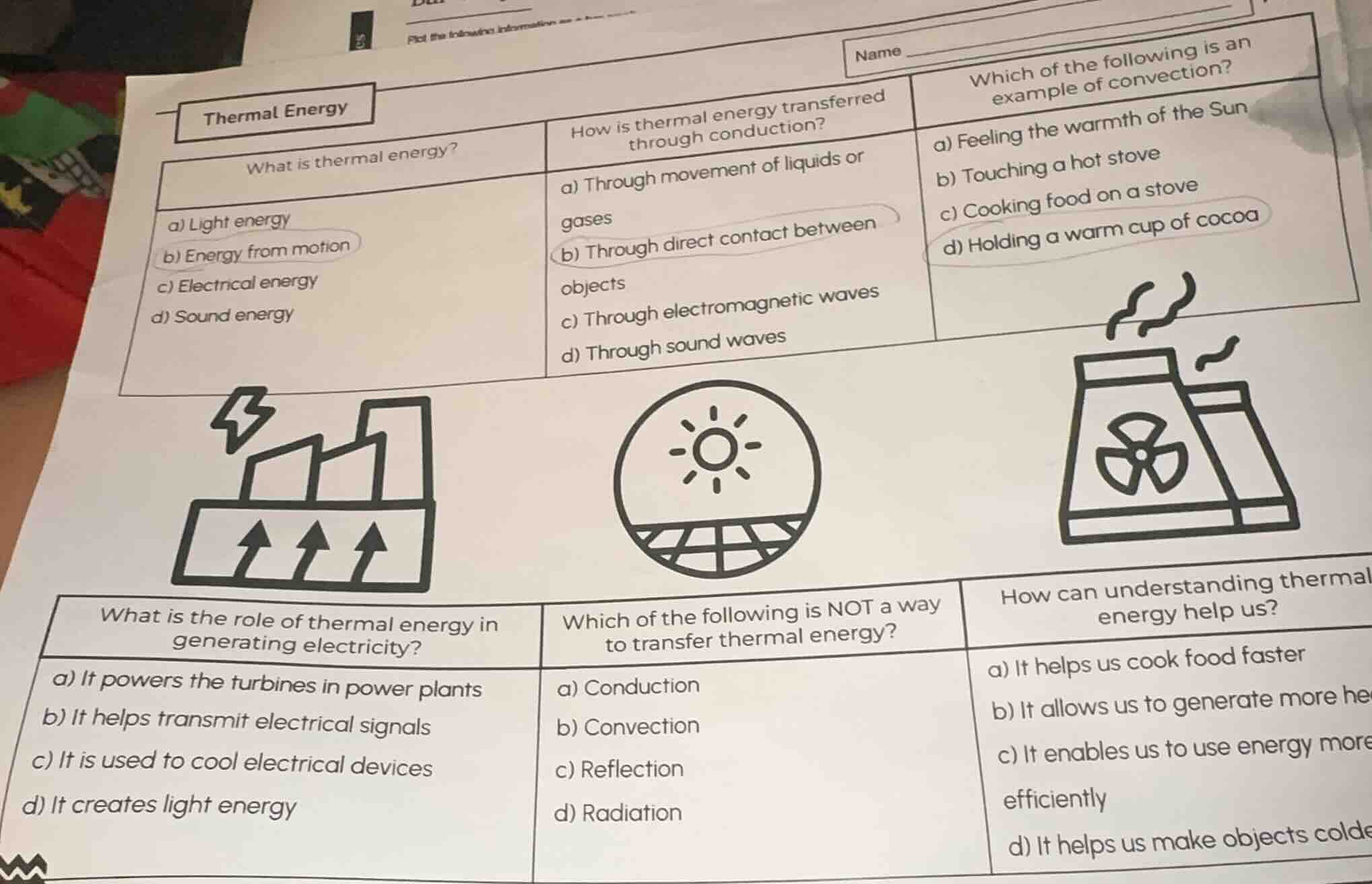
what is thermal energy?
a) light energy
b) energy from motion
c) electrical energy
d) sound energy
how is thermal energy transferred through conduction?
a) through movement of liquids or gases
b) through direct contact between objects
c) through electromagnetic waves
d) through sound waves
which of the following is an example of convection?
a) feeling the warmth of the sun
b) touching a hot stove
c) cooking food on a stove
d) holding a warm cup of cocoa
what is the role of thermal energy in generating electricity?
a) it powers the turbines in power plants
b) it helps transmit electrical signals
c) it is used to cool electrical devices
d) it creates light energy
which of the following is not a way to transfer thermal energy?
a) conduction
b) convection
c) reflection
d) radiation
how can understanding thermal energy help us?
a) it helps us cook food faster
b) it allows us to generate more he
c) it enables us to use energy more efficiently
d) it helps us make objects colde
1. "What is thermal energy?"
Thermal energy is related to the energy of motion of particles (kinetic energy of particles in a substance). Option b says "Energy from motion", which aligns with the concept of thermal energy (due to the motion of atoms/molecules in a substance). Option a is light energy, c is electrical energy, d is sound energy, so they are incorrect.
Conduction is the transfer of thermal energy through direct contact between objects (when two objects are in contact, heat moves from the hotter to the colder one through molecular collisions). Option a is convection (movement of fluids), c is radiation (electromagnetic waves), d is sound waves (not thermal transfer), so option b is correct.
Convection is the transfer of thermal energy through the movement of liquids or gases. Option a is radiation (Sun's warmth via EM waves), b and d are conduction (direct contact), option c: cooking food on a stove - the heat from the stove warms the air or the liquid (like in a pot) which moves, transferring heat (convection in the air or liquid around the food). Wait, actually, let's re - check: Feeling the Sun (a) is radiation. Touching a hot stove (b) and holding a warm cup (d) are conduction (direct contact). Cooking food on a stove: if it's like a gas stove, the heat warms the air, and the air circulates (convection) to cook the food, or in a pot of water, the water moves (convection) to transfer heat. But wait, the original marked option in the image is d, but that's a mistake. Wait, no: holding a warm cup is conduction (direct contact between hand and cup). Wait, maybe the intended answer is c? Wait, no, let's recall: Convection is heat transfer by movement of fluids (liquids/gases). So cooking food on a stove: the heat from the stove heats the air around it, and the air moves (convection) to cook the food. Or in a pot, the water moves. So option c: "Cooking food on a stove" is convection. But the image has d marked, which is wrong. Wait, maybe the question has a typo, but according to the options: a) radiation, b) conduction, c) convection (heat from stove to air or liquid, which moves), d) conduction (hand and cup). So the correct answer should be c. But maybe the original problem has a different context. Wait, no, let's re - evaluate:
- Option a: Radiation (Sun's heat via EM waves).
- Option b: Conduction (direct contact between hand and stove).
- Option c: When cooking on a stove, the heat from the stove (e.g., a gas burner) heats the air, and the air circulates (convection) to transfer heat to the food. Or if it's a pot of water, the water circulates (convection) as it's heated. So this is convection.
- Option d: Conduction (direct contact between hand and cup).
So the correct answer is c) Cooking food on a stove. But the image has d marked, which is an error. However, based on the concept, the correct answer is c.

Snap & solve any problem in the app
Get step-by-step solutions on Sovi AI
Photo-based solutions with guided steps
Explore more problems and detailed explanations
b) Energy from motion