QUESTION IMAGE
Question
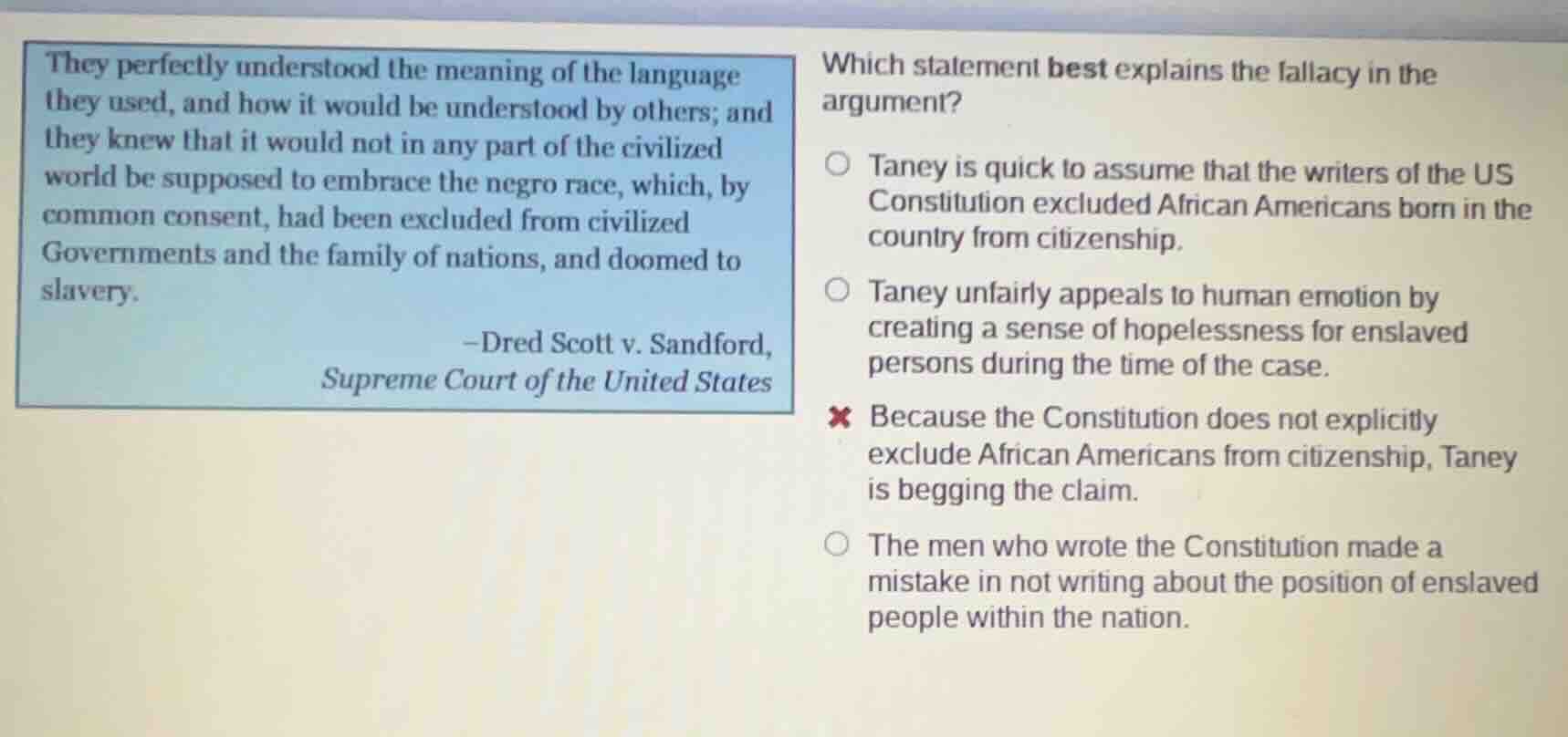
they perfectly understood the meaning of the language they used, and how it would be understood by others; and they knew that it would not in any part of the civilized world be supposed to embrace the negro race, which, by common consent, had been excluded from civilized governments and the family of nations, and doomed to slavery.
—dred scott v. sandford, supreme court of the united states
which statement best explains the fallacy in the argument?
- taney is quick to assume that the writers of the us constitution excluded african americans born in the country from citizenship.
- taney unfairly appeals to human emotion by creating a sense of hopelessness for enslaved persons during the time of the case.
- because the constitution does not explicitly exclude african americans from citizenship, taney is begging the claim.
- the men who wrote the constitution made a mistake in not writing about the position of enslaved people within the nation.
To identify the fallacy, we analyze each option:
- Option 1: Taney’s assumption is about the writers’ intent, not a fallacy of begging the question.
- Option 2: The passage does not use emotional appeals (pathos) but focuses on legal interpretation.
- Option 3: Begging the question (circular reasoning) occurs when Taney assumes African Americans are excluded from citizenship because the Constitution “would not embrace” them, yet the Constitution does not explicitly exclude them. He assumes his conclusion (exclusion) to prove itself.
- Option 4: The question is about Taney’s fallacy, not the Constitution’s authors’ mistakes.

Snap & solve any problem in the app
Get step-by-step solutions on Sovi AI
Photo-based solutions with guided steps
Explore more problems and detailed explanations
C. Because the Constitution does not explicitly exclude African Americans from citizenship, Taney is begging the claim.
(Note: The option labels here assume the standard A-D, with the correct one being the third option as analyzed, labeled as C for clarity in this context.)