QUESTION IMAGE
Question
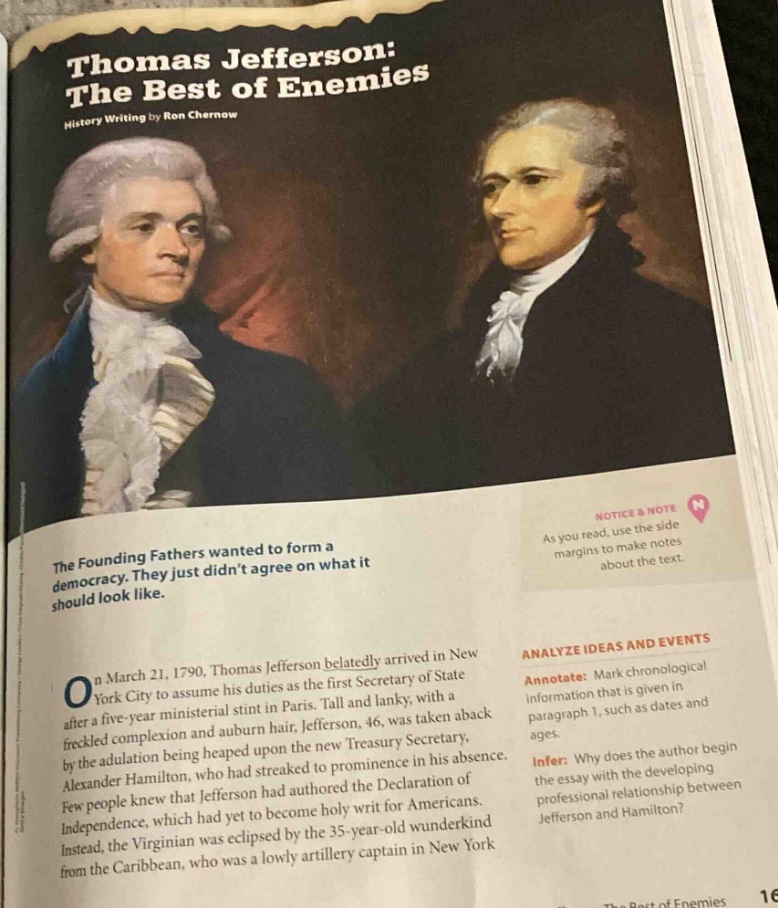
thomas jefferson: the best of enemies history writing by ron chernow the founding fathers wanted to form a democracy. they just didnt agree on what it should look like. on march 21, 1790, thomas jefferson belatedly arrived in new york city to assume his duties as the first secretary of state after a five - year ministerial stint in paris. tall and lanky, with a freckled complexion and auburn hair, jefferson, 46, was taken aback by the adulation being heaped upon the new treasury secretary, alexander hamilton, who had streaked to prominence in his absence. few people knew that jefferson had authored the declaration of independence, which had yet to become holy writ for americans. instead, the virginian was eclipsed by the 35 - year - old wunderkind from the caribbean, who was a lowly artillery captain in new york notice & note as you read, use the side margins to make notes about the text. analyze ideas and events annotate: mark chronological information that is given in paragraph 1, such as dates and ages. infer: why does the author begin the essay with the developing professional relationship between jefferson and hamilton?
The opening frames the tension between Jefferson and Hamilton as a microcosm of the broader disagreement among Founding Fathers about the structure of U.S. democracy. By focusing on their professional rivalry from the start, the author immediately anchors the essay to the central conflict: competing ideas about the nation's future, which directly ties to the introductory claim that the Founding Fathers agreed on forming a democracy but not on its form. This also leverages the historical significance of both figures to draw readers into the specific debate that would shape American governance.

Snap & solve any problem in the app
Get step-by-step solutions on Sovi AI
Photo-based solutions with guided steps
Explore more problems and detailed explanations
The author begins the essay with this relationship to highlight the core ideological conflict between two key Founding Fathers that shaped early U.S. democratic identity, as their opposing visions for the nation were central to defining what American democracy would become.