QUESTION IMAGE
Question
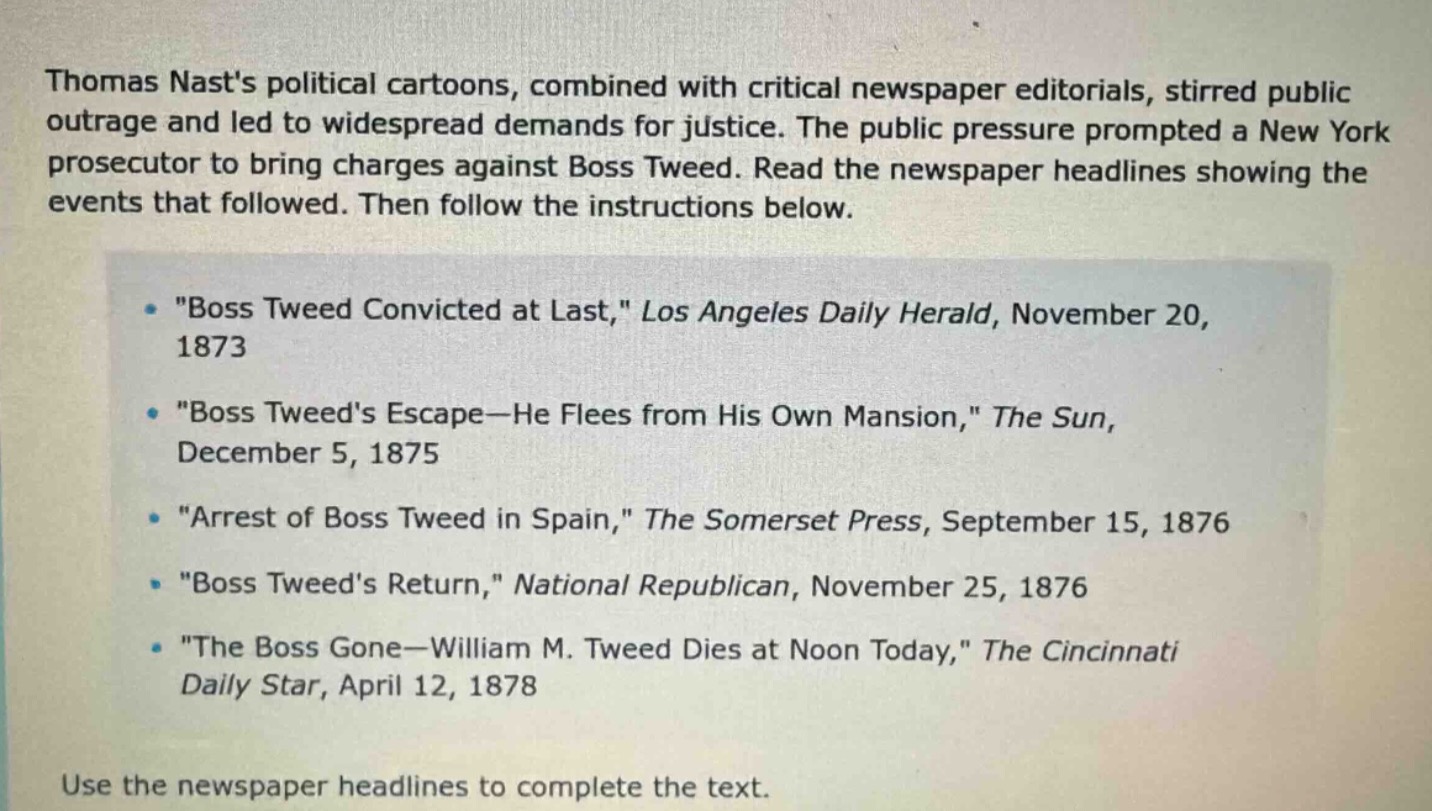
thomas nasts political cartoons, combined with critical newspaper editorials, stirred public outrage and led to widespread demands for justice. the public pressure prompted a new york prosecutor to bring charges against boss tweed. read the newspaper headlines showing the events that followed. then follow the instructions below.
- \boss tweed convicted at last,\ los angeles daily herald, november 20, 1873
- \boss tweeds escape—he flees from his own mansion,\ the sun, december 5, 1875
- \arrest of boss tweed in spain,\ the somerset press, september 15, 1876
- \boss tweeds return,\ national republican, november 25, 1876
- \the boss gone—william m. tweed dies at noon today,\ the cincinnati daily star, april 12, 1878
use the newspaper headlines to complete the text.
Since the specific text to complete isn't provided, here's a general approach to organize the events in chronological order (which is likely the instruction) using the headlines:
- First, list the events by their dates:
- November 20, 1873: "Boss Tweed Convicted at Last" (conviction)
- December 5, 1875: "Boss Tweed’s Escape—He Flees from His Own Mansion" (escape)
- September 15, 1876: "Arrest of Boss Tweed in Spain" (arrest abroad)
- November 25, 1876: "Boss Tweed’s Return" (return to face consequences)
- April 12, 1878: "The Boss Gone—William M. Tweed Dies at Noon Today" (death)
To complete the text, you would insert these events in order, explaining how each headline represents a stage in Boss Tweed’s story after his initial prosecution (e.g., conviction → escape → arrest abroad → return → death). If the text has blanks for each event, match the headline to the corresponding time period or narrative gap.
For example, if the text has a sequence like: "After his conviction, Tweed managed to __. Later, he was in Spain and to the U.S. Eventually, __."
You’d fill:
- "After his conviction, Tweed managed to flee from his own mansion (per the 1875 headline). Later, he was arrested in Spain (1876 headline) and returned (1876 headline) to the U.S. Eventually, he died (1878 headline)."
If you need a more precise completion, share the text with blanks or the specific instructions, and I can refine the response!

Snap & solve any problem in the app
Get step-by-step solutions on Sovi AI
Photo-based solutions with guided steps
Explore more problems and detailed explanations
Since the specific text to complete isn't provided, here's a general approach to organize the events in chronological order (which is likely the instruction) using the headlines:
- First, list the events by their dates:
- November 20, 1873: "Boss Tweed Convicted at Last" (conviction)
- December 5, 1875: "Boss Tweed’s Escape—He Flees from His Own Mansion" (escape)
- September 15, 1876: "Arrest of Boss Tweed in Spain" (arrest abroad)
- November 25, 1876: "Boss Tweed’s Return" (return to face consequences)
- April 12, 1878: "The Boss Gone—William M. Tweed Dies at Noon Today" (death)
To complete the text, you would insert these events in order, explaining how each headline represents a stage in Boss Tweed’s story after his initial prosecution (e.g., conviction → escape → arrest abroad → return → death). If the text has blanks for each event, match the headline to the corresponding time period or narrative gap.
For example, if the text has a sequence like: "After his conviction, Tweed managed to __. Later, he was in Spain and to the U.S. Eventually, __."
You’d fill:
- "After his conviction, Tweed managed to flee from his own mansion (per the 1875 headline). Later, he was arrested in Spain (1876 headline) and returned (1876 headline) to the U.S. Eventually, he died (1878 headline)."
If you need a more precise completion, share the text with blanks or the specific instructions, and I can refine the response!