QUESTION IMAGE
Question
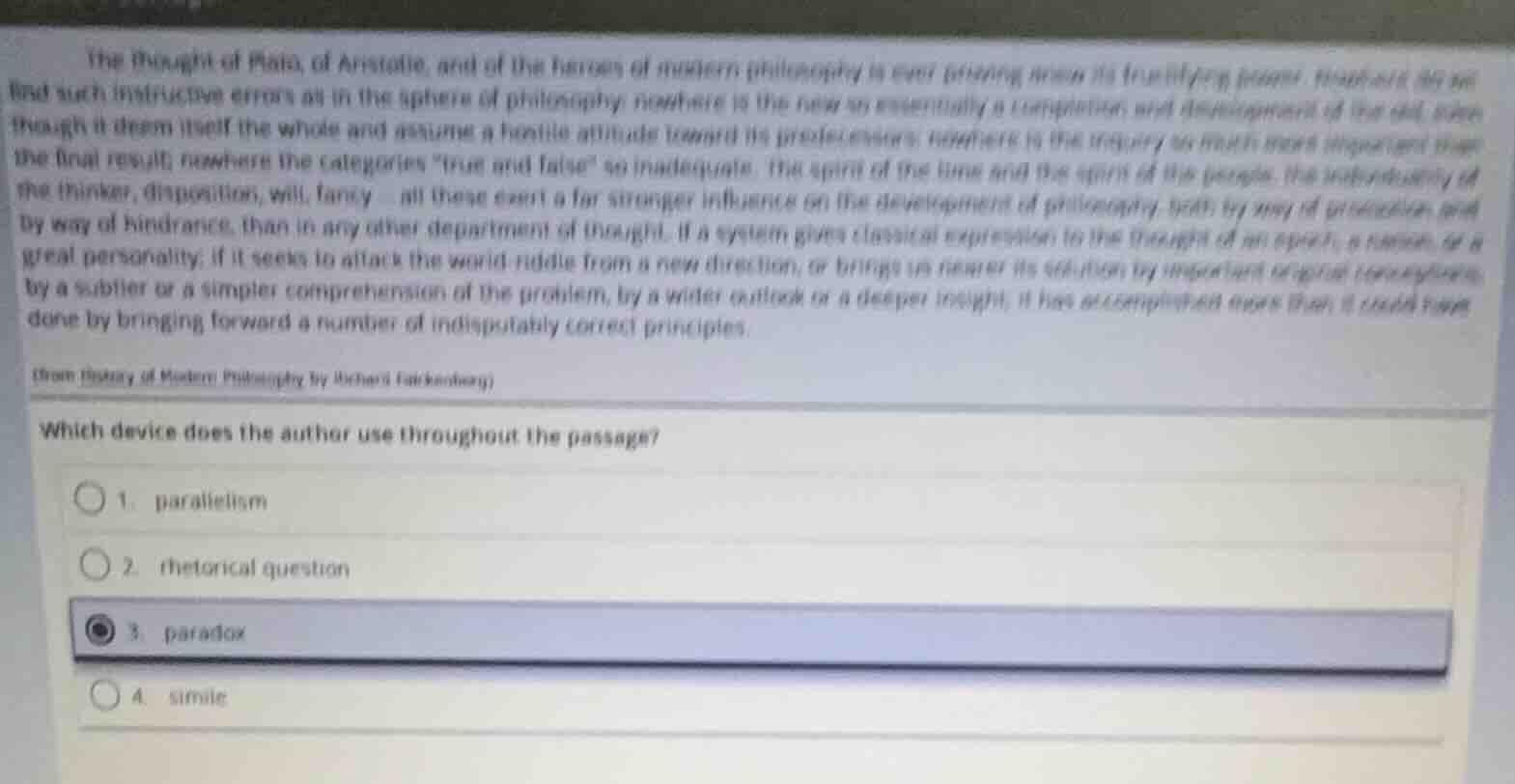
the thought of plato, of aristotle, and of the founders of modern philosophy is ever finding new its fertilizing points. nowhere do we find such instruction errors as in the sphere of philosophy: nowhere is the new so essentially a completion, and development of the old, even though it deem itself the whole and assume a hostile attitude toward its predecessors; nowhere is the inquiry to truth more important than the final result; nowhere the categories \true and false\ so inadequate. the spirit of the time and the spirit of the people, the individuality of the thinker, disposition, will, fancy — all these exert a far stronger influence on the development of philosophy, both by way of promotion and by way of hindrances, than in any other department of thought. if a system gives classical expression to the thought of an epoch, a nation, or a great personality; if it seeks to attack the world - riddle from a new direction; or brings in nearer its solution by important original conceptions, by a subtler or a simpler comprehension of the problem, by a wider outlook or a deeper insight; it has accomplished more than it could have done by bringing forward a number of indisputably correct principles.
(from history of modern philosophy by richard falckenberg)
which device does the author use throughout the passage?
- parallelism
- rhetorical question
- paradox
- simile
To determine the rhetorical device, we analyze each option:
- Parallelism: The passage uses repeated structures like "nowhere...", "by way of...", and lists (e.g., "the spirit of the time and the spirit of the people, the individuality of the thinker, disposition, will, fancy") with parallel grammatical forms.
- Rhetorical question: No questions (direct or implied) seeking an answer are present.
- Paradox: No self - contradictory statements are made.
- Simile: No "like" or "as" comparisons are used.
The repeated parallel structures confirm parallelism is the device.

Snap & solve any problem in the app
Get step-by-step solutions on Sovi AI
Photo-based solutions with guided steps
Explore more problems and detailed explanations
- parallelism