QUESTION IMAGE
Question
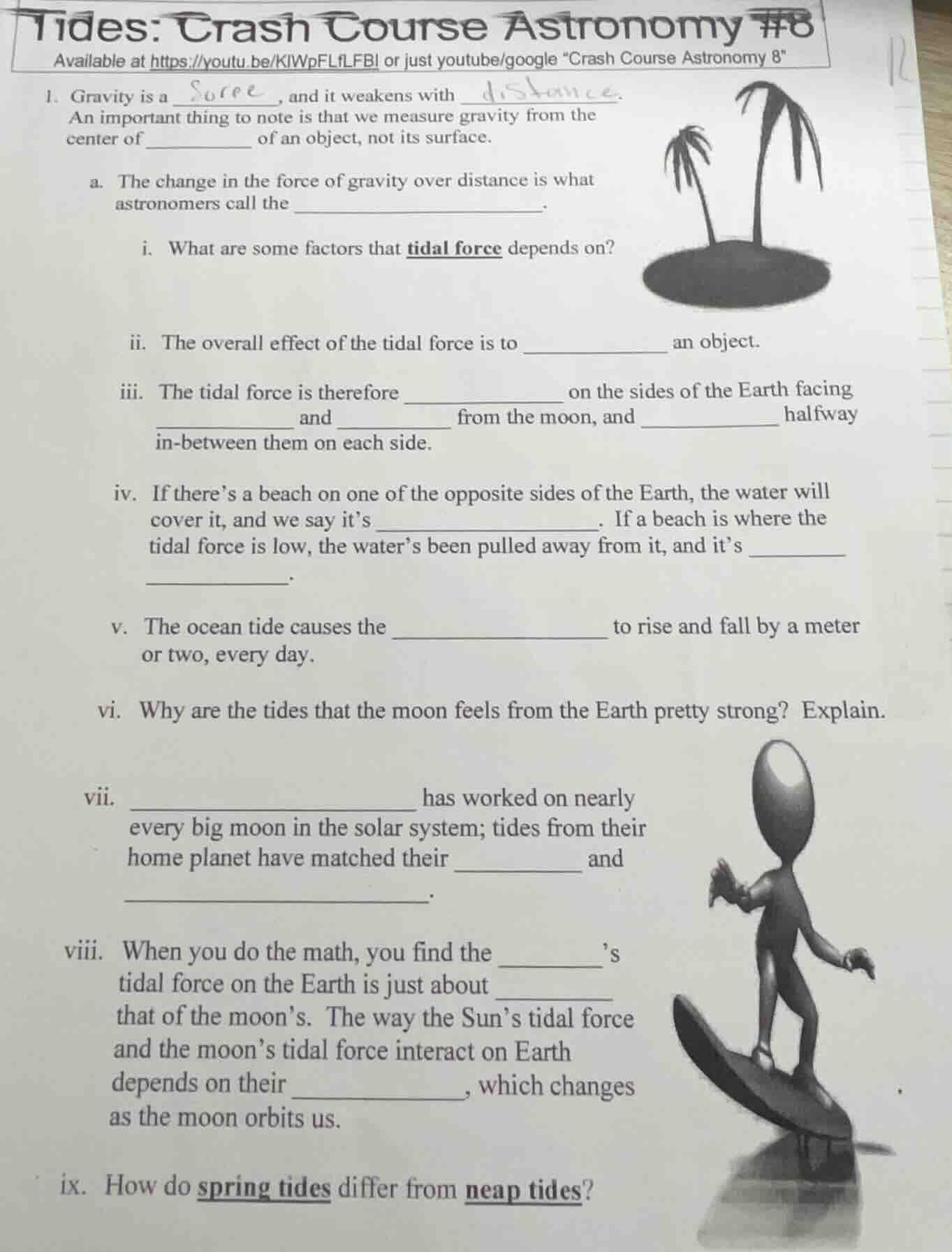
tides: crash course astronomy #8
available at https://youtu.be/kiwpflflfbi or just youtube/google \crash course astronomy 8\
- gravity is a ____, and it weakens with ____.
an important thing to note is that we measure gravity from the
center of ______ of an object, not its surface.
a. the change in the force of gravity over distance is what
astronomers call the ______.
i. what are some factors that tidal force depends on?
ii. the overall effect of the tidal force is to ______ an object.
iii. the tidal force is therefore ______ on the sides of the earth facing
____ and __ from the moon, and ____ halfway
in - between them on each side.
iv. if theres a beach on one of the opposite sides of the earth, the water will
cover it, and we say its ______. if a beach is where the
tidal force is low, the waters been pulled away from it, and its ______
______.
v. the ocean tide causes the ______ to rise and fall by a meter
or two, every day.
vi. why are the tides that the moon feels from the earth pretty strong? explain.
vii. ______ has worked on nearly
every big moon in the solar system; tides from their
home planet have matched their ______ and
______.
viii. when you do the math, you find the ______s
tidal force on the earth is just about ______
that of the moons. the way the suns tidal force
and the moons tidal force interact on earth
depends on their ______, which changes
as the moon orbits us.
ix. how do spring tides differ from neap tides?
Step1: Fill core gravity basics
Gravity is a force, and it weakens with distance. An important thing to note is that we measure gravity from the center of mass of an object, not its surface.
Step2: Define tidal force term
a. The change in the force of gravity over distance is what astronomers call the tidal force.
Step3: List tidal force factors
i. Some factors tidal force depends on:
- The mass of the gravitational object
- The distance between the two objects
- The size of the object experiencing the tide
Step4: State tidal force effect
ii. The overall effect of the tidal force is to stretch an object.
Step5: Map tidal force on Earth
iii. The tidal force is therefore strongest on the sides of the Earth facing toward and away from the moon, and weakest halfway in-between them on each side.
Step6: Define tide states
iv. If there's a beach on one of the opposite sides of the Earth, the water will cover it, and we say it's high tide. If a beach is where the tidal force is low, the water's been pulled away from it, and it's low tide.
Step7: Identify tide's affected feature
v. The ocean tide causes the sea level to rise and fall by a meter or two, every day.
Step8: Explain Earth's tide on moon
vi. The Earth is far more massive than the moon, and tidal force depends strongly on the mass of the gravitational object. Even though the moon is close, the Earth's large mass creates a strong tidal pull on the moon.
Step9: Fill tidal locking details
vii. Tidal locking has worked on nearly every big moon in the solar system; tides from their home planet have matched their rotation and orbital periods.
Step10: Compare Sun-Moon tidal forces
viii. When you do the math, you find the Sun's tidal force on the Earth is just about half that of the moon's. The way the Sun's tidal force and the moon's tidal force interact on Earth depends on their relative positions, which changes as the moon orbits us.
Step11: Differentiate tide types
ix. Spring tides occur when the Sun, moon, and Earth are aligned (full or new moon), so their tidal forces combine to create much higher high tides and much lower low tides. Neap tides occur when the Sun and moon are at a 90-degree angle to Earth (first or third quarter moon), so their tidal forces partially cancel out, creating smaller differences between high and low tides.

Snap & solve any problem in the app
Get step-by-step solutions on Sovi AI
Photo-based solutions with guided steps
Explore more problems and detailed explanations
- force; distance; mass
a. tidal force
i. Mass of the gravitational body, distance between objects, size of the object experiencing tides
ii. stretch
iii. strongest; toward; away; weakest
iv. high tide; low tide
v. sea level
vi. The Earth has far greater mass than the moon, and tidal force relies heavily on the mass of the gravitational object, creating a strong tidal pull on the moon despite the moon's proximity to Earth.
vii. Tidal locking; rotation; orbital periods
viii. Sun; half; relative positions
ix. Spring tides (aligned Sun/moon/Earth) create extreme high/low tides from combined tidal forces; neap tides (90° Sun-moon angle) create milder tides from partially canceling forces.