QUESTION IMAGE
Question
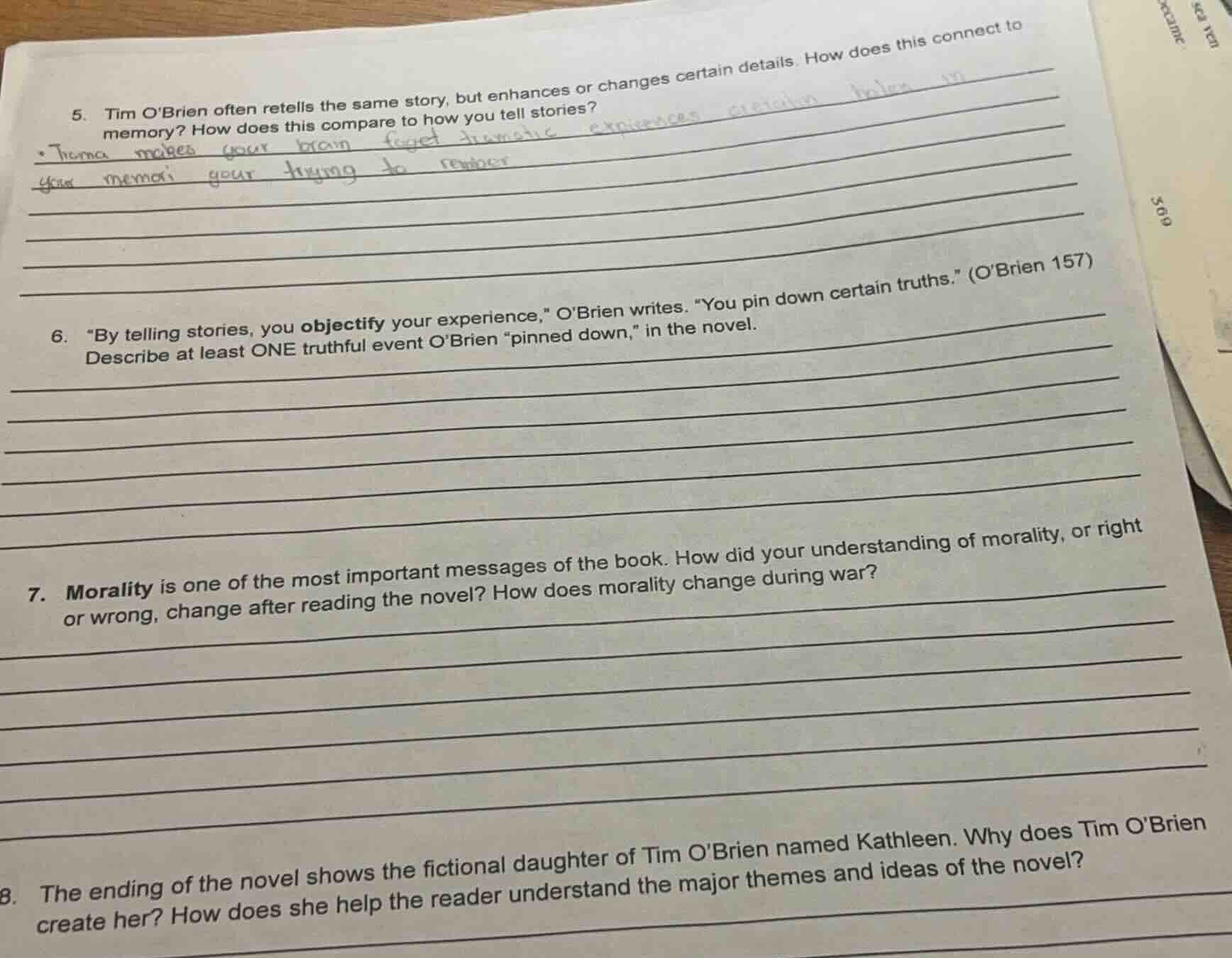
- tim obrien often retells the same story, but enhances or changes certain details. how does this connect to memory? how does this compare to how you tell stories?
- \by telling stories, you objectify your experience,\ obrien writes. \you pin down certain truths.\ (obrien 157) describe at least one truthful event obrien \pinned down,\ in the novel.
- morality is one of the most important messages of the book. how did your understanding of morality, or right or wrong, change after reading the novel? how does morality change during war?
- the ending of the novel shows the fictional daughter of tim obrien named kathleen. why does tim obrien create her? how does she help the reader understand the major themes and ideas of the novel?
Question 5
Tim O'Brien's retelling with altered details connects to memory's reconstructive nature (memories aren't static; they're reshaped by emotion, time, and perspective). When we tell personal stories, we also unconsciously adjust details—emphasizing impactful parts, downplaying others—similar to how memory evolves. Trauma or emotion can make memory flexible, so retellings reflect that fluidity, just as our own story - telling adapts to how we want to convey an experience or how memory has shifted.
In The Things They Carried, the death of Curt Lemon is a truthful event (in terms of the emotional and thematic truth) O'Brien "pinned down." Lemon's death (stepping on a mine) shows the randomness and brutality of war. The story around it, like the soldiers' reaction (playing catch with his body parts) and O'Brien's internal conflict about witnessing it, captures the dehumanizing and surreal nature of war, conveying the truth of war's impact on soldiers' psyche and the absurdity of violence.
After reading the novel, morality is seen as more complex—war blurs right/wrong. Pre - reading, morality might seem more black - and - white, but the novel shows soldiers making morally ambiguous choices (e.g., killing the young Vietnamese soldier out of fear/anger). During war, survival and group loyalty override traditional morality; actions like killing civilians or making violent choices become justified in the context of war's chaos, showing morality shifts from individual ethics to collective survival.

Snap & solve any problem in the app
Get step-by-step solutions on Sovi AI
Photo-based solutions with guided steps
Explore more problems and detailed explanations
Tim O'Brien's story - retelling connects to memory as memory is reconstructive (details change with time, emotion, or perspective). When we tell stories, we also modify details (e.g., emphasizing key feelings, omitting minor parts), similar to how O'Brien retells with enhancements/changes, as both reflect memory's fluidity.