QUESTION IMAGE
Question
tivity k: key terms review—page 4
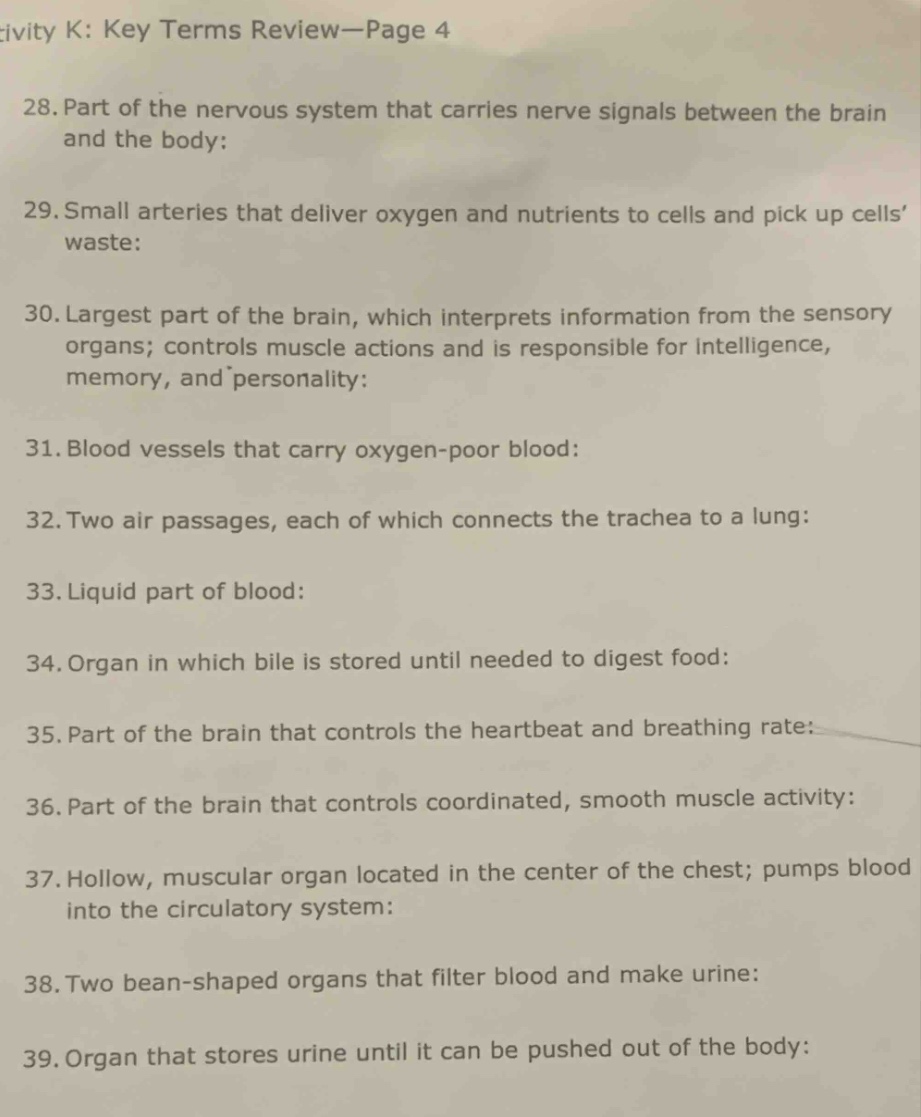
- part of the nervous system that carries nerve signals between the brain and the body:
- small arteries that deliver oxygen and nutrients to cells and pick up cells waste:
- largest part of the brain, which interprets information from the sensory organs; controls muscle actions and is responsible for intelligence, memory, and personality:
- blood vessels that carry oxygen - poor blood:
- two air passages, each of which connects the trachea to a lung:
- liquid part of blood:
- organ in which bile is stored until needed to digest food:
- part of the brain that controls the heartbeat and breathing rate:
- part of the brain that controls coordinated, smooth muscle activity:
- hollow, muscular organ located in the center of the chest; pumps blood into the circulatory system:
- two bean - shaped organs that filter blood and make urine:
- organ that stores urine until it can be pushed out of the body:
28.
The part of the nervous system that transmits nerve signals between the brain and the body is the spinal cord (along with peripheral nerves, but the main pathway for communication between brain and body is the spinal cord as part of the central nervous system's connection to the peripheral).
Small arteries that branch into capillaries to deliver oxygen and nutrients to cells and pick up waste are arterioles.
The cerebrum is the largest part of the brain, responsible for interpreting sensory info, controlling muscles, and higher functions like intelligence, memory, personality.

Snap & solve any problem in the app
Get step-by-step solutions on Sovi AI
Photo-based solutions with guided steps
Explore more problems and detailed explanations
Spinal Cord